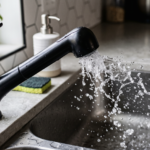
If every other tap in your house runs fine but one faucet has low water pressure, the problem is local — not a whole-house issue. That narrows the diagnosis significantly and usually points to one of a handful of fixable causes.
This article walks through every likely cause of low water pressure in a single faucet, how to test each one, and what to do about it — starting with the simplest fixes first.
Comparing the Most Common Causes at a Glance
| Cause | Who It Affects | Difficulty | Average Cost |
|---|---|---|---|
| Clogged aerator | Single faucet | Very easy | $0–$10 |
| Partially closed shutoff valve | Single faucet | Very easy | $0 |
| Kinked supply line | Single faucet | Easy | $5–$15 |
| Worn cartridge | Single faucet | Moderate | $10–$40 |
| Mineral buildup in faucet body | Single faucet | Moderate | $0–$15 |
| Water heater restriction (hot only) | Multiple fixtures | Moderate–Hard | $50–$300+ |
| Corroded galvanized pipe | One branch or fixture | Hard | $200–$800+ |
Why Would Only One Faucet Have Low Pressure?
Low water pressure isolated to a single faucet means the restriction exists somewhere between the shutoff valve under that fixture and the faucet outlet itself. The main supply line, water meter, and pressure regulator are all upstream of this problem — so they’re almost never responsible when only one tap is affected.
The most common reasons include a clogged aerator, a partially closed shutoff valve, a failing cartridge or valve seat, mineral buildup inside the supply lines, or a kinked flexible connector. Each of these is relatively straightforward to test and fix without professional help.
Step 1: Check the Aerator First
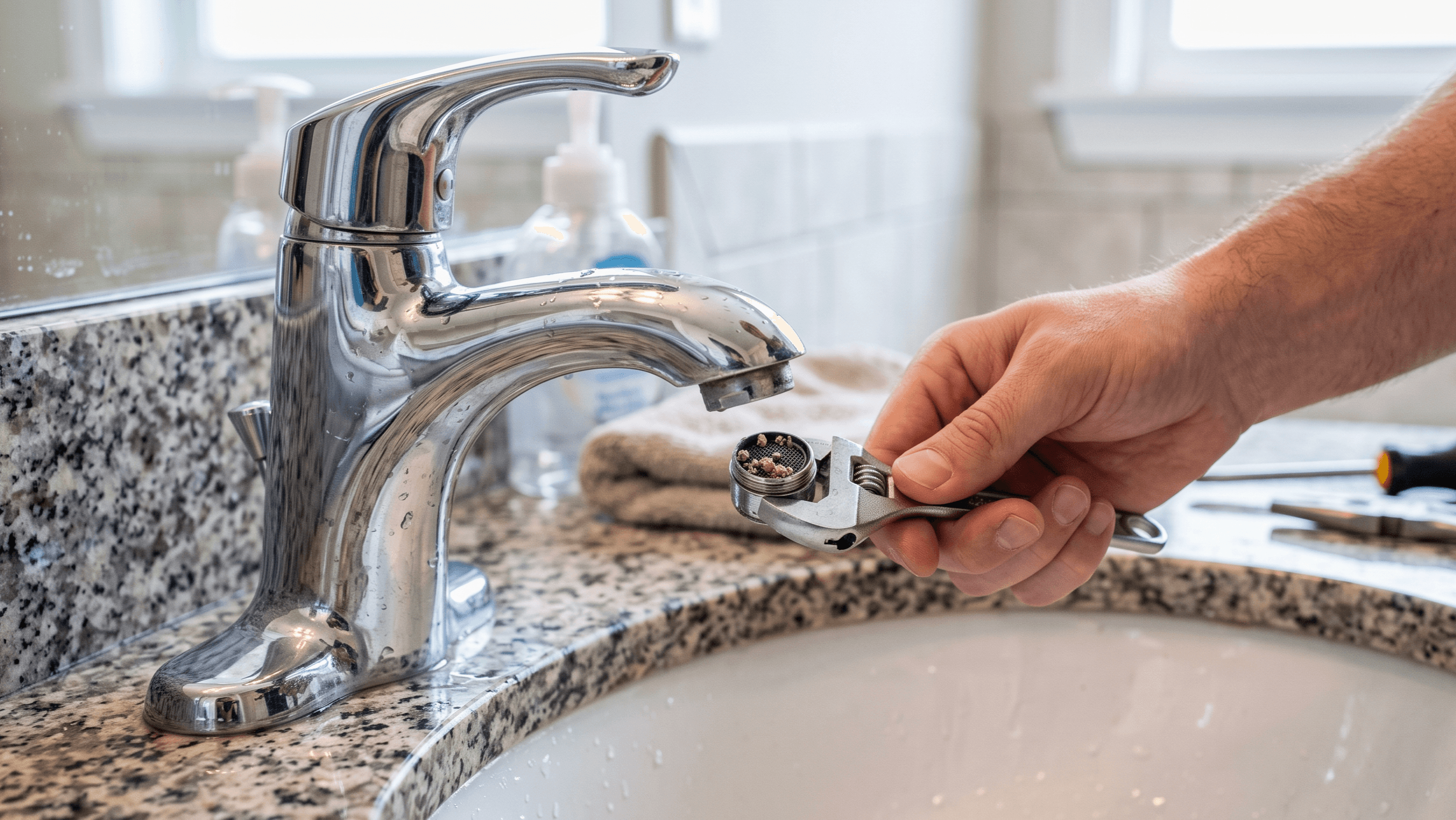
The aerator is the small mesh screen screwed onto the tip of the faucet spout. It mixes air into the water stream and catches sediment over time. A clogged aerator is the single most common cause of low water pressure in one faucet.
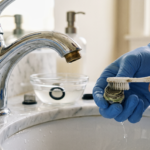
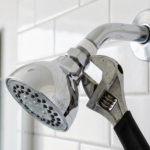
To test it, unscrew the aerator by hand or with a wrench (use a cloth to protect the finish), remove the screen, and run the faucet without it. If pressure returns to normal, the aerator is the problem.
Cleaning is straightforward: soak the aerator in white vinegar for 30–60 minutes to dissolve mineral deposits, then rinse under running water and scrub with an old toothbrush. If the screen is visibly damaged or heavily corroded, replacement aerators cost $3–$10 at any hardware store.
More detailed instructions for aerators — including stuck or seized units — are covered in the guides on how to clean a faucet aerator to fix low water pressure and how to remove and clean a stuck faucet aerator.
Step 2: Inspect the Shutoff Valve
Every faucet has a shutoff valve on the supply lines beneath the sink. It’s a small valve — usually a quarter-turn ball valve or a multi-turn oval-handle valve — and it can restrict flow if it’s been accidentally bumped or never fully opened after a repair.
Turn the valve counterclockwise as far as it will go (for multi-turn valves) or until the handle runs parallel to the pipe (for quarter-turn valves). Then check pressure again.
A shutoff valve that feels stiff or doesn’t move freely may have mineral scale buildup inside. If the valve is old, corroded, or damaged, replacement is a straightforward plumbing job — supply valves cost $8–$25 depending on type.
Step 3: Test the Supply Lines for Kinks or Restrictions
The flexible braided hoses connecting the shutoff valve to the faucet body can develop kinks, especially if they were bent during installation or if something under the sink shifted over time. A kinked hose cuts flow significantly without leaving any visible external sign of trouble.
Turn off the shutoff valve, disconnect the supply hose, and inspect its interior by holding it up to a light source. If it appears partially collapsed or obstructed, replace it. Braided stainless supply lines are inexpensive (typically $5–$15) and simple to swap out.
Step 4: Diagnose the Cartridge or Valve Seat
Inside most modern faucets is a cartridge — a replaceable component that controls water flow and temperature mixing. Mineral scale, wear, and sediment buildup can cause a cartridge to partially block the water path, resulting in reduced pressure at that faucet only.
Signs that the cartridge is the problem include pressure loss that developed gradually over months, reduced flow that correlates with turning the handle to a specific position, or visible grit in the water stream.
Cartridge replacement requires shutting off the supply valves, disassembling the faucet handle, and swapping the cartridge. The process varies by faucet brand and model, but most manufacturers publish detailed instructions. Replacement cartridges typically run $10–$40, and the repair takes 20–45 minutes.
Older faucets with compression valves use a rubber washer and valve seat instead. A damaged valve seat causes the same restricted-flow symptoms and is fixed by resurfacing the seat or replacing the faucet entirely.
Step 5: Look for Mineral Buildup Inside the Faucet Body
In homes with hard water, calcium and magnesium deposits can accumulate inside the faucet body itself — not just the aerator. This is more common in faucets over 10 years old in areas where water hardness exceeds 7–10 grains per gallon (120–171 mg/L as CaCO₃, per USGS water hardness classifications).
Disassembling the faucet and soaking the components in a descaling solution (white vinegar or a commercial lime remover) typically clears moderate buildup. Severe internal scale that doesn’t respond to descaling usually means the faucet has reached end of life.
Step 6: Check Whether It’s Only the Hot Side or Both
If pressure is low specifically on the hot water side of a single faucet, the restriction may actually be upstream at the water heater rather than at the faucet itself. Sediment accumulation in the water heater tank can obstruct the outlet port and reduce hot water flow throughout the house — but it’s most noticeable at fixtures running mostly hot water.
To isolate this, check whether hot water pressure is low at multiple fixtures or just one. If multiple fixtures show reduced hot pressure, the water heater inlet valve, outlet valve, or a corroded dip tube is the likely cause. If it’s only the one faucet, refocus on the cartridge and aerator. The article on low hot water pressure when cold is fine covers the heater-side diagnosis in detail.
Step 7: Rule Out a Partially Clogged Supply Line
In older homes with galvanized steel pipes, corrosion and scale can build up inside the pipe walls over decades and progressively narrow the water path. This typically causes gradually worsening flow in one or more fixtures over time, rather than sudden pressure loss.
Galvanized pipe restrictions are localized — they affect the section of pipe feeding that fixture specifically. The fix is repiping that section with copper or PEX, which is a job for a licensed plumber. If multiple fixtures in a bathroom share the same galvanized branch line and all show reduced pressure, this is likely the cause.
How to Systematically Diagnose the Problem
Working through the causes in order from simplest to most complex saves time and avoids unnecessary repairs. Here is the recommended diagnostic sequence:
- Remove and clean or replace the aerator.
- Confirm the shutoff valve under the sink is fully open.
- Inspect the supply hoses for kinks or damage.
- Check whether the issue is hot-side only, cold-side only, or both.
- Replace the cartridge if cleaning doesn’t restore pressure.
- Look for signs of galvanized pipe corrosion if the faucet is in an older home.
If pressure is inconsistent — normal sometimes and low at other times — that points to a different class of problem. Fluctuating pressure across the house typically involves the pressure regulator valve or municipal supply variations, as covered in the article on water pressure that fluctuates daily.
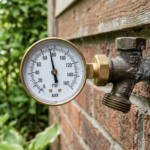
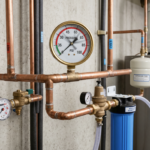
If you want to establish a baseline for your home’s pressure before diagnosing further, the guide on how to test home water pressure with a gauge walks through the full process.
When to Call a Plumber
Most single-faucet pressure problems are DIY-friendly. Call a licensed plumber if:
- The shutoff valve under the sink is visibly corroded or won’t turn.
- You suspect the issue is inside the wall — supply lines that feed into the faucet from behind the drywall, not the exposed flexible connectors.
- Pressure dropped suddenly after a nearby pipe froze or was repaired.
- The home has galvanized pipes throughout and multiple fixtures are affected.
FAQ
Can a clogged aerator really drop pressure that much?
Yes. A heavily mineralized aerator can reduce water flow by 50% or more compared to its rated capacity. In areas with hard water — defined as water containing more than 7 grains per gallon of dissolved calcium and magnesium — aerator screens can become nearly fully blocked within 12–24 months without periodic cleaning.
How do I know if my faucet’s cartridge needs replacing versus just cleaning?
If cleaning the aerator and checking the shutoff valve don’t restore pressure, disassemble the faucet handle and inspect the cartridge. A cartridge that feels rough when pulled out, shows visible mineral scale around the ports, or has cracked rubber seals needs replacement. If the cartridge looks clean and intact, the problem may be in the faucet body itself or the supply line.
My bathroom faucet lost pressure but my kitchen faucet is fine — are they on the same line?
Not necessarily. Bathroom and kitchen fixtures typically run on separate branch lines from the main supply. Pressure loss isolated to a bathroom faucet is almost always caused by something at that specific fixture — aerator, shutoff valve, cartridge, or supply line — rather than a shared upstream restriction.
Does water pressure change between floors affect one faucet more than others?
Gravity reduces static water pressure by approximately 0.43 psi per foot of elevation. In a two-story home, a second-floor faucet starts with roughly 8–9 psi less pressure than a ground-floor fixture on the same line. If a second-floor faucet already runs near the lower end of acceptable pressure (40 psi or above is standard), any additional restriction — even a mildly clogged aerator — will produce noticeably weak flow.
Should I worry about water quality if pressure suddenly drops at one faucet?
Sudden pressure loss at a single fixture usually signals a physical restriction, not a water quality issue. However, if the reduced-pressure water also tastes metallic or looks discolored, it may indicate pipe corrosion near that fixture. Metallic taste is worth investigating separately — the article on tap water that tastes like metal covers the most likely causes.