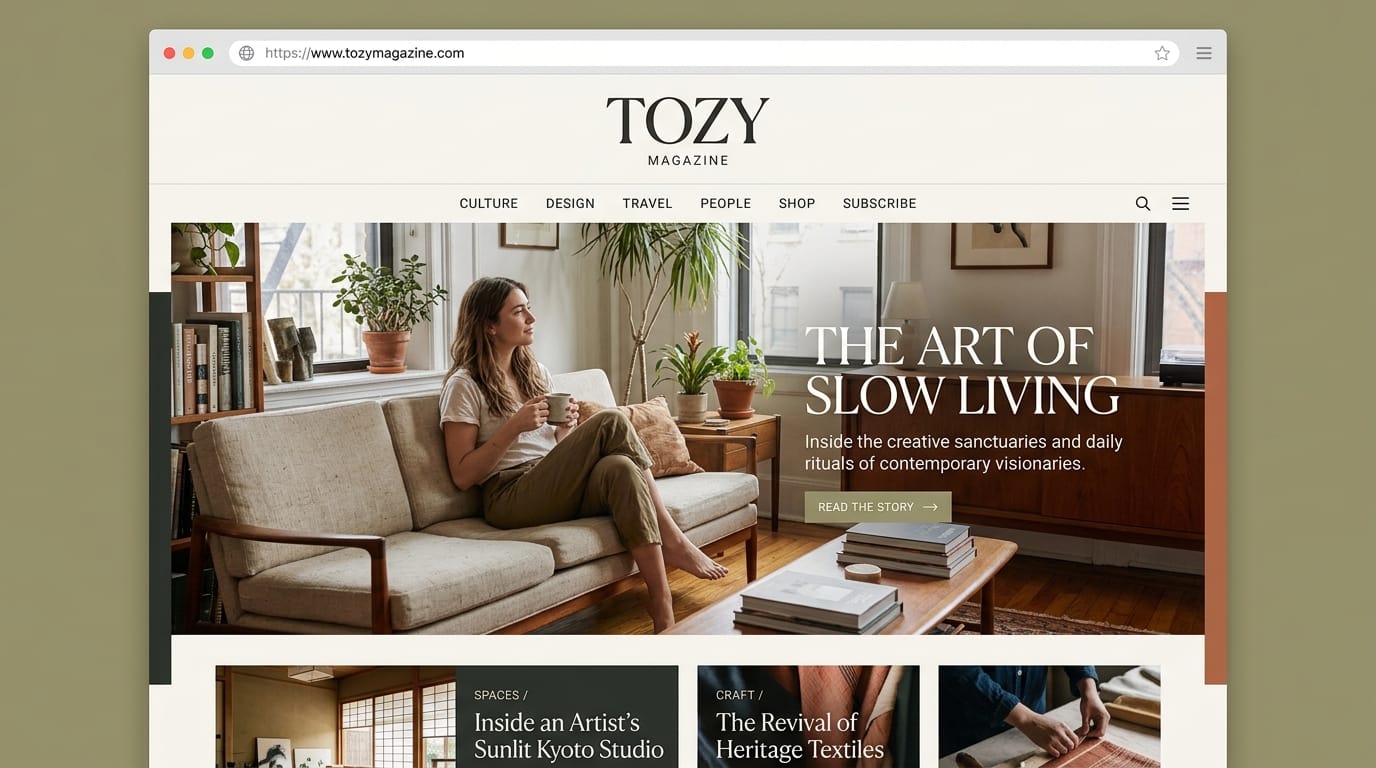
Tozymagazine.com: What It Really Is, What It Publishes, and Is It Legit? (2026 Guide)
You typed “tozymagazine.com” into Google and landed here, which means you’re trying to answer one of three questions: Is this a real website? What does it actually publish? And can you trust what it says?
Fair questions — and the honest answer is more interesting than most of the write-ups about this site will tell you. Tozymagazine.com is a real, functioning online magazine, but it’s not quite the site its name suggests anymore. It started life as a small corner of the internet devoted to birthday wishes and anniversary messages, and somewhere along the way it grew into a sprawling general-interest site covering everything from credit-card fraud rules to motorcycle accident claims in Washington, D.C. to coffee blending.
This guide looks at the site as it actually runs today — what it publishes, how it makes money, whether it’s safe, and where its limits are — so you can decide for yourself how to use it.

So, What Is Tozymagazine.com?
Quick answer: Tozymagazine.com is the website of Tozy Magazine, a free, ad-supported online magazine built on WordPress. Its tagline is “Crafting Sentiments for Every Occasion,” which points back to its roots: birthday messages, marriage wishes, anniversary notes, and thank-you card wording. Today it also publishes general-interest articles across news, law, technology, health, business, and product news. It has no print edition and no paywall.
If that sounds like two different websites wearing one name, you’re noticing the central thing about Tozymagazine.com. The branding still says “sentiments for every occasion,” but a visit to the homepage tells a different story. Recent posts have covered the Google–Huawei situation, PC game optimization software, crypto ATMs, solar pumping for irrigation, and gallery-wall planning — alongside the original occasion content like “37 Happy 8th Birthday Wishes” and anniversary messages for in-laws.
That range isn’t an accident. It’s the site’s whole strategy: publish broadly, attract search traffic across many topics, and monetize the visits. Understanding that explains nearly everything else about it.
What Tozymagazine.com Publishes
The original lane: occasion and message content
This is where Tozy Magazine began, and it’s still the part of the site that feels most natural to the brand. You’ll find collections of wishes and messages organized by relationship and event: birthday wishes for specific ages (5th, 8th birthdays and the like), wedding anniversary messages, marriage wishes, thank-you notes, and similar wording help. Third-party reviews consistently say this is the content the site does best, and it makes sense — it’s a narrow, well-understood niche where the bar is “helpful and warm” rather than “authoritative.”
If you arrived looking for the right words for a card, this is the section worth bookmarking.
The expanded magazine: everything else
Somewhere along the way, the site started publishing far beyond occasion content. The categories now in play include:
- News — general-interest and timely pieces
- Law — explainers on topics like fraud liability and accident claims
- Technology — software guides, gadget explainers
- Health — wellness topics and procedure considerations
- Business — practical business and finance reads
- Product News — buying guides and product roundups
- Lifestyle, Travel, Education, Home Improvement — reported by third-party reviews as active areas
The quality here is mixed, and that’s worth saying plainly. Some of these articles are solid, readable explainers. Others skim the surface of subjects where depth matters. A piece on anniversary wishes doesn’t need an expert; a piece on pensions or cosmetic surgery arguably does. The site doesn’t always signal which kind of article you’re reading, so the reader has to.
What you’ll rarely find
To set expectations: Tozymagazine.com is not a traditional news organization with a specialist newsroom, and it doesn’t present itself as one on close inspection — it’s a multi-topic content site. You won’t find original reporting, interviews, or investigative work. You won’t find named journalists with beats, and ownership details are thin. That’s not unusual for small web magazines, but it means the site’s content is best treated as general information rather than sourced journalism.
How Tozymagazine.com Makes Money (and Why It’s Free)
Reading the site costs nothing — there’s no subscription, no account, no paywall. The business model is the standard one for free content sites, and third-party analysis describes the usual mix:
- Display advertising — banner and in-article ads earning from impressions and clicks
- Affiliate marketing — commissions when readers click through to recommended products and buy
- Sponsored content — paid placements appearing alongside regular articles
- Search traffic — the whole engine runs on people finding articles through Google
None of this is sinister; it’s how most of the free web works. But it’s worth keeping in mind for two reasons. First, it explains the broad topic spread: more topics mean more search queries mean more ad impressions. Second, affiliate relationships can shape product recommendations, so buying guides on any ad-supported site deserve a second source before you spend money. This isn’t a knock on Tozy Magazine specifically — it’s just how the model works everywhere.

Is Tozymagazine.com Legit and Safe to Use?
Quick answer: Yes, it’s a real, functioning website — not an obvious scam. It uses standard HTTPS encryption, has a working Contact page and Privacy Policy, and third-party safety checkers haven’t flagged it as malicious. But “safe to visit” and “safe to trust on everything” are different things. Ownership is not transparent, and articles on high-stakes topics (health, money, law) vary in depth, so treat those as starting points and verify elsewhere before acting.
Let’s break the legitimacy question into the two questions people are really asking.
Is it a real website, or a scam?
It’s real. The domain resolves, the site loads, articles are actively published with dates and author names, and the infrastructure looks like any ordinary WordPress site: SSL certificate, About page, Contact page, Privacy Policy. Third-party safety scanners (the ScamAdviser-type tools) don’t flag it for malware or phishing, and there’s no sign of the classic scam patterns — no fake checkout, no credential harvesting, nothing asking for your money or personal details.
One caution about safety scores in general: “not flagged as malicious” is a low bar. It tells you the site probably won’t infect your device. It tells you nothing about whether a specific article’s claims about finance, law, or health are accurate. That requires reading the article itself, not the domain’s safety rating.
Can you trust what it publishes?
Here’s where the honest answer gets nuanced. Trust shouldn’t be assigned to the whole domain; it should be assigned article by article. Consider:
- Who wrote it? Recent articles do carry author names — a good sign, though the bylines don’t come with the credentials you’d see at a specialist publication.
- Is it dated? The homepage shows publication dates, which matters a lot for topics that change (regulations, financial products, medical guidance).
- Does it cite sources? Informational articles that make factual claims should link to something you can check. When they don’t, be more skeptical.
- What’s at stake? A birthday wish can’t hurt you. A wrong statement about fraud liability or a medical procedure can. Match your skepticism to the stakes.
- Can you confirm it elsewhere? For anything consequential, one more source — ideally an official or specialist one — is cheap insurance.
The site’s biggest structural weakness is the mismatch between its authority signals and its topic range. A polished design and a professional-looking layout don’t make a general-interest blog an authority on pensions law or cosmetic surgery. Tozy Magazine is fine for casual browsing and genuinely useful for its original occasion content. For high-stakes decisions, it’s a starting point, not a final answer.
Tozymagazine.com vs Tozymagazines.com — Don’t Mix Them Up
Here’s something most write-ups about this site miss, and it can genuinely confuse readers: tozymagazines.com (with an “s”) is a different website. It presents itself as a curated digital platform covering biography, entertainment, technology, and business — “curated stories for everyday life,” mobile-friendly, with a Trending section. Same family of name, similar look and feel, different domain, different operator.
Why does this matter? Because search results for “tozymagazine” surface both, and reviews of one sometimes describe the other. If you’re trying to evaluate whether a site is trustworthy, make sure you’re evaluating the right one. Check the actual domain in your address bar — one letter makes the difference. This guide is about tozymagazine.com (no “s”), the WordPress-based Tozy Magazine with the occasion-content roots.

Who Gets the Most Value From Tozymagazine.com (and Who Should Look Elsewhere)
| Good fit | Look elsewhere |
|---|---|
| Someone hunting for birthday, anniversary, or thank-you wording | Someone making a medical decision based on a single article |
| A casual reader browsing lifestyle and general-interest pieces | Someone who needs current legal or financial advice |
| A student or curious reader wanting a plain-English explainer as a starting point | A researcher who needs sourced, peer-reviewed, or officially documented information |
| Anyone who enjoys discovering new blogs through search | Anyone who wants named experts and transparent editorial standards |
The pattern is simple: the lighter the stakes, the better the fit. Tozy Magazine is at its best when it’s helping you find the right words for a card or giving you a breezy overview of a topic. It is at its weakest when a reader mistakes breadth for depth on subjects where mistakes are expensive.
How to Judge Any Article You Read on the Site
Rather than memorizing a verdict about one domain, here’s a five-check habit that works for Tozymagazine.com and every site like it:
- Check the About page against the content. Does what the site says it is match what it actually publishes? A gap — like a “sentiments for every occasion” tagline on a site publishing fraud-liability explainers — doesn’t mean dishonesty, but it tells you the site has outgrown its original identity.
- Look for the author and the date. A named author and a visible publication date are basic accountability signals. Their absence on a consequential topic is a reason to pause.
- Follow the money. Free content is paid for somehow. Ads and affiliate links are normal, but they mean product recommendations deserve a second opinion.
- Watch for the review pattern. When every third-party review of a site says the same vague things in the same order, those reviews are feeding off each other, not off independent checking. Discount them accordingly.
- Match trust to stakes. This is the big one. Casual reading needs casual trust. Money, health, and legal decisions need verified sources and, where it matters, qualified professionals.
Common Mistakes Readers Make With Sites Like This
- Treating “not a scam” as “authoritative.” A site can be perfectly legitimate and still publish a shallow article on a complex topic. Legitimacy is about honesty of operation; authority is about depth of knowledge. They’re different axes.
- Trusting the design. A clean WordPress theme with nice typography feels credible, but design is cheap and expertise is expensive. Judge the words, not the wrapping.
- Reading only the article that confirms what you wanted. If you’re researching whether a financial product is a good idea, one general-interest article is not research — it’s a starting point wearing a research costume.
- Confusing the two “tozymagazine” domains. As covered above: check the URL. Reviews and reputations don’t transfer between lookalike domains.
- Ignoring the date. An article about regulations, prices, or medical guidance from two years ago can be actively misleading today. Always glance at the publication date before acting on time-sensitive information.
Frequently Asked Questions
Is Tozymagazine.com free to use?
Yes. There’s no subscription, no account requirement, and no paywall. The site runs on advertising and affiliate revenue, so reading costs you nothing but attention.
Is Tozymagazine.com a US website?
Not exactly — there’s no evidence of a separate American edition or a US-only operation. It appears to target a worldwide audience in English, and the “USA” that shows up in related searches mostly reflects regional search interest and some America-focused topics rather than a distinct platform.
Is Tozymagazine.com a news website?
Not in the traditional sense. It publishes informational and general-interest articles across many subjects, but it isn’t a newsroom doing original reporting. A better description is a general-interest digital magazine or multi-topic content site.
Who owns Tozymagazine.com?
Publicly available ownership details are limited. The site has About and Contact pages, but it doesn’t prominently name an owner, editor, or parent company. Limited ownership transparency is common among small web magazines, but it does mean readers have less to go on when judging credibility.
Is Tozymagazine.com safe to visit?
By the technical measures — HTTPS encryption, no malware or phishing flags from third-party scanners, no scam patterns — yes, it appears safe to browse. As with any site, keep your browser updated and don’t download anything you weren’t expecting.
Can I trust its health, finance, or legal articles?
Treat them as introductions, not authorities. These are high-stakes topics where accuracy matters and the site’s editorial depth is uneven. Read them to orient yourself, then confirm the details with official sources or qualified professionals — a doctor, lawyer, or financial advisor — before making decisions.
How is Tozymagazine.com different from Tozymagazines.com?
They’re separate websites with confusingly similar names. Tozymagazine.com (no “s”) is Tozy Magazine, the WordPress site rooted in occasion content. Tozymagazines.com (with “s”) is a different curated-content platform covering biography, entertainment, technology, and business. Always check which domain you’re actually on.
Read Also: Android 10 App Drawer: How to Open, Use & Customize It (Complete Guide)