The Best Water Filtration System for Well Water: A Practical Guide to Choosing the Right Setup
Orange stains in the bathtub. A rotten-egg smell every time you run the hot water. A glass of water that looks fine in the morning and turns brown by lunch. If you’re on a private well, you’ve probably met at least one of these problems — and you’ve probably also discovered that the “whole house water filter” aisle is full of systems designed for city water, not yours.
Here’s the truth most product pages skip: there is no single best water filtration system for well water. The right system depends entirely on what’s in your water. A system that strips iron like a champ does nothing for bacteria. A UV sterilizer kills microbes but won’t touch the sulfur smell. Buy the wrong one and you’ve spent thousands to solve a problem you don’t have while the one you do have keeps staining your sinks.
This guide walks you through how to figure out what your well water actually needs, what each type of filtration equipment does, how the pieces fit together, and how to pick a setup that matches your test results — not a marketing brochure.

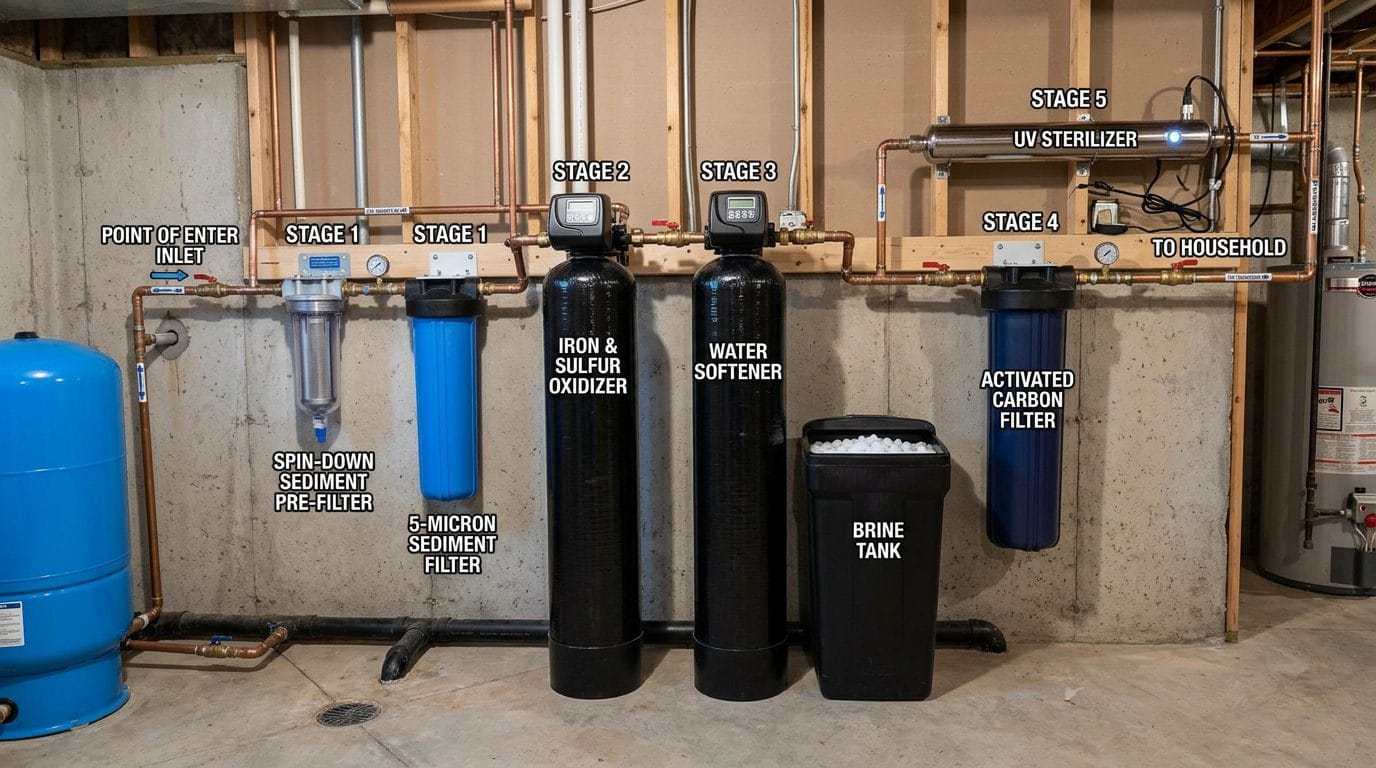
A typical whole-house well water treatment setup: well pressure tank, sediment filter, carbon filter, water softener, and brine tank working in sequence.
Why Well Water Needs Its Own Approach
Municipal water plants treat water before it reaches your tap. They adjust the pH, disinfect it, and are legally required to meet federal standards — with public reports to prove it. A private well has none of that. Nobody treats it, nobody monitors it, and nobody tells you when something changes. The EPA itself notes that private wells are not regulated under the Safe Drinking Water Act, which is why it recommends well owners test their water at least once a year for bacteria, nitrates, total dissolved solids, and pH.
What shows up in well water depends on geology, and geology changes zip code by zip code. Common culprits include:
- Iron — dissolved iron (ferrous iron) comes out of the tap clear, then oxidizes on contact with air and turns water orange or rust-brown. It stains laundry, fixtures, and dishes, and gives water a metallic taste. The EPA’s secondary standard — a guideline for aesthetics, not health — is 0.3 mg/L, and many wells run well above it.
- Manganese — iron’s frequent companion. It causes brown or black staining and can leave an oily-looking film on standing water. The secondary standard is 0.05 mg/L.
- Hydrogen sulfide — the “rotten egg” smell. Caused by sulfur-reducing bacteria or natural sulfur deposits. It’s mostly an aesthetic problem, but at higher levels it corrodes plumbing and makes water taste awful.
- Hardness (calcium and magnesium) — leaves scale in pipes and water heaters, makes soap refuse to lather, and spots up glassware. Extremely common in well water across the Midwest and Southwest.
- Sediment, sand, and silt — especially in new wells, shallow wells, or after heavy rain. Wrecks plumbing fixtures and clogs everything downstream.
- Bacteria and other microorganisms — coliform bacteria, E. coli, and in some regions Giardia. A cracked well cap, a flooded wellhead, or a nearby septic system can introduce them without any change in how the water looks or smells.
- Nitrates — from fertilizer runoff or septic systems. Odorless and colorless, but a genuine health concern, especially for infants (the EPA limit for nitrate-nitrogen is 10 mg/L). This one is a strong argument for testing even when your water looks perfect.
- Arsenic — naturally occurring in groundwater in parts of New England, the Upper Midwest, and the Southwest. Also invisible. The EPA limit is 10 parts per billion, and some wells test above it.
- Low pH (acidic water) — dissolves copper and lead out of your own plumbing. If your well water has a metallic taste and blue-green stains, low pH is the prime suspect.
Notice how many of these are invisible, tasteless, and odorless. That’s why the visible problems — the orange toilet, the smell — are actually the easy ones. They tell you exactly where to look. The scary contaminants never announce themselves, which is the whole reason step one is always a water test.
Step One: Test Your Water Before You Buy Anything
This is the step everyone wants to skip, and it’s the step that determines whether you buy the right equipment or an expensive guess. A $30 DIY test strip kit from a hardware store can hint at hardness and iron, but strips are imprecise and they don’t test for bacteria, arsenic, or nitrates. What you actually want is a lab test.
You have two solid options:
- A state-certified lab test. Your county health department or state environmental agency can point you to a certified lab. A basic panel — bacteria, nitrates, pH, total dissolved solids, iron, manganese, hardness — typically runs $25 to $50. Extended panels that add heavy metals, arsenic, and volatile organic compounds run $75 to $150. This is the gold standard.
- A mail-in test kit. Companies like Tap Score and My Water Test sell kits where you collect the sample and mail it to a certified lab. Expect $150 to $300 for a comprehensive panel. More expensive, but thorough and convenient.
When the results come back, pay attention to these numbers first:
- Iron: above 0.3 ppm (mg/L) — you’ll see staining. Above 3 ppm, you need serious iron treatment, not just a cartridge filter.
- Manganese: above 0.05 ppm — staining and taste issues begin here.
- Hardness: above 7 grains per gallon (gpg) is considered hard; above 10.5 gpg is very hard.
- pH: below 7.0 is acidic and worth addressing; below 6.5 can corrode plumbing.
- Total coliform / E. coli: any positive result means you need disinfection, full stop.
- Nitrates: above 10 mg/L (as nitrogen) — requires reverse osmosis or another targeted treatment.
- Arsenic: above 10 ppb — requires a dedicated arsenic reduction system or reverse osmosis.

Testing tells the story: iron-rich water (left) versus filtered water (right). A water test gives you the numbers behind what you can see.
The Filtration Technologies That Actually Work on Well Water
Once you know your numbers, the equipment landscape gets much simpler. Almost every effective well water setup is built from these components. None of them does everything — that’s the point of understanding each one.
Sediment Pre-Filters
The bodyguard of the whole system. A sediment filter — typically a pleated or spun-polypropylene cartridge rated at 5 to 20 microns — catches sand, silt, rust flakes, and other particles before they can clog or damage the more expensive stages downstream. Every well water setup should have one, even if your water looks clear. Sediment loads spike after storms and pump repairs, and a $15 cartridge is cheap insurance against a ruined softener valve or a fouled carbon tank. Replace cartridges every 3 to 6 months, or sooner if you notice a pressure drop.
Iron and Manganese Oxidation Filters
Dissolved iron and manganese pass straight through a sediment cartridge. To remove them, you first have to oxidize them — convert them from dissolved to solid form — then filter out the solids. Air-injection oxidation (AIO) systems do this without chemicals: they inject air into a media tank, the oxygen converts dissolved iron and manganese into filterable particles, and the media bed traps them. The system then backwashes (flushes itself clean) on a timer.
These systems handle moderate to high iron — manufacturer ratings commonly run from 3 ppm up to 10–30 ppm depending on the model. They’re low-maintenance compared to older greensand systems and don’t use chemicals. The catch: they need enough backwash flow from your well pump (often 5–10 GPM), and very high iron levels may need a dedicated iron filter ahead of everything else.
Activated Carbon Filtration
Carbon is the taste-and-odor specialist. It adsorbs hydrogen sulfide, chlorine (if you ever shock-chlorinate your well), pesticides, herbicides, volatile organic compounds, and the general “well water” taste. Granular activated carbon (GAC) and carbon block both work; backwashing carbon tanks last years, while cartridge-based carbon needs replacement every 6–12 months. Carbon doesn’t remove dissolved iron, hardness, or bacteria — it has a specific job, and it does it well.
Water Softeners
Softeners use ion exchange: resin beads swap sodium or potassium ions for the calcium and magnesium that cause hardness. They’re the standard fix for hard water, and they also remove small amounts of dissolved iron (usually up to about 1 ppm — they’re not iron filters, and high iron will foul the resin). If your hardness is above 7 gpg, a softener is almost certainly part of your setup. Salt-free “conditioners” are a different technology — they reduce scale buildup but don’t actually remove hardness minerals, so read claims carefully.
UV Sterilizers
Ultraviolet light disinfects. A UV lamp at 254 nm damages the DNA of bacteria, viruses, and protozoa so they can’t reproduce. It’s chemical-free and highly effective — but only if the water is already clear. Sediment, iron, and turbidity shield microbes from the light, which is why UV always goes last in the treatment chain, after sediment and iron filtration. Look for NSF/ANSI 55 certification: Class A systems deliver 40 mJ/cm² and are rated for disinfecting unsafe water; Class B systems deliver 16 mJ/cm² and are for supplemental treatment of already-safe water. Budget for a new lamp every 12 months — they lose intensity long before they burn out.
Reverse Osmosis (Point of Use)
Reverse osmosis forces water through a semipermeable membrane that rejects the vast majority of dissolved contaminants — nitrates, arsenic, fluoride, lead, sodium, and most dissolved solids. It’s the heaviest hitter in residential treatment, which is why it’s installed at a single tap (usually the kitchen sink) rather than for the whole house: whole-house RO is expensive, wastes significant water, and strips minerals you’d rather keep in shower and laundry water. If your test shows arsenic, high nitrates, or heavy metals, an under-sink RO unit with NSF/ANSI 58 certification is the reliable answer.
How the Stages Work Together
Order matters. Every stage protects the next one, and installing them in the wrong sequence wastes money. The standard arrangement for a whole-house well system is:
- Sediment pre-filter — catches particles, protects everything downstream.
- Iron/manganese oxidation filter or water softener — handles dissolved metals and hardness. Which comes first depends on your numbers; iron treatment typically precedes softening when iron is significant.
- Activated carbon — polishes taste, odor, and chemicals.
- UV sterilizer — disinfects the now-clear water, always last in the chain.
- Point-of-use RO at the kitchen tap — for drinking water when dissolved contaminants demand it.

How a typical three-stage well water system works: sediment removal, iron and manganese reduction, then UV disinfection.
Not every home needs every stage. A well with moderate iron and no bacteria needs the first two stages, not the UV lamp. A well with bacteria but clean, low-iron water needs sediment filtration plus UV, not an oxidation tank. The test results are the blueprint — the equipment is just the building materials.
Matching a System to Your Situation
With your test results in hand, here are the setups that make sense for the situations well owners actually run into. These describe equipment categories with real-world examples of systems built for each job — check current specs and certifications before buying, since models and ratings change.
The all-around well water package. If your water has moderate iron (up to a few ppm), manganese, and the rotten-egg smell, an air-injection oxidation system designed for well water is the core of the setup. Systems like SpringWell’s WS series are built specifically for this combination — iron, manganese, and hydrogen sulfide in one tank — and pair naturally with a sediment pre-filter and a UV stage. Expect whole-setup costs in the low thousands before installation.
The high-iron well. When iron runs into the double digits, you need equipment rated for it. Oxidation systems with higher media capacity, such as SoftPro’s IronMaster line (rated by its maker for very high iron levels), or a dedicated iron filter ahead of a standard softener, are built for this. The key detail people miss: verify your well pump can deliver the backwash flow the system requires, or the media bed will never clean itself properly and performance will quietly collapse.
The bacteria problem. A positive coliform test means disinfection is non-negotiable, but UV only works on clear water — so the honest fix is sediment filtration (and iron treatment if needed) plus a UV sterilizer, not UV alone. Systems like Aquasana’s Rhino with UV bundle pre-filtration and disinfection together. Get a Class A unit (40 mJ/cm²) if the water is microbiologically unsafe, and retest after installation to confirm the fix worked.
Hard water with moderate iron. This is the classic Midwest well: 10+ gpg hardness, 1–2 ppm iron. A quality water softener handles the hardness and light iron together, with a sediment pre-filter in front. Cartridge-based whole-house systems like iSpring’s WGB32BM pair a carbon block with an iron and manganese reducing cartridge — a sensible, budget-friendly option when iron stays under about 3 ppm. Push past the rated limits and you’ll be changing cartridges constantly, so respect the numbers.
Arsenic, nitrates, or heavy metals. Whole-house equipment won’t reliably solve these. Treat the whole house for the visible problems (sediment, iron, odor), then put a certified reverse osmosis unit under the kitchen sink for drinking and cooking water. Arsenic in particular comes in two forms (arsenite and arsenate), and your test should identify which — it affects treatment choice.
The acidic well. Low pH water that eats plumbing needs a calcite neutralizer — a tank of calcium carbonate media that dissolves slowly and raises pH — before anything else. Otherwise the acidic water keeps leaching copper and lead from your own pipes no matter how well you filter it.
Sizing: The Step That Gets Skipped
An undersized system is a system that doesn’t work. Two numbers matter:
- Flow rate (GPM). Add up what your household can run at once. A shower uses about 2.5 GPM, a washing machine 3–5, a dishwasher 2–3. A family of four with two bathrooms typically peaks around 8–12 GPM. Your system should handle that peak without a noticeable pressure drop. Most whole-house well systems are rated 7–15 GPM.
- Backwash requirements. Oxidation filters and softeners clean themselves by backwashing, and that takes flow — sometimes more than your well pump delivers. A system that needs 10 GPM to backwash, fed by a pump that delivers 7, will slowly strangle on its own trapped contaminants. Check your pump’s output before you buy, not after.
When in doubt, size up. The cost difference between adequate and generous capacity is usually a few hundred dollars; the cost of an undersized system is replacing it.
Installation: DIY or Professional?
Cartridge-based whole-house systems — the kind that mount on a bracket with two or three filter housings — are genuinely DIY-friendly if you’re comfortable sweating copper or working with PEX and shutoff valves. A Saturday, a pipe cutter, and careful attention to flow direction will get it done.
Tank-based systems (oxidation filters, softeners, neutralizers) are a different story. They’re heavy, the plumbing is more complex, and correct setup — drain line for backwash, bypass valves, proper media loading — determines whether the thing works at all. Professional installation typically runs $500 to $1,500 depending on complexity, and for tank systems it’s money well spent. At minimum, have a plumber handle the main-line tie-in even if you do the rest.
One non-negotiable detail: install a bypass valve around every major component. When a filter needs service at 9 p.m. on a Sunday, you’ll be glad you can route water around it instead of shutting off the whole house.
What Maintenance Really Costs
Filtration isn’t a one-time purchase — it’s a subscription you pay in cartridges, salt, lamps, and the occasional service call. Here’s what to budget:
| Component | Typical maintenance | Typical annual cost |
|---|---|---|
| Sediment cartridges | Replace every 3–6 months | $40–$120 |
| Carbon cartridges | Replace every 6–12 months | $50–$150 |
| Backwashing media (AIO/carbon tanks) | Media lasts 3–7 years; no cartridges | $0–$100 (amortized media) |
| Water softener | Salt refills; resin lasts 10–15 years | $100–$300 (salt) |
| UV lamp | Replace every 12 months; clean quartz sleeve | $70–$150 |
| RO membranes and pre-filters | Pre-filters yearly; membrane every 2–3 years | $80–$200 |
Realistic total: roughly $150 to $600 a year depending on your setup. Budget systems with frequent cartridge changes often cost more per year than a pricier tank system with long-lived media — one more reason to look past the sticker price.
Common Mistakes Well Owners Make
- Buying before testing. The single most expensive mistake. A system chosen from symptoms alone misses the invisible contaminants and often the real one too.
- Treating city-water problems. Chlorine and chloramine filters are the stars of municipal-water marketing. Your well has neither. Don’t pay for stages that solve someone else’s problem.
- Putting UV first — or UV alone. UV can’t disinfect cloudy or iron-heavy water. It goes last, after the water is clear, or it’s decorative.
- Ignoring backwash flow. Covered above, worth repeating: the fanciest oxidation filter in the world fails silently if your pump can’t backwash it.
- Skipping the bypass valves. See installation. Future you says thanks.
- Forgetting the well itself. A cracked well cap, a missing sanitary seal, or surface water pooling around the wellhead will recontaminate treated water. Inspect the wellhead annually — filtration treats the water, not the source.
- Never retesting. Aquifers change. Test annually for bacteria and nitrates, and retest the full panel every few years or after any major change (new pump, nearby construction, flooding).
Frequently Asked Questions
Do I really need a water test before buying a filtration system?
Yes. A basic lab test costs $25–$50 and tells you exactly which contaminants to target. Without it, you’re guessing — and the most dangerous well contaminants (bacteria, nitrates, arsenic) are invisible, tasteless, and odorless, so symptoms alone can’t guide you.
What is the best whole-house water filter for well water with iron?
For moderate iron (up to about 3 ppm), a cartridge system with an iron-reducing stage or a water softener can work. For higher iron, an air-injection oxidation filter rated for your iron level is the standard solution. Above all, match the equipment’s rated iron capacity to your actual test number — exceeding the rating is the most common reason iron filters “stop working.”
How do I get rid of the rotten-egg smell in my well water?
First, check whether the smell is in hot water only — if so, it’s likely your water heater’s anode rod reacting with harmless bacteria, and replacing the rod (or raising the heater temperature) may fix it. If both hot and cold smell, hydrogen sulfide in the well is the cause, and an oxidation filter or activated carbon stage will remove it.
Will a whole-house filter remove bacteria from well water?
Standard sediment and carbon filters do not reliably remove bacteria. You need disinfection: a UV sterilizer installed after pre-filtration, or chlorination. If your test is positive for coliform or E. coli, add UV and retest to confirm it’s resolved.
How much does a well water filtration system cost?
Cartridge-based whole-house systems run roughly $200–$800. Tank-based systems (oxidation filters, softeners) run roughly $1,000–$3,000. Professional installation adds $500–$1,500. Annual maintenance typically costs $150–$600. Whole-house reverse osmosis, rarely needed, can exceed $5,000 installed.
Do whole-house water filters reduce water pressure?
A properly sized system shouldn’t cause a noticeable drop. Pressure loss usually means the system is undersized for your peak flow, the cartridges are overdue for replacement, or sediment has fouled the media. Size for your household’s peak demand and change cartridges on schedule.
Can I drink well water with a filtration system installed?
If the system is matched to tested contaminants and maintained on schedule — yes. But filtration is only as good as its maintenance: an exhausted carbon cartridge or a dead UV lamp gives you untreated water with extra confidence. Retest annually to verify.
Read Also: Beautiful Amaryllis: How to Grow, Care For & Rebloom Stunning Amaryllis Flowers