Greywater — the used water from sinks, showers, bathtubs, and laundry — makes up roughly 50–80% of household wastewater, and most of it can irrigate a garden without any treatment beyond basic filtering. If you’re looking to cut outdoor water use without buying complex equipment, reusing greywater in the garden is one of the most practical changes you can make.
This article covers eight proven methods for collecting and applying household greywater safely, which plants tolerate it well, what to avoid putting down the drain if you plan to reuse water, and the health precautions that keep your garden productive and your household safe.
What Is Greywater and Why Does It Matter for Gardens?
Greywater is any household wastewater that has not come into contact with toilet waste. It includes water from bathroom sinks, showers, bathtubs, and washing machines. Water from kitchen sinks and dishwashers is technically greywater but contains high levels of grease, food particles, and pathogens that make it unsuitable for garden reuse in most home setups.
Unlike blackwater (toilet waste), greywater poses a much lower health risk and retains small amounts of nitrogen, phosphorus, and potassium — mild nutrients that benefit soil biology over time. According to the EPA’s WaterSense program, outdoor water use accounts for 30% or more of total household consumption in many regions, and greywater reuse can offset a significant share of that demand.
8 Ways to Safely Reuse Greywater in the Garden
1. Bucket Collection from the Shower
The lowest-barrier method: place a bucket in the shower while the water warms up and collect the cold water that would otherwise run down the drain. A typical shower takes 30–90 seconds to reach temperature, producing 1–3 gallons of perfectly clean, reusable water per session.
This water has had zero contact with soap or body wash, so it can be applied directly to any plant, including edible crops. Use it the same day or store for up to 24 hours.
2. Laundry-to-Landscape (L2L) Systems
A laundry-to-landscape system redirects the washing machine’s discharge hose away from the sewer and toward a mulched garden bed or drip emitters. It is the most widely permitted greywater reuse method in the United States because it requires no pump, uses the machine’s built-in pump to push water outside, and involves minimal plumbing modifications.
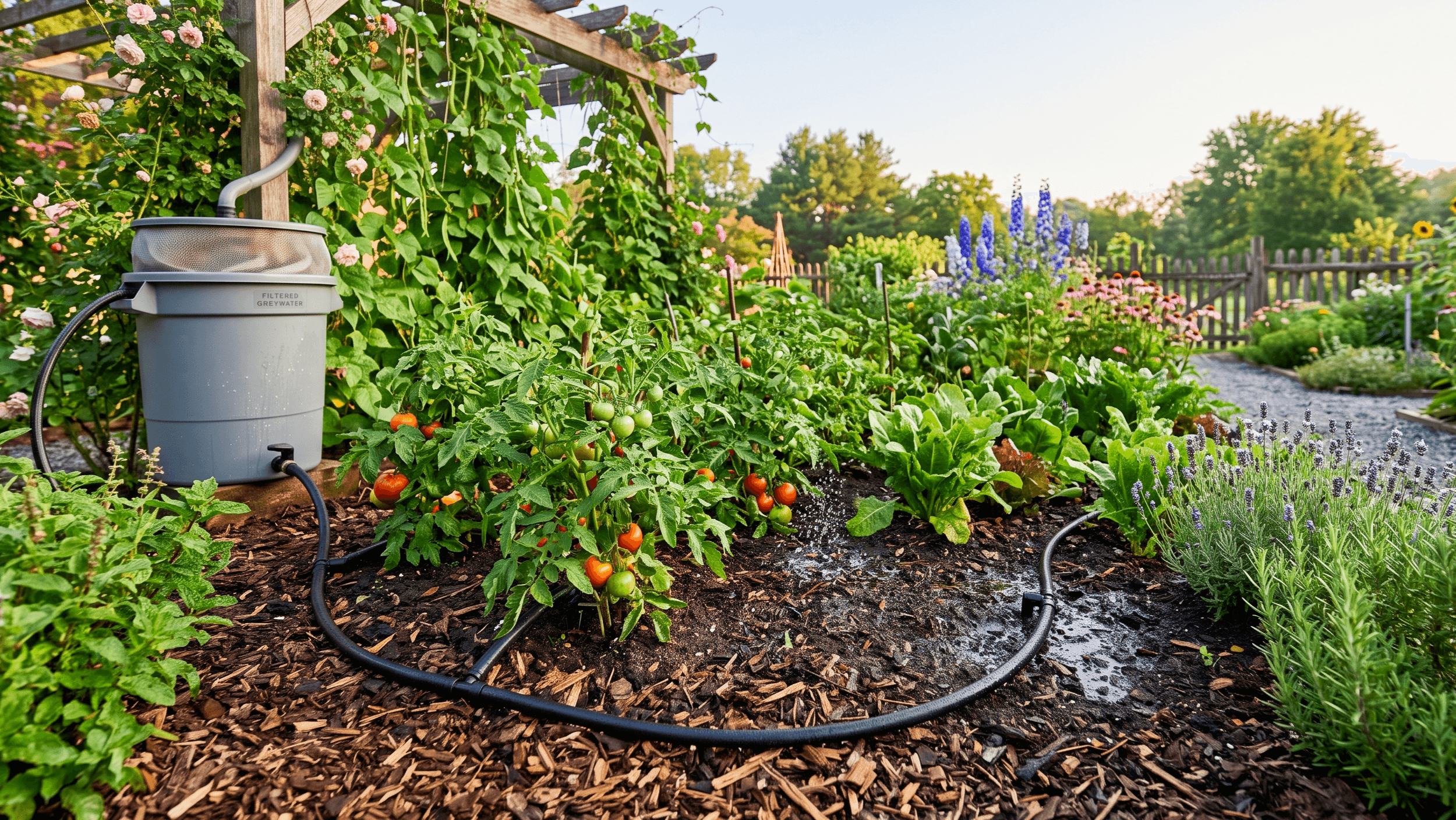
Water flows from the washing machine through a 3-way valve (which lets you switch back to the sewer as needed) and out to a branched drip system buried under 2–4 inches of mulch. The mulch filters the water and prevents direct human contact. California’s greywater standards explicitly recognize L2L as a simple system that does not require a permit in most residential applications.
Laundry water works best for trees, shrubs, and ornamentals. Avoid directing it to root vegetables or leafy greens where leaves or edible parts contact the soil.
3. Branched Drain Systems for Shower and Sink Water
A branched drain system uses gravity to distribute greywater from a bathroom to multiple garden outlets, with no electricity required. The shower or tub drain is redirected through a modified pipe network that splits the flow between two or more mulch basins in the yard.
The system requires a minimum 2% slope from the source to each outlet to maintain gravity flow. Each basin is filled with wood chip mulch at least 6 inches deep, which acts as a biological filter and prevents pooling or odors. Branched drain systems are well-suited to sloped properties and can serve 3–8 outlets from a single source depending on yard layout.
4. Greywater Irrigation Pumps for Flat Properties
On flat or uphill garden sites, gravity-fed systems aren’t an option. A small submersible pump placed in a collection tank below the drain outlet can push greywater uphill to drip emitters or mulch basins. Pumps rated at 500–1,000 gallons per hour handle typical household greywater volumes without running continuously.
Pump-based systems require a filter ahead of the pump to prevent clogging with lint or hair. A coarse mesh filter (100–200 micron) installed at the tank inlet is generally sufficient. If your home has low water pressure affecting other fixtures, reviewing your home’s overall pressure setup before adding pump loads to the system is worth doing.
5. Greywater Surge Tanks with a Timer
A surge tank buffers the irregular flow of greywater — a single shower produces 15–25 gallons in 8–10 minutes, which is more than most drip systems can absorb at once. A 30–50 gallon tank installed downstream of the collection point holds the surge and releases water slowly through a timed valve or float-controlled outlet.
Tanks must be sealed, dark-colored (to inhibit algae), and vented. Greywater should not sit in a tank longer than 24 hours, as bacterial growth accelerates rapidly after that point. A timer set to release water during cooler morning hours reduces evaporation and keeps the tank cycling regularly.
6. Mulch Basins as Natural Filter Zones
Regardless of which delivery method you use, mulch basins are the recommended endpoint for all greywater in a garden setting. A mulch basin is simply a shallow depression 12–18 inches in diameter, filled with 4–6 inches of coarse wood chip mulch, surrounding the base of a tree or shrub.
The mulch performs three functions: it filters particulates, it hosts the microbial communities that break down soap residue and organic matter, and it keeps water subsurface — which is a key safety requirement in most greywater regulations. Direct spray or surface flooding with greywater is generally prohibited because it creates aerosolization risks and runoff.
7. Constructed Wetland (Reed Bed) Systems
A constructed wetland is a planted filter bed, typically planted with cattails, bulrushes, or other water-tolerant plants, that treats greywater as it passes slowly through gravel or sand media. These are more common in off-grid or rural settings and pair well with well water and off-grid systems where household water management is handled independently of municipal infrastructure.
A basic single-family wetland requires 10–20 square feet of surface area per household member to process daily greywater flows. Properly designed wetland systems can reduce biological oxygen demand (BOD) by 80–90% before water reaches the soil, making the output safe for a wider range of garden applications than untreated greywater.
8. Sink-to-Garden Diverter Valves
Bathroom sink water — from handwashing, brushing teeth, and face washing — is low in contamination and easy to capture with a simple diverter valve installed under the sink. The valve redirects water to a small collection bucket or outdoor pipe rather than the drain, with a flip to switch back to the sewer when the container is full.
Sink diverters are inexpensive (typically $20–$60), require no structural plumbing changes, and are a practical starting point for households that aren’t ready for a full laundry-to-landscape installation. The water collected is generally cleaner than shower greywater and can be used on ornamentals, trees, and — if only plain soap is used — fruit trees and berry bushes.
Which Plants Are Safe to Water with Greywater?
| Plant Type | Greywater Compatible? | Notes |
|---|---|---|
| Trees and shrubs | ✅ Yes | Ideal recipients — roots are far from edible parts |
| Ornamental flowers | ✅ Yes | Apply to soil, not leaves or flowers |
| Citrus and fruit trees | ✅ Yes | Use plant-safe soap only |
| Berry bushes | ✅ Yes | Keep water away from fruit |
| Lawn grass | ⚠️ Conditional | Only if local regulations permit surface application |
| Tomatoes, peppers | ⚠️ Conditional | Apply at base only, not overhead |
| Root vegetables (carrots, beets) | ❌ Avoid | Soil contact with edible parts increases risk |
| Leafy greens (lettuce, spinach) | ❌ Avoid | High contamination risk from direct contact |
Greywater Safety Rules That Apply to All Methods
Keep water subsurface. Greywater must not pond, run off, or spray. All delivery should occur below mulch or through drip emitters with no surface exposure.
Use greywater within 24 hours. Fresh greywater is low-risk. Water held beyond 24 hours develops significant bacterial populations and should be diverted to the sewer rather than the garden.
Choose plant-safe products. Conventional laundry detergents contain sodium, boron, and bleach that harm soil biology over time. Use sodium-free, plant-safe detergents when laundry water will be reused. Similarly, avoid antibacterial soaps, products with bleach, and chemical drain cleaners if those drains feed your greywater system. This is also a reason to check for hidden household leaks or drain issues before incorporating a toilet-adjacent bathroom into your greywater setup.
Don’t apply to edible crops where water contacts the consumed part. This is the consistent standard across state-level greywater guidance: sub-surface application to trees and shrubs is acceptable; overhead application to anything eaten raw is not.
Check local regulations. Greywater law varies by state, county, and municipality. Arizona, California, Montana, New Mexico, and Texas have relatively permissive residential greywater codes. Other states require permits or prohibit reuse entirely. Verify local rules before installing any permanent system.
Products to Avoid if You Plan to Reuse Greywater
Using the wrong household products in greywater-generating fixtures can damage soil, harm plants, and increase pathogen risk. Avoid:
- Bleach and chlorine-based cleaners — destroy beneficial soil microbes and can damage plant roots
- Products with boron — accumulates in soil and becomes toxic to plants at concentrations above 0.5 mg/L
- Sodium-based softeners — degrade soil structure over time; if your home uses a salt-based water softener, do not route softened water to the garden (water softeners and their alternatives are worth reviewing if this applies to your setup)
- Antibacterial soaps with triclosan — classified as an environmental concern; best avoided when water will contact soil
- Chemical drain cleaners — highly caustic; even residue can harm soil biology
Using plant-safe dish soaps and laundry detergents rated for greywater systems reduces all of the above risks and expands which garden areas you can safely irrigate.
How Much Water Can a Household Actually Save?
An average person generates approximately 20–40 gallons of greywater per day from showers, sinks, and laundry combined. For a household of four, that’s 80–160 gallons daily — enough to irrigate a medium-sized garden without any municipal water on non-rain days.
A laundry-to-landscape system alone, based on 4–5 laundry loads per week at 15–25 gallons per load, redirects 60–125 gallons per week to the garden. Over a 6-month dry season, that equals 1,500–3,000 gallons of outdoor water demand eliminated from the utility bill.
Pairing greywater reuse with low-flow shower heads doesn’t reduce greywater volume enough to matter for garden supply — a 1.5 GPM head still produces adequate irrigation water — but it does reduce overall household consumption, which compounds the water savings.
Frequently Asked Questions
Is greywater safe to use on vegetable gardens?
Greywater is safe for vegetable gardens only under specific conditions. It can be applied subsurface (under mulch) near fruit trees, tomatoes, and pepper plants, provided it does not contact the edible portions. Root vegetables and leafy greens should not receive greywater because the parts that are eaten come into direct contact with the soil where the water is applied. Most state greywater guidelines draw the same line: trees, shrubs, and ornamentals are acceptable recipients; raw-eaten vegetables are not.
Does greywater need to be filtered before using in the garden?
Basic filtration is recommended but not always required. Hair, lint, and soap scum can clog emitters and create odor issues if left unfiltered. A simple coarse mesh screen (100–200 micron) placed at the collection point is sufficient for most laundry-to-landscape and branched drain systems. Pump-based systems require filtration to protect the pump. Constructed wetland systems provide their own biological filtration and do not require a separate filter upstream.
Can greywater from a washing machine harm soil over time?
Conventional laundry detergents can degrade soil structure over years of repeated use if they contain sodium or boron. Sodium displaces calcium and magnesium in the soil matrix, leading to compaction. Boron accumulates and becomes phytotoxic at concentrations above 0.5 mg/L. Switching to a greywater-compatible, sodium-free, boron-free detergent eliminates both risks. Brands like Oasis Biocompatible and Ecos Free & Clear are widely cited in greywater guidance as safe for soil reuse.
How do I know if greywater reuse is legal where I live?
Check your state’s plumbing code or water quality agency website first. California’s State Water Resources Control Board, Arizona’s Department of Environmental Quality, and New Mexico’s Environment Department all publish residential greywater guidance online. If your state requires a permit, the application is typically straightforward for simple systems like laundry-to-landscape. Local county health departments may have additional rules even in permissive states.
How does a faucet aerator affect greywater collection from bathroom sinks?
A clean, functioning aerator does not affect greywater quality or usability. Clogged aerators reduce flow rate, which can make bucket collection slower but has no impact on the water’s suitability for garden use. If sink flow seems unusually slow, cleaning the aerator is a quick fix that restores normal volume without requiring any plumbing work.