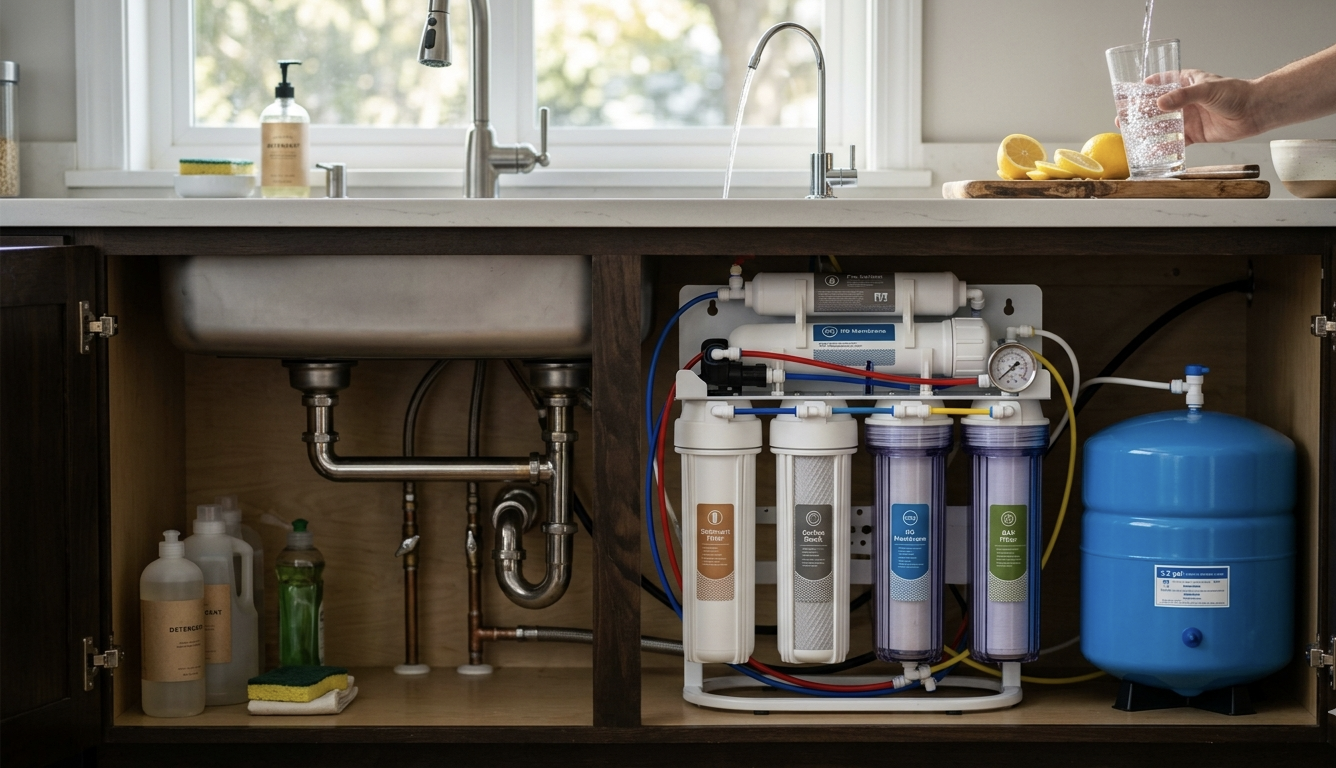
If your tap water tastes off, leaves stains on your fixtures, or you’ve noticed white buildup on your appliances, a water filter might be exactly what your home needs—but knowing where to start can feel overwhelming. There are dozens of filter types, dozens of brands, and a lot of confusing technical language that doesn’t help you make a practical decision.
This guide cuts through the noise. You’ll learn what a water filter actually does, how the main filtration technologies work, which contaminants different filters can and can’t remove, and how to match the right filter to your specific situation—without needing a background in water chemistry.
What Is a Water Filter?
A water filter is a device that removes impurities from water by passing it through one or more filtration materials, reducing contaminants that affect safety, taste, odor, or appearance. Most household water filters target dissolved chemicals, heavy metals, sediment, chlorine, and in some cases microorganisms, depending on the technology used.
The word “filter” covers a wide range of products—from a $20 pitcher sitting on your counter to a whole-house system installed at your main water line. What they share is a core function: water goes in one side, passes through a filtering medium that captures or transforms contaminants, and cleaner water comes out the other side.
Why it matters to your home: Unfiltered municipal water typically contains chlorine (used for disinfection), trace heavy metals from aging pipes, and disinfection byproducts. Well water often carries sediment, iron, bacteria, and hardness minerals. A water filter addresses whichever of these issues your water supply actually has—but only if you choose the right type.
How Does a Water Filter Work to Remove Contaminants?
Water filters work through three core mechanisms: physical filtration, chemical adsorption, and membrane separation. Most modern filter systems use at least two of these in combination, because no single mechanism removes every type of contaminant.
Physical Filtration (Mechanical Barrier)
The simplest filtration method uses a physical barrier with tiny pores that water can pass through but contaminants cannot. Think of it like a very fine strainer. The smaller the pore size—measured in microns—the smaller the particles it can catch.
- 100+ microns: Removes visible debris, sand, and large sediment
- 1–5 microns: Catches rust, fine silt, and suspended solids
- 0.5 microns: Can block protozoa like Giardia and Cryptosporidium
- 0.1 microns or less: Approaches bacterial filtration
Ceramic and fiber sediment filters are the most common mechanical filtration materials. These are often used as a first stage in multi-stage systems to protect finer filtration stages downstream.
Chemical Adsorption (Activated Carbon)
Activated carbon is the most widely used filtration material in household water filters. “Adsorption” (not absorption) means contaminants chemically bond to the carbon’s surface rather than being soaked up like a sponge. Activated carbon has an enormous surface area—one gram can have a surface area equivalent to a tennis court—giving it tremendous capacity to capture dissolved chemicals.
Activated carbon effectively removes chlorine, chloramines, many volatile organic compounds (VOCs), disinfection byproducts, certain pesticides, and compounds that cause bad taste and odor. It does not reliably remove dissolved minerals, heavy metals (unless specially treated), nitrates, or bacteria.
Two forms exist: granular activated carbon (GAC), which is loose carbon granules, and carbon block, which is compressed carbon with a tighter pore structure. Carbon block generally performs better because water has more contact time with the filtration material.
Membrane Filtration (Reverse Osmosis)
Reverse osmosis (RO) forces water through a semipermeable membrane under pressure. The membrane’s pores are extremely small—around 0.0001 microns—allowing water molecules to pass while blocking dissolved ions, heavy metals, fluoride, nitrates, and even some microorganisms.
RO is the most thorough household filtration method available, but it comes with tradeoffs: it removes beneficial minerals along with harmful ones, produces wastewater (typically 3–4 gallons for every 1 gallon filtered), and filters water slowly, usually storing it in a tank. Most RO systems combine a sediment pre-filter, a carbon pre-filter, the RO membrane, and a polishing carbon post-filter.
Ion Exchange
Ion exchange resins swap unwanted ions in water for less harmful ones. The most familiar application is water softening: the resin exchanges calcium and magnesium ions (which cause hard water) for sodium or potassium ions. Some ion exchange filters also target lead, nitrates, or radium. ZeroWater’s pitcher filter uses ion exchange to remove virtually all total dissolved solids (TDS) from tap water.
What Types of Water Filters Are Available?
The filter market breaks down into five main categories based on where the filter is installed and how much water it treats. Each suits different needs, budgets, and water problems.
Pitcher and Countertop Filters
Pitcher filters (like Brita or ZeroWater) hold filtered water in a reservoir and use gravity to pass water through a carbon or ion exchange cartridge. They’re inexpensive upfront ($20–$50), require no installation, and improve taste effectively. Their limitations: small capacity, slow filtration, and cartridges that typically last only 40–120 gallons before needing replacement.
Best for: Renters, small households, or anyone primarily concerned about taste and chlorine.
Faucet-Mount Filters
These attach directly to your kitchen tap and filter water on demand. They switch between filtered and unfiltered modes, extend cartridge life compared to pitchers, and cost $30–$80. Most are NSF/ANSI 42 or 53 certified, meaning they address aesthetic issues and some health contaminants like lead.
Best for: Households wanting filtered water without under-sink installation.
Under-Sink Filters
Installed below the kitchen sink and connected directly to the water line, under-sink filters deliver higher flow rates and higher filtration capacity than pitchers or faucet mounts. They’re either single-stage (usually carbon only) or multi-stage. Under-sink reverse osmosis systems fall into this category and offer the most thorough point-of-use filtration available for residential use.
Best for: Households with specific contaminant concerns (lead, VOCs, PFAS, nitrates) or those wanting reliable high-volume filtered water.
Refrigerator Filters
Built into most modern refrigerators, these filter water going to the ice maker and door dispenser. They use activated carbon and are convenient but have limited filtration capacity. Refrigerator filters should be replaced every six months regardless of use—they’re a common source of degraded water quality that homeowners overlook.
Best for: Light filtration needs on water already used for drinking via the refrigerator.
Whole-House Filters
Installed at the main water supply line, whole-house systems (also called point-of-entry systems) filter every drop of water entering the home—including water used for bathing, laundry, and appliances. They protect plumbing, extend appliance life, and address issues like sediment, iron, chlorine, or hard water throughout the entire house.
Best for: Homes with well water, high sediment, widespread taste/odor issues, or appliance damage from mineral buildup.
Water Filter Type Comparison
| Filter Type | Typical Cost | Contaminants Addressed | Best Use |
|---|---|---|---|
| Pitcher | $20–$50 | Chlorine, taste, some lead | Renters, basic taste improvement |
| Faucet-Mount | $30–$80 | Chlorine, lead, cysts | Single tap, no installation |
| Under-Sink Carbon | $100–$300 | Chlorine, VOCs, lead, PFAS | Kitchen drinking water |
| Under-Sink RO | $200–$600 | Most dissolved contaminants | High-concern water quality |
| Whole-House | $300–$1,500+ | Sediment, chlorine, iron, hardness | Full home treatment |
What Can Water Filters Remove—and What Can’t They Remove?
No single filter removes everything. Understanding this gap is one of the most practical things a homeowner can know before buying a filter.
What Most Household Filters Can Remove
- Chlorine and chloramines – Addressed by nearly all activated carbon filters; dramatically improves taste and odor
- Lead – NSF/ANSI 53-certified carbon block and RO filters reliably reduce lead to below EPA action levels
- VOCs (volatile organic compounds) – Activated carbon is effective for most VOCs including benzene and trichloroethylene
- Sediment, rust, and particulates – Mechanical/sediment filters handle these
- PFAS (“forever chemicals”) – High-quality activated carbon (NSF/ANSI 58 or P473) and RO systems significantly reduce PFAS levels
- Nitrates – RO and ion exchange filters (standard carbon does not remove nitrates)
- Fluoride – RO and some specialty media filters; standard carbon filters do not remove fluoride
- Cysts (Giardia, Cryptosporidium) – Filters rated 0.5 microns or finer, or certified NSF P231
What Most Household Filters Cannot Remove
- Bacteria and viruses – Standard pitcher, carbon, and most under-sink filters are not designed to disinfect water. The CDC notes that most home filters are not reliable microbiological treatment devices. If biological contamination is a concern (common with well water), a UV disinfection system or certified ceramic filter is needed.
- Total dissolved solids (TDS) at high levels – Only RO and ion exchange filters meaningfully reduce TDS
- Hardness minerals (calcium and magnesium) – Carbon filters don’t soften water; a dedicated water softener or RO system is required. If you’re seeing white scale on your fixtures or appliances, see What Is Hard Water and How Does It Affect Your Home? for context.
- Some industrial chemicals – Coverage varies significantly by filter type and certification
The practical rule: A filter can only remove what it was designed and tested for. Always match the filter’s NSF/ANSI certification claims to your specific contaminants of concern—don’t assume broader protection than what’s documented.
How Do You Choose the Right Water Filter for Your Home?
The most common mistake homeowners make is choosing a filter based on brand recognition or price rather than their actual water problem. A $300 pitcher filter won’t solve iron staining. An RO system won’t help if your only concern is a chlorine taste.
Step 1: Know What’s in Your Water
Before buying anything, find out what you’re dealing with. There are three ways to do this:
- Review your annual Consumer Confidence Report (CCR) – Municipal water suppliers are required by law to provide this. It lists detected contaminants and how they compare to EPA limits.
- Test your water – Home test kits ($20–$50) detect common contaminants. For a comprehensive picture, a certified lab test ($100–$200) identifies a broader range. This is essential for well water, which is not regulated and can carry bacteria, iron, sulfur, or nitrates that municipal testing doesn’t address.
- Check the EWG Tap Water Database – Enter your zip code to see detected contaminants in your local municipal supply.
Step 2: Match Your Concern to the Right Filtration Technology
| Your Water Problem | Technology Needed |
|---|---|
| Bad taste / chlorine odor | Activated carbon (any type) |
| Lead from pipes | NSF 53 carbon block or RO |
| Hard water / scale buildup | Water softener or RO |
| Iron staining / metallic taste | Whole-house iron filter |
| Nitrates (well water or agricultural area) | RO or ion exchange |
| PFAS contamination | NSF P473-certified carbon or RO |
| Bacteria / biological risk | UV system + carbon filter |
| High TDS / poor-tasting well water | RO system |
Step 3: Consider Practical Constraints
Ask yourself:
- How much water do I need filtered daily? A family of four needs more capacity than a single person.
- Where will this filter live? Under-sink systems need cabinet space and plumbing access. Whole-house systems need space near the main line.
- What’s my total budget? Include filter cartridge replacement costs over 3–5 years, not just the upfront price.
- Do I rent or own? Renters may be limited to pitcher or faucet-mount options.
Step 4: Verify NSF/ANSI Certification
NSF/ANSI certification is not just a quality badge—it defines what the filter has been independently tested and confirmed to remove. Key standards to know:
- NSF/ANSI 42 – Aesthetic improvements (taste, odor, chlorine)
- NSF/ANSI 53 – Health-related contaminants including lead, cysts, VOCs
- NSF/ANSI 58 – Reverse osmosis systems; covers TDS, fluoride, nitrates, heavy metals
- NSF/ANSI 401 – Emerging contaminants including pharmaceuticals and PFAS
- NSF P473 – PFAS (PFOA/PFOS) reduction specifically
Always verify the certification on the NSF public database before purchasing—marketing claims on packaging are not a substitute for independent testing.
The Filter Selection Decision Framework
Use this logic to narrow your choice:
- Taste/odor only? → Pitcher or faucet-mount carbon filter
- Lead or VOCs? → NSF 53 carbon block, under-sink or faucet-mount
- High TDS, nitrates, fluoride, or multiple concerns? → Under-sink RO system
- Hard water throughout the house? → Whole-house water softener (not a filter; a different treatment)
- Well water with bacterial risk? → UV system combined with sediment and carbon filtration
- Whole-home sediment or chlorine? → Whole-house filter at the main line
How Often Should You Replace and Maintain a Water Filter?
A filter that’s overdue for replacement doesn’t just stop working—it can release trapped contaminants back into your water or become a site for bacterial growth. Maintenance is where many homeowners let their systems down.
Replacement Intervals by Filter Type
| Filter Type | Replacement Interval | Capacity |
|---|---|---|
| Pitcher filter cartridge | Every 2–3 months | 40–120 gallons |
| Refrigerator filter | Every 6 months | ~300 gallons |
| Faucet-mount cartridge | Every 3–6 months | 100–200 gallons |
| Under-sink carbon | Every 6–12 months | 500–1,000 gallons |
| RO pre/post filters | Every 6–12 months | — |
| RO membrane | Every 2–3 years | — |
| Whole-house sediment | Every 3–6 months | Varies by water quality |
These intervals assume average household usage. Households with poorer-quality source water—high sediment, high TDS, high chlorine—will exhaust filters faster.
Warning Signs Your Filter Needs Replacement
Don’t rely solely on calendar-based schedules. Replace your filter when you notice:
- Reduced water flow or pressure – The filter media is becoming clogged
- Return of taste or odor issues – Carbon capacity is exhausted
- Visible discoloration in filtered water – Sediment filter is overloaded
- Indicator light activation – Most refrigerator and faucet-mount filters have sensors; take them seriously
- Unusual taste even with a new cartridge – Could indicate bacterial growth in an unused or improperly stored system
Maintenance Beyond Cartridge Replacement
For RO systems, flush the membrane annually per manufacturer instructions and sanitize the storage tank. For whole-house systems, check the housing for sediment buildup every six months. For any filter that’s been unused for two weeks or more, run water through for several minutes before drinking it.
A practical maintenance habit: write the installation date on the new cartridge with a marker when you install it. It takes ten seconds and eliminates the most common reason people delay replacement—not knowing how long the filter has been in place.
Frequently Asked Questions
Do water filters remove bacteria and viruses?
Most standard household water filters—including pitcher filters, activated carbon systems, and basic under-sink units—are not designed to reliably remove bacteria or viruses. The CDC notes that these filters typically improve taste and reduce chemical contaminants but are not microbiological treatment devices. If biological contamination is a concern, look for a filter certified under NSF/ANSI P231 (bacteria and cysts), or pair a carbon filter with a UV disinfection system.
What’s the difference between a water filter and a water softener?
A water filter removes contaminants like chlorine, lead, sediment, and chemicals from water. A water softener addresses hard water by replacing calcium and magnesium ions (the minerals that cause scale buildup and soap scum) with sodium or potassium ions through ion exchange. They solve different problems. Some households need both; many only need one. If you’re seeing white scale on faucets and appliances, the issue is likely hardness, not filtration.
How do I know if my water actually needs filtering?
Request your municipality’s annual Consumer Confidence Report (CCR), or check the EWG Tap Water Database using your zip code. For well water, testing is essential since it’s not regulated—contaminants like bacteria, iron, nitrates, and sulfur vary widely by location. You can also look for visible signs: staining on fixtures, cloudy water, or strong chlorine taste. See How to Tell If You Have Hard Water if mineral-related issues are part of your concern.
Is reverse osmosis worth it for home use?
RO systems offer the most thorough point-of-use filtration available to homeowners, removing dissolved minerals, heavy metals, nitrates, fluoride, and PFAS that other filters miss. The tradeoffs are real: they filter water slowly, require a storage tank, produce wastewater, and need annual maintenance. They’re worth it if your water has multiple serious concerns (lead AND nitrates AND PFAS, for example), or if you’re on well water with high TDS. For households whose main concern is taste and chlorine, a quality under-sink carbon filter does the job at lower cost and complexity.
What does NSF certification actually mean for water filters?
NSF/ANSI certification means an independent laboratory has tested the specific product—not just the technology—and verified it reduces the contaminants listed on its label to the levels claimed, under standardized conditions. It’s the difference between a manufacturer’s claim and independently verified performance. When comparing filters, check that the certification applies to the specific contaminant you’re concerned about: NSF 42 covers taste and odor; NSF 53 covers health contaminants like lead; NSF 58 covers reverse osmosis systems. Verify the product’s listing directly on the NSF public database before purchasing.
Can I use a water filter with well water?
Yes, but well water typically requires a different approach than municipal water. Well water isn’t regulated or treated before it reaches your tap, so contaminants vary widely—common issues include bacteria, iron, sulfur, nitrates, hardness, and sediment. A single carbon filter is rarely sufficient. Well water owners generally benefit from a water test first, then a system matched to actual results: often a sediment pre-filter, followed by a problem-specific stage (iron filter, UV disinfection, softener), and a carbon post-filter or RO for drinking water. See Is Well Water Hard? for more on how well water differs from municipal supplies.