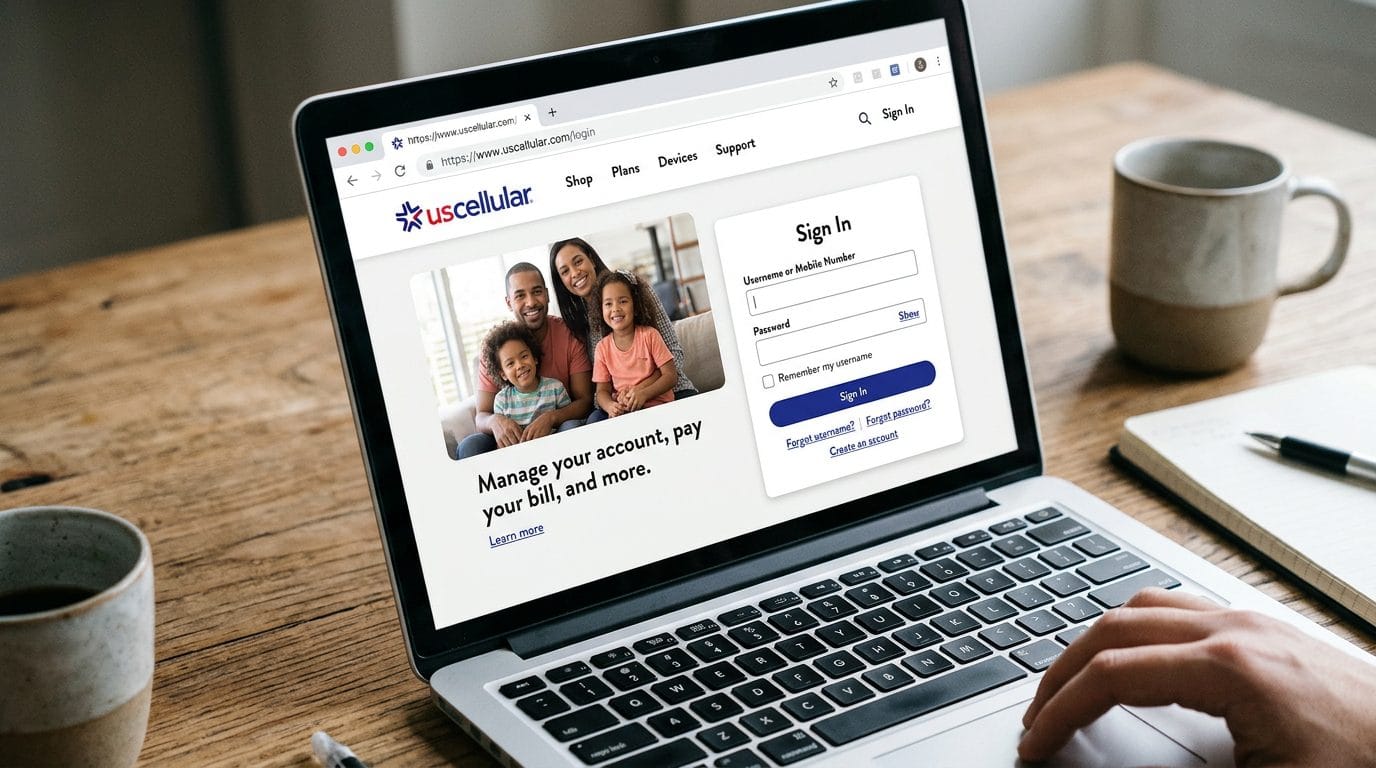
The U.S. Cellular login should take less than a minute — and most of the time it does. But if you’ve tried to sign in lately and found yourself bounced to an unfamiliar page, asked for a “T-Mobile ID,” or simply couldn’t remember which login you created, you’re not alone. A lot has changed behind the scenes, and the sign-in process looks different in 2026 than it did a couple of years ago.
This guide walks you through the current U.S. Cellular login process step by step, explains the move to T-Mobile’s sign-in system, and shows you exactly how to fix the problems people run into most often — from forgotten passwords to accounts that seem to have vanished.
IN THIS GUIDE
- The short answer: where to sign in right now
- How to log in to your U.S. Cellular account (desktop and mobile)
- The big 2026 change: UScellular is now part of T-Mobile
- U.S. Cellular login vs. T-Mobile ID: what’s different
- How to reset a forgotten password
- Common login problems and how to fix them
- What you can do after you sign in
- Security tips for keeping your account safe
- FAQs
- Conclusion
The Short Answer: Where to Do Your U.S. Cellular Login
The short answer: most U.S. Cellular customers now sign in through T-Mobile’s system. Go to uscellular.com and follow the Login or My Account link, which will point you to the right place — or use the T-Life app with your T-Mobile ID. Your old UScellular username and password don’t carry over; T-Mobile requires a separate T-Mobile ID, which you may need to create the first time you sign in after the transition.
If that sentence raised more questions than it answered, keep reading. The rest of this guide breaks it down piece by piece.
How to Log In to Your U.S. Cellular Account
Whether you’re on a computer or a phone, the login itself is simple once you’re at the right page. Here’s the standard process.
Logging in from a computer
- Go to the official site. Type uscellular.com into your browser’s address bar yourself rather than clicking a link from an email or a search ad. This is the single best habit for avoiding lookalike scam pages.
- Click Login or My Account. You’ll usually find it in the top-right corner of the homepage.
- Enter your credentials. Type your username and password carefully. Passwords are case-sensitive, so check that Caps Lock is off.
- Complete any verification step. You may be asked for a code sent to your phone or email, especially on a new device.
- You’re in. From your dashboard you can view your bill, check usage, manage lines, and more.
Logging in from your phone
The mobile route works the same way, but with a twist: T-Mobile now manages former UScellular accounts through the T-Life app. If you haven’t already, download the T-Life app from your phone’s app store, sign in (or create) your T-Mobile ID, and your account information will be there once everything is migrated. Many people find the app faster than the mobile website for quick checks like data usage or paying a bill.
Practical tip: If you use a password manager, save the final login page you land on — not the old bookmark you might have from years ago. Old bookmarks are one of the most common reasons people end up on a page that no longer accepts their credentials.
The Big 2026 Change: UScellular Is Now Part of T-Mobile
Here’s the context that explains almost every confusing login experience people have had recently: T-Mobile completed its acquisition of UScellular in 2025. Former UScellular customers were brought into the T-Mobile system, and with that move came a new sign-in setup.
According to T-Mobile’s own guidance for incoming UScellular customers, your previous UScellular login information does not carry over. Instead, you access your account with a T-Mobile ID, which is a separate set of credentials. In some cases T-Mobile created one for you automatically to make the transition smoother, but many people need to set theirs up the first time they sign in.
This is why you might enter the username and password that worked for years and get an error. The credentials aren’t necessarily wrong — they just belong to a system that’s no longer in charge of your account.
Practical tip: When you create your T-Mobile ID, use the same email address UScellular had on file if you can. It makes it easier for the system to match your new ID to your existing account, lines, and billing history.
U.S. Cellular Login vs. T-Mobile ID: What’s Different
If you’re wondering what actually changed, this comparison lays it out:
| What | Old UScellular login | Current T-Mobile ID sign-in |
|---|---|---|
| Where you sign in | The UScellular website’s My Account page | uscellular.com routes you to T-Mobile’s sign-in; the T-Life app also works |
| Your credentials | Your UScellular username and password | A T-Mobile ID (new, separate credentials) |
| Password resets | Through the UScellular site | Through T-Mobile’s ID recovery process |
| Two-factor codes | Sent to your registered number or email | Same idea, managed through your T-Mobile ID settings |
| What stays the same | Your plan, lines, and billing history | Your service and account details carry over — only the sign-in changed |
The important takeaway: your service, your number, and your plan didn’t disappear. Only the door you walk through to manage them changed. Once your T-Mobile ID is set up, everything you’re used to seeing — current balance, due dates, data usage — is still there.
How to Reset a Forgotten Password
Forgetting a password happens to everyone. The reset process is straightforward:
- Go to the login page and click “Forgot password?” or the equivalent link under the sign-in fields.
- Enter the email address associated with your account.
- Check your inbox for a reset link. If it doesn’t arrive within a few minutes, check your spam or junk folder.
- Click the link and choose a new password. Pick something you haven’t used on other sites.
- Sign back in with the new password.
Practical tip: If your browser auto-fills your old UScellular password, delete that saved entry after you set up your T-Mobile ID. Stale saved passwords are a sneaky cause of repeated “wrong password” errors.
Common U.S. Cellular Login Problems and How to Fix Them
These are the issues people report most often, with the fixes that actually work:
| Problem | Likely cause | What to do |
|---|---|---|
| Your old username and password don’t work | You’re still trying the pre-acquisition UScellular credentials | Set up or sign in with your T-Mobile ID instead |
| “Account not found” error | Email on file doesn’t match, or migration is still processing | Double-check the email UScellular had on file; try the reset flow |
| Never received the verification code | Code sent to an old number or email, or blocked by spam filters | Check spam, confirm your contact info, request the code again |
| Page keeps reloading or won’t load | Browser cache holding onto old login pages | Clear cache and cookies, or try a different browser |
| Locked out after too many attempts | Security lockout from repeated failed sign-ins | Wait the stated lockout period, then use the password reset |
| Cloudflare or verification screen loops | Bot protection misfiring on VPNs or aggressive ad blockers | Pause your VPN or ad blocker for the login, then re-enable it |
If you’ve tried the relevant fix and still can’t get in, contact T-Mobile customer care — they handle former UScellular accounts now and can verify your identity to unlock or reset your sign-in. For more everyday explainers and how-to guides like this one, browse A Daily Insight 360.
What You Can Do After You Sign In
Once you’re logged in, the account dashboard is the fastest way to handle routine tasks without calling anyone. Typical things you can do:
- View and pay your bill. See the current balance, due date, and payment history; make one-time payments or set up autopay.
- Check your usage. Monitor data, talk, and text usage across each line so nothing surprises you mid-cycle.
- Manage your plan and features. Review your current plan, add or remove features, and see upgrade eligibility.
- Manage multiple lines. If your account covers family members, you can oversee all lines from one dashboard.
- Shop devices and upgrades. Browse phones, check trade-in eligibility, and see current promotions.
- Get support. Access help articles, start a chat, or find the right support number for your issue.
Practical tip: Turn on paperless billing and autopay from the dashboard if you haven’t already. It removes the “did I pay the bill?” question entirely and usually keeps you clear of late fees.
Security Tips for Keeping Your Account Safe
Your carrier account is a high-value target — it controls your phone number, and your phone number controls password resets for half the internet. A few habits go a long way:
- Use a unique password. Don’t reuse the password from your email or social accounts. A password manager makes this painless.
- Turn on two-factor authentication. If it’s offered on your account, enable it. A code on your phone beats a password alone every time.
- Never sign in from email links. Phishing emails pretending to be your carrier are common. Always navigate to the site yourself.
- Review authorized users. After the migration to T-Mobile, check who is listed as an authorized user on your account and remove anyone who shouldn’t be there.
- Update your account PIN. T-Mobile guidance specifically recommends that the primary account holder update their account PIN after the transition, since a PIN is often required to verify your identity when making changes.
FAQs
Why doesn’t my old U.S. Cellular password work anymore?
Because UScellular is now part of T-Mobile, and your old UScellular login credentials don’t carry over. You need a T-Mobile ID to sign in. Create one (or sign in with it) through the login page or the T-Life app.
Where do I log in to pay my U.S. Cellular bill?
Start at uscellular.com and follow the Login or My Account link, then sign in with your T-Mobile ID. From the dashboard you can view your balance and make a payment, or use the T-Life app for the same thing on your phone.
Is uscellular.com still the right website?
Yes — uscellular.com is still the official starting point. It now routes you into T-Mobile’s sign-in system, which is expected after the acquisition. Just make sure you type the address yourself rather than clicking links from emails.
What is a T-Mobile ID?
It’s the single sign-in T-Mobile uses across its services — one email and password for your account, the T-Life app, and T-Mobile’s website. Former UScellular customers need one to manage their accounts going forward.
Do I need to create a new account, or is my old one still there?
You don’t need a new account. Your existing account, lines, and plan carried over — only the sign-in method changed. If the system can’t find you, it’s usually an email mismatch or a migration still in progress, not a deleted account.
Can I still log in if I never set up a T-Mobile ID?
Yes. Go through the normal sign-in flow and look for the option to create a T-Mobile ID. In some cases T-Mobile may have already created one for you; the recovery flow will tell you if an ID exists for your email.
Who do I call if I’m locked out?
Contact T-Mobile customer care, which now handles former UScellular accounts. They can verify your identity and reset your sign-in if the self-service options aren’t working.
Conclusion
The U.S. Cellular login looks different in 2026 than it used to, but the underlying task hasn’t changed: sign in, handle your business, get on with your day. The one thing to internalize is that your old UScellular credentials are retired — a T-Mobile ID is your new key to the account. Set it up once, save it in your password manager, and the monthly routine of checking usage and paying your bill goes back to taking about a minute.
If you hit a wall, work through the fixes in the troubleshooting table above before anything else; nine times out of ten, the answer is the T-Mobile ID, a stale bookmark, or a cached page. And when in doubt, navigate to the official site yourself — it’s the simplest security habit there is.
Read Also: T-Mobile Fiber Outage Compensation (2026 Guide): How to Get Bill Credits