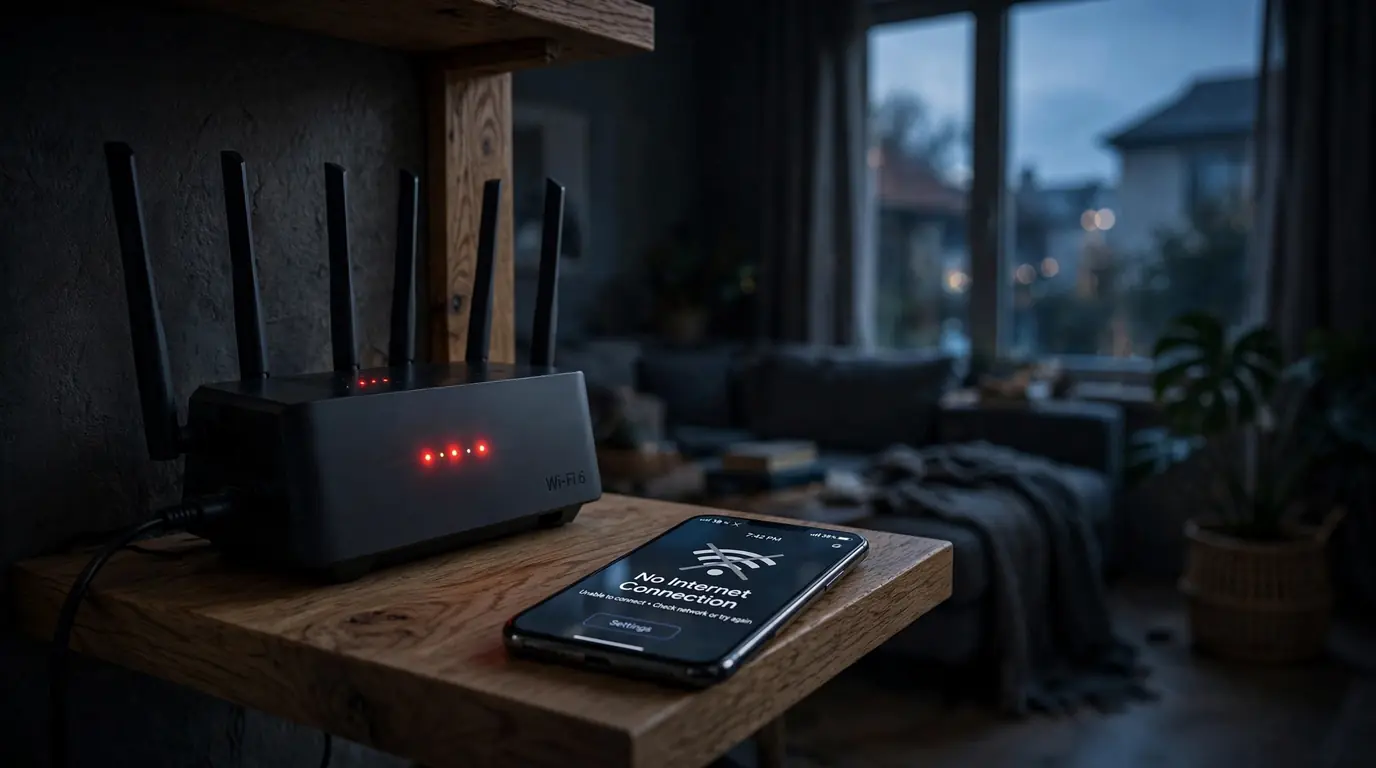
Your T-Mobile fiber connection dropped, the workday went sideways, and now you are wondering the obvious question: will T-Mobile pay you back for the downtime? The honest answer is that T-Mobile publishes no standing, automatic compensation policy for fiber outages — but customers do receive bill credits when they ask, and there is a documented playbook for getting them.
The short answer: To get T mobile fiber outage compensation, document the outage (dates, times, duration, impact), then contact T-Mobile Fiber support at 1-844-783-4327 or through your T-Mobile account and explicitly request a bill credit. Credits are not applied automatically — you have to ask. Reported credit amounts from T-Mobile’s most recent major outage ranged from $10 to $80 depending on the account and impact, and politely explaining real consequences (missed work, for example) has resulted in larger adjustments.
One important clarification before the steps: the best-documented recent case of T-Mobile paying outage credits was the July 27, 2026 outage, which affected T-Mobile’s mobile network (roughly 470,000 subscribers reported issues, per outage trackers). That incident is the clearest public precedent for how T-Mobile handles compensation requests, and the request process for fiber customers follows the same support channels — but it was a wireless outage, not a fiber one. This guide keeps that distinction straight while giving you the process that works for fiber.
IN THIS GUIDE
- The Short Answer: How Compensation Works
- What T-Mobile Fiber Is (and Isn’t)
- The Precedent: What Happened After the July 2026 Outage
- Step-by-Step: Requesting Your Credit
- What to Say: A Script That Works
- How Much Can You Get? Reported Credit Amounts
- How to Document an Outage Properly
- Your Rights Under T-Mobile Fiber’s Terms
- If They Say No: Escalation Options
- Preventing the Next One: Backup Options
- Frequently Asked Questions
- Conclusion
The Short Answer: How Compensation Works
The short answer: T-Mobile does not automatically credit your bill when fiber service goes down. Compensation happens when you contact support, describe the outage and its impact, and request a bill credit. Agents have discretion to issue credits, and published reports show they do — but only for customers who ask.
This “ask and you may receive” model is standard across US carriers. As industry coverage has noted, most American carriers do not proactively compensate for outages unless a regulation or legal settlement requires it. That makes the customer’s job simple but non-optional: document, contact, request, and follow up.
Practical tip: Call sooner rather than later. T-Mobile Fiber’s own terms require billing disputes to be raised within 60 days of first receiving the disputed bill — and practically speaking, agents are far more willing to credit a recent outage than one from three months ago. The best time to start the request is while the details are fresh.
What T-Mobile Fiber Is (and Isn’t)
The short answer: T-Mobile Fiber is T-Mobile’s wired fiber-optic home internet service, distinct from T-Mobile’s 5G Home Internet (which runs over the wireless network through a gateway). Fiber plans include unlimited data with no monthly caps. Because it is a separate product line, it has its own support channels and its own terms and conditions.
The distinction matters for compensation. T-Mobile’s 5G Home Internet customers call home internet support lines; fiber customers use fiber-specific channels — fiber.T-Mobile.com and 1-844-783-4327 (1-844-7TFIBER) — and are governed by the T-Mobile Fiber Residential Terms and Conditions. When you contact support, make clear you are a fiber customer so your request routes to the right team with the right account tools.
Practical tip: Before assuming the outage is on T-Mobile’s side, rule out your own equipment: reboot the ONT (the fiber box) and your router, check for a service-status notice in your T-Mobile account, and ask a neighbor on the same service whether they are down too. Agents ask these questions first, and having the answers ready shortens the call.
The Precedent: What Happened After the July 2026 Outage
The short answer: On July 27, 2026, T-Mobile suffered a widespread network outage that left many customers without calls, texts, or data for several hours — some users saw “SOS” in their phone status bars, and outage trackers logged well over 400,000 reports. T-Mobile apologized but did not proactively offer compensation. Customers who contacted support and asked received bill credits reported between $10 and $80.
Several patterns emerged from customer reports that are directly useful for fiber customers:
- Credits were not automatic. Nobody reported receiving one without asking. The customers who got credits all contacted T-Mobile through 611, 1-800-937-8997, or the T-Life app’s chat.
- Amounts varied widely. Some customers reported $10, others $20, and at least one documented case reached $80 — structured as $20 immediately plus $10 per month over six months. There was no published standard amount.
- Explaining real impact helped. Customers who politely described concrete consequences — a missed work opportunity, being unreachable during an emergency — reported larger credits than those who simply asked for “something.”
- Politeness outperformed pressure. Multiple reports describe agents increasing an initial small offer (sometimes starting around $5) when the customer calmly explained the situation and their history with the company.
Again: this was a mobile-network outage, and fiber outages are a different service. But it is the clearest public evidence of how T-Mobile’s support organization handles outage compensation in practice — discretionary credits, issued on request, scaled to impact.
Practical tip: When you call about a fiber outage, you can reference this precedent calmly and factually: “I understand T-Mobile has issued bill credits for service disruptions when customers were affected — I’d like to request the same consideration for this fiber outage.” You are not demanding a specific amount; you are anchoring the conversation in established practice.
Step-by-Step: Requesting Your Credit
The short answer: Document the outage, contact T-Mobile Fiber support at 1-844-783-4327 (or through your online account), state the facts, describe the impact, and explicitly ask for a bill credit. Get any promise in writing via chat transcript or a confirmation number.
Step 1 — Confirm it is a network outage, not your equipment. Reboot the ONT and router, check T-Mobile’s service status or an outage tracker for reports in your area, and confirm with a neighbor if possible. Note the exact time service dropped and the exact time it returned.
Step 2 — Gather your documentation. Screenshots of the outage (router lights, error pages, speed tests showing zero connectivity), the date and duration, and a one-line note on how it affected you. You do not need a legal brief — a few timestamps and screenshots are enough.
Step 3 — Contact T-Mobile Fiber support. Call 1-844-783-4327, use the support chat at fiber.T-Mobile.com, or message through your T-Mobile account. Early in the conversation, state that you are requesting a bill credit for a service outage on specific dates.
Step 4 — State facts, then impact, then the ask. “My fiber service was down from [time] to [time] on [date]. I work from home and lost [X hours] of work. I’d like a bill credit for the disruption.” Keep it calm, specific, and short.
Step 5 — If the first offer is small, politely push once. Reports consistently show initial offers start low. A calm “I appreciate that — given that I lost a full workday, is there anything more you can do?” has moved offers upward in documented cases.
Step 6 — Get it in writing. Ask for a confirmation number, and if you used chat, save the transcript. Note the agent’s name, the date, and the promised credit amount and timing.
Step 7 — Verify on your next bill. Credits can take one to two billing cycles to appear. If the credit does not show up, call back with your confirmation number rather than starting over.
What to Say: A Script That Works
The short answer: Lead with facts, add one concrete impact, and make a direct request. Here is a script shaped by what actually worked for customers in the documented cases:
“Hi, I’m calling about a service outage on my T-Mobile Fiber account. My internet was completely down from about 9 a.m. to 4 p.m. on [date] — I have screenshots of the outage and my router logs. I work from home and I lost most of a workday because of it. I’d like to request a bill credit for the disruption. Can you help with that?”
What makes this work: it is specific (times, evidence), it names a real consequence (lost work, not vague frustration), and it asks directly. What to avoid: threats to cancel in the first sentence (escalation works better as a later step, not an opener), exaggeration (agents handle outage calls all day and spot it), and demanding a specific dollar amount (let the agent make the first offer, then negotiate from there).
If the agent says credits are not available, try: “I understand — could you check with a supervisor? I’ve seen T-Mobile issue bill credits for service disruptions, and I’d appreciate the same consideration here.” One level of escalation is reasonable; beyond that, the formal dispute and FCC routes below are more effective than arguing on a single call.
How Much Can You Get? Reported Credit Amounts
The short answer: There is no published schedule, but customer reports from T-Mobile’s July 2026 outage cluster between $10 and $80. Expect the low end for brief outages with no special impact, and more when you can show real consequences.
| Situation | Reported Credit Range | What Drove It |
|---|---|---|
| Brief outage, simple request | $5–$10 | Standard goodwill gesture |
| Multi-hour outage, polite follow-up | $10–$20 | Most common reported outcome |
| Full-day outage with documented work impact | $20–$80 | Concrete consequences, longer tenure, multiple lines |
Treat this table as observed history, not a promise. The $80 case — $20 immediately plus $10 monthly for six months — came after the customer explained a missed work opportunity, and other customers with similar stories reported less. Your account history, the outage’s length, and the agent’s discretion all play a role. The realistic goal for a multi-hour fiber outage with real impact is in the $10–$30 range; anything above that is a win.
Practical tip: Frame the credit as a proportion of your bill, not a windfall. “A day of a $70/month service is worth about $2.30, but the disruption cost me far more than that” is a reasonable, grounded way to justify asking for more than a strict pro-rata refund.
How to Document an Outage Properly
The short answer: Record the start and end times, screenshot the failure, save any T-Mobile status notices, and write one sentence about the impact. This takes five minutes during the outage and multiplies your credibility later.
- Timestamps: Note when service dropped and when it returned, to the nearest 15 minutes. Your router’s admin page or app often logs disconnect times.
- Screenshots: The router’s red/amber status lights, a browser error page, a speed test showing no connection, and any “no internet” system notification.
- Corroboration: A screenshot from an outage tracker showing reports in your area, or a neighbor’s confirmation that their T-Mobile fiber was also down.
- T-Mobile’s own notices: Save any text, email, or account notification acknowledging the outage — this is the strongest evidence, because it is the company’s own admission.
- Impact note: One factual sentence: “Missed a client video call at 2 p.m.” or “Could not submit time-sensitive work.” Specific beats dramatic.
Keep this file until the credit appears on your bill. If you ever need to escalate to a formal dispute or an FCC complaint, this documentation becomes the backbone of your case.
Your Rights Under T-Mobile Fiber’s Terms
The short answer: T-Mobile Fiber’s Residential Terms and Conditions give you a formal dispute path: contact T-Mobile at fiber.T-Mobile.com or 1-844-783-4327, or write to T-Mobile Customer Relations, P.O. Box 37380, Albuquerque, NM 87176-7380. You must raise billing disputes within 60 days of first receiving the disputed bill, and you must keep paying disputed charges while the dispute is pending unless the law says otherwise.
Two clauses deserve attention. First, the 60-day clock: if an outage credit you were promised never appears, the dispute window runs from the bill, not the outage — calendar it. Second, accepting a credit to resolve a dispute is treated as final: the terms state that if you accept a credit, refund, or other compensation to resolve a billing dispute, the issue is considered fully resolved and T-Mobile Fiber is released from further liability on that dispute. That is standard, but it means you should not accept a token $5 credit if you believe a larger one is warranted and you intend to keep disputing — negotiate first, accept last.
Practical tip: For a written dispute, keep it to one page: account info, outage dates and duration, what you were promised (with confirmation number if you have one), and what you are asking for. Written disputes create a paper trail that phone calls do not.
If They Say No: Escalation Options
The short answer: If frontline support refuses a credit, escalate in this order: supervisor on the same call, a written dispute under the fiber terms, and then a complaint to the FCC’s Consumer Complaint Center. Each step increases the attention your case gets.
Level 1 — Supervisor. Ask calmly for a supervisor or the retention/loyalty team. Supervisors have broader credit authority than frontline agents, and the request costs you nothing but hold time.
Level 2 — Written dispute. Use the formal channel in the fiber terms (address above). Written disputes are logged differently from call notes and are typically reviewed by a separate team.
Level 3 — FCC complaint. The Federal Communications Commission accepts consumer complaints about internet service, and carriers are required to respond to them — usually within 30 days. An FCC complaint does not guarantee a credit, but it reliably gets your case in front of a carrier’s executive response team, which has the most discretion of all. File at the FCC’s consumer complaint portal with your documentation attached.
Consumer advocacy coverage of carrier billing practices appears regularly in outlets like DailyScope67, and DailyOrvix tracks consumer-rights stories including telecom disputes — worth a read before you escalate, so you know which arguments land.
Practical tip: Mention at Level 1 that you will file a written dispute if the call does not resolve it. You are not threatening; you are informing. Agents know that written disputes and FCC complaints cost the company far more staff time than a $20 credit, and the math often resolves in your favor right there.
Preventing the Next One: Backup Options
The short answer: If outages cost you real money, a backup connection pays for itself. T-Mobile itself sells a Home Internet Backup plan — a cellular gateway that automatically takes over when your primary connection drops — and a phone hotspot covers short outages in a pinch.
T-Mobile’s Home Internet Backup plan is designed exactly for this scenario: it stays plugged in, and when your primary internet goes down, your devices switch to the backup connection automatically. It comes with a monthly data allowance (check current terms for the hour/data cap), which is plenty for email, video calls, and document work during a fiber outage. Alternatives include a prepaid mobile hotspot line from any carrier or simply tethering from your phone — free, but it drains battery and data fast during a long outage.
Practical tip: If you work from home, test your backup before you need it. Unplug your fiber ONT for ten minutes on a quiet evening and confirm the backup actually takes over. Discovering a dead backup during a real outage is a special kind of frustration.
Frequently Asked Questions
Q: Does T-Mobile automatically compensate for fiber outages?
A: No. T-Mobile publishes no automatic outage-compensation policy for fiber. Credits are issued when customers contact support and request them — you have to ask.
Q: How do I request T mobile fiber outage compensation?
A: Call T-Mobile Fiber support at 1-844-783-4327, use the chat at fiber.T-Mobile.com, or message through your T-Mobile account. State the outage dates and duration, describe the impact, and explicitly ask for a bill credit.
Q: How much compensation can I get for a T-Mobile outage?
A: There is no fixed amount. Customer reports from T-Mobile’s July 2026 outage ranged from $10 to $80, with most falling between $10 and $20. Documented real-world impact (missed work, for example) has led to larger credits.
Q: What was the T-Mobile outage in July 2026?
A: A widespread network disruption on July 27, 2026, that left many T-Mobile customers without calls, texts, or data for several hours. It affected the mobile network, not fiber specifically, but it is the clearest public precedent for how T-Mobile handles outage compensation requests.
Q: What if T-Mobile promised me a credit and it never appeared?
A: Call back with your confirmation number first. If that fails, file a written billing dispute — T-Mobile Fiber’s terms require disputes within 60 days of the bill — and consider an FCC consumer complaint if the written dispute stalls.
Q: Does accepting a small credit prevent me from asking for more later?
A: Under T-Mobile Fiber’s terms, accepting a credit to resolve a billing dispute is treated as final resolution of that dispute. Negotiate before you accept, not after.
Q: Can I get compensation if the outage was only a few hours?
A: Possibly. Short outages typically yield small goodwill credits ($5–$10 in reported cases), but it costs nothing to ask, and documented impact improves the outcome regardless of duration.
Conclusion
T mobile fiber outage compensation is not automatic, but it is real: document the outage while it is happening, contact fiber support at 1-844-783-4327 and ask directly for a bill credit, and escalate politely — supervisor, written dispute, FCC complaint — if the first answer is no. Reported credits run from $10 to $80, with concrete, documented impact being the difference between the low end and the high end. And if your livelihood depends on the connection, set up a backup before the next outage, because the cheapest credit is the one you never need.
Read Also: AT&T Mobile Cell Phones (2026 Guide): Plans, Deals, Devices & How to Buy