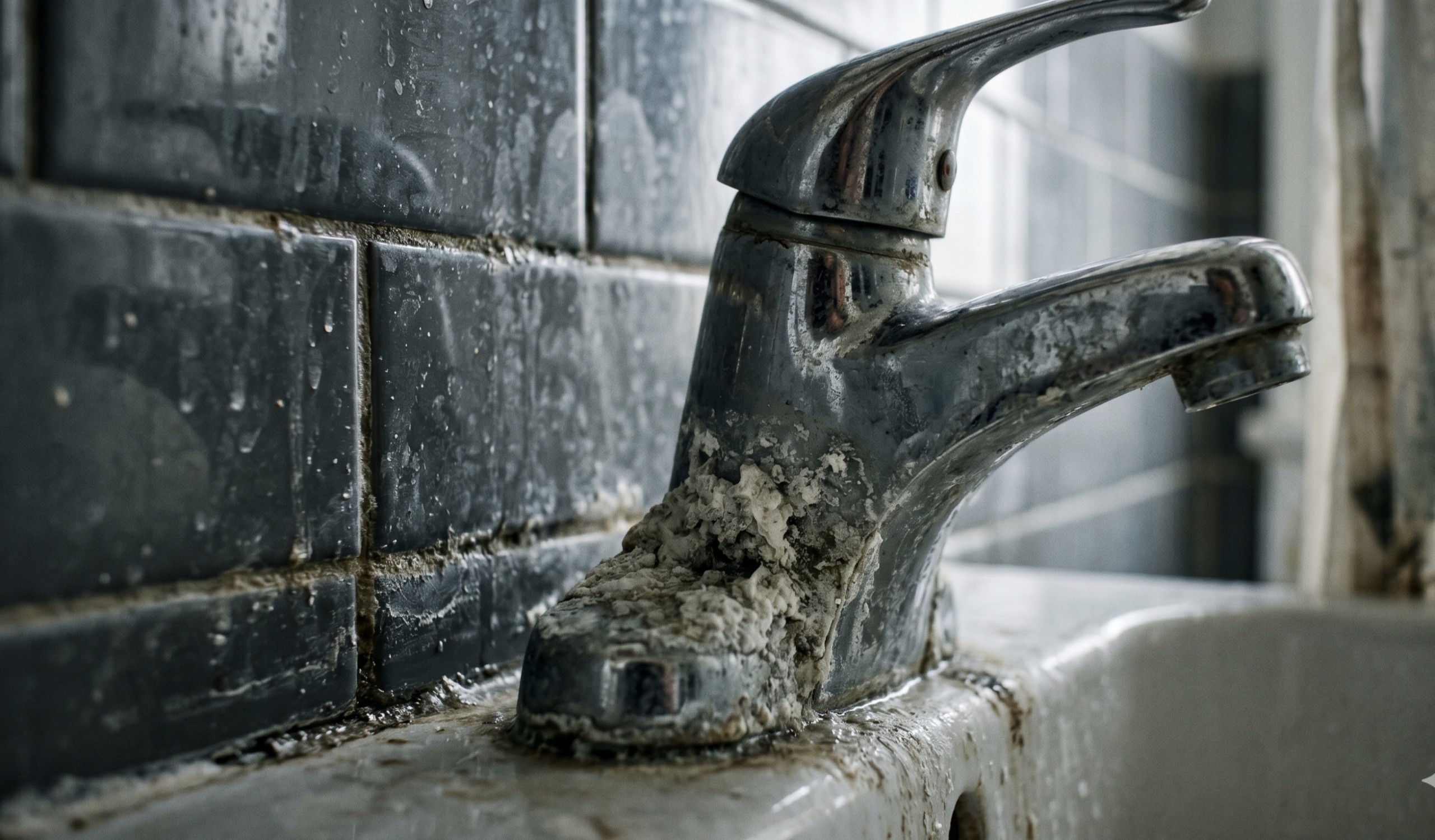
Hard water forms when water absorbs calcium and magnesium minerals as it moves through rock and soil. These dissolved minerals are what make water “hard” — and they’re behind the white buildup on your faucets, the soap that won’t lather, and the scale clogging your appliances.
Here’s a complete breakdown of where hard water comes from, what it does, and how to deal with it.
Hard Water: Key Facts at a Glance
| Topic | Quick Answer |
|---|---|
| Primary cause | Dissolved calcium and magnesium in water |
| Where it comes from | Groundwater passing through limestone, chalk, or dolomite |
| Most affected regions | Midwest, Southwest, Southeast U.S. |
| Common signs | White residue, soap scum, dry skin, spotty dishes |
| What causes stains | Mineral deposits left behind as water evaporates |
| How to test | Home test kit, soap test, or professional water test |
| How to treat | Water softener, descaler, or filtration system |
What Causes Water to Be Hard?
Water becomes hard when it picks up calcium (Ca²⁺) and magnesium (Mg²⁺) ions while filtering through underground rock formations — primarily limestone, chalk, and dolomite. These minerals dissolve readily into water, and the longer water stays in contact with mineral-rich rock, the harder it becomes.
Hardness is measured in:
- Grains per gallon (GPG) — most common in the U.S.
- Parts per million (PPM) or mg/L — used in lab reports
- Milligrams per liter (mg/L) — equivalent to PPM
| Hardness Level | GPG | PPM |
|---|---|---|
| Soft | 0–1 | 0–17 |
| Slightly hard | 1–3.5 | 17–60 |
| Moderately hard | 3.5–7 | 60–120 |
| Hard | 7–10.5 | 120–180 |
| Very hard | 10.5+ | 180+ |
Source: U.S. Geological Survey (USGS)
Calcium and magnesium are the two main culprits, but iron, manganese, and other trace minerals can also contribute to hardness-related problems like staining and buildup.
Two types of hardness exist:
- Temporary hardness — caused by calcium bicarbonate. It can be reduced by boiling, which converts the bicarbonate into insoluble calcium carbonate (the white flakes you see in a boiled kettle).
- Permanent hardness — caused by calcium sulfate and magnesium sulfate. Boiling won’t remove it; it requires a softener or filtration system.
Where Does Hard Water Come From and How Does It Enter Your Water Supply?
Hard water originates from groundwater — water that has percolated through layers of sedimentary rock over months or years. This is the same water that feeds wells, aquifers, springs, and many municipal water systems.
The process:
- Rain or snowmelt soaks into the ground
- Water moves slowly through limestone, chalk, or dolomite formations
- Carbon dioxide in the soil creates a mild carbonic acid
- That acid dissolves calcium and magnesium from the rock
- Mineral-laden water collects in aquifers and is drawn into wells or treatment plants
Surface water (lakes and rivers) is generally softer because it hasn’t spent as much time in contact with mineral-bearing rock. However, if that surface water drains through limestone-heavy terrain, it can still pick up significant hardness.
Municipal vs. well water:
- Municipal systems often draw from groundwater aquifers and may soften water before distribution — but not always. Hardness levels vary significantly by city and region.
- Private well water is almost always groundwater with no treatment. Hardness levels depend entirely on local geology.
Where Is Hard Water Found Most Often?
Hard water is common throughout most of the United States. According to the USGS, approximately 85% of U.S. homes have hard water to some degree.
Hardest water regions in the U.S.:
- Midwest: Indiana, Illinois, Ohio, Kansas, Nebraska — underlain by thick limestone deposits
- Southwest: Texas, Arizona, New Mexico, Nevada — alkaline soils and limited rainfall concentrate minerals
- Southeast: Florida, parts of Georgia and Tennessee — extensive karst limestone geology
- Rocky Mountain states: Colorado, Utah — high mineral content from sedimentary formations
Softer water regions:
- Pacific Northwest: Washington, Oregon — volcanic geology with less limestone
- New England: Maine, Vermont, New Hampshire — granite-dominated terrain that doesn’t dissolve as readily
Even within a single city, hardness levels can vary block by block depending on which aquifer or treatment plant supplies that area.
What Causes Hard Water Stains on Fixtures, Glass, and Appliances?
Hard water stains are mineral deposits — specifically calcium carbonate and magnesium carbonate — left behind when water evaporates. The water disappears, but the dissolved minerals stay put and accumulate over time.
Common stain types and where they appear:
| Stain Type | Appearance | Common Location |
|---|---|---|
| Limescale | White, chalky buildup | Faucets, showerheads, kettles |
| Soap scum | Gray/white film | Shower walls, tubs, glass doors |
| Water spots | White spots or rings | Glasses, dishes, mirrors |
| Rust-tinged scale | Orange or brown | Toilets, sinks (iron in water) |
Why stains get worse over time:
Each water droplet that evaporates leaves behind a tiny mineral deposit. Without regular cleaning, those deposits layer on top of each other and harden into a cement-like crust that becomes increasingly difficult to remove.
Heat accelerates the process. Hot water holds minerals in suspension, but as it heats further or cools and evaporates, those minerals precipitate out faster — which is why your kettle, water heater, and dishwasher tend to accumulate scale quickly.
What causes hard water stains on glass specifically?
Glass surfaces are especially vulnerable because water beads and evaporates in concentrated droplets. Shower glass and car windows often develop an etched appearance over time when mineral deposits aren’t removed and bond chemically with the glass surface.
How Can You Tell If You Have Hard Water at Home?
Several signs point to hard water without the need for any testing. Learn how to identify every major sign of hard water — from taste and texture to stains and buildup.
Common indicators:
- White or yellowish residue on faucets, showerheads, or around drains
- Soap that won’t lather — hard water minerals bind to soap and prevent foaming
- Spots on dishes and glassware after washing and drying
- Dry, itchy skin or dull hair after showering
- Reduced water pressure from scale-clogged pipes or showerheads
- Stiff, scratchy laundry after washing
- Metallic or chalky taste in drinking water
How to test for hard water:
- Home test kit — Available at hardware stores and online. Strips change color based on hardness level. Fast and inexpensive (~$10–$20).
- Soap test — Add a few drops of pure liquid soap (not detergent) to a water-filled bottle. Shake vigorously. Hard water produces little lather and a cloudy, milky appearance instead of clear bubbles.
- Lab or mail-in test — Provides precise hardness levels along with other water quality data. Recommended if you’re on a private well.
- Municipal water report — Your city’s annual Consumer Confidence Report (CCR) will include hardness data. Search “[your city] water quality report” or request one from your utility.
What Problems Can Hard Water Cause for Plumbing, Appliances, and Daily Use?
Hard water isn’t a health risk in most cases, but it causes real, measurable damage to your home and daily routines over time.
Plumbing and appliances:
- Scale buildup in pipes restricts flow and can eventually cause blockages. Older galvanized pipes are especially vulnerable.
- Water heaters lose efficiency as scale accumulates on heating elements. A 1/4-inch layer of scale can increase energy use by up to 40%, according to the Water Quality Research Foundation.
- Dishwashers and washing machines experience shortened lifespans. Internal components, valves, and hoses are prone to mineral-related wear.
- Showerheads and faucet aerators clog with scale and reduce water pressure over time.
Daily life and household costs:
- Soap and detergent use increases — hard water requires more product to achieve the same cleaning result
- Laundry fades faster — minerals in the wash water trap in fabric fibers, dulling colors and stiffening texture
- Skin and hair — minerals strip natural moisture barriers, which can worsen dry skin and leave hair brittle or flat
Is hard water dangerous to drink?
Moderately hard water is generally safe and is even a minor dietary source of calcium and magnesium. The World Health Organization (WHO) notes no convincing health risk from hard water consumption at typical levels. Very high hardness can affect taste and may be a concern for people with specific kidney conditions — consult your doctor if that applies to you.
Can Hard Water Be Reduced or Treated?
Yes. Several proven methods reduce or eliminate hardness depending on your budget, water usage, and hardness level.
1. Salt-based water softeners
The most effective solution for whole-home hard water. Uses an ion exchange process to swap calcium and magnesium ions for sodium ions. Requires periodic salt refills and generates a small amount of brine wastewater.
- Best for: Households with GPG 7+ or significant scale and appliance problems
- Not ideal for: People on low-sodium diets (a separate drinking water tap or RO system is recommended)
2. Salt-free water conditioners (template-assisted crystallization)
Changes the structure of minerals so they don’t stick to surfaces, without removing them from the water. No salt, no wastewater, no electricity needed.
- Best for: Moderately hard water, eco-conscious households, or those wanting low-maintenance options
- Limitation: Does not soften water in the traditional sense; effectiveness varies by hardness level
3. Electromagnetic/electronic descalers
Wrap-around devices that use electromagnetic fields to alter mineral behavior. Low cost and no maintenance, but evidence for effectiveness is mixed and largely anecdotal.
- Best for: Mild hardness, renters, or as a supplemental option
4. Reverse osmosis (RO) systems
Forces water through a semi-permeable membrane that removes minerals along with many other contaminants. Typically installed under the kitchen sink for drinking and cooking water.
- Best for: Improving drinking water quality alongside a whole-home softener
- Limitation: Produces a small amount of wastewater; not designed for whole-home use
5. Citric acid and descaling treatments
Not a prevention method, but useful for removing existing scale from appliances, kettles, and showerheads. Vinegar and commercial descalers work through the same acid-mineral reaction.
Quick comparison:
| Method | Removes Hardness? | Best For | Maintenance |
|---|---|---|---|
| Salt-based softener | Yes | Whole home, high hardness | Monthly salt refill |
| Salt-free conditioner | No (prevents scale) | Moderate hardness | Very low |
| Electronic descaler | Partially (debated) | Mild hardness | None |
| Reverse osmosis | Yes | Drinking water | Annual filter change |
| Descaling treatments | Removes existing scale | Spot treatment | As needed |
Conclusion
Hard water forms when groundwater absorbs calcium and magnesium from limestone and chalk formations underground. It enters your home through wells and municipal systems, leaves white scale on every surface it touches, and gradually degrades your plumbing, appliances, and water quality.
The good news: it’s one of the most straightforward water problems to identify and solve. A basic home test can confirm hardness levels in minutes, and the right treatment — whether a water softener, salt-free conditioner, or point-of-use filter — can eliminate most symptoms quickly.
Start with a water test, understand your hardness level, and match the solution to your household’s actual needs.
Frequently Asked Questions
Is hard water the same as contaminated water?
No. Hard water contains dissolved minerals — primarily calcium and magnesium — that are naturally occurring and generally safe. Contamination refers to harmful substances like bacteria, lead, or nitrates. Hard water can be a nuisance and cause appliance damage, but it’s a separate issue from water safety.
Can you soften hard water without a water softener?
For drinking and cooking, a reverse osmosis filter effectively removes hardness minerals. Boiling can reduce temporary hardness. For whole-home use, there’s no practical alternative that matches the effectiveness of a salt-based softener, though salt-free conditioners work well for scale prevention.
Does a water softener fix all hard water stains?
A softener prevents new mineral deposits from forming. Existing stains require manual removal with descaling agents or acidic cleaners like white vinegar or citric acid.
Why does my water feel slippery after a water softener is installed?
Soft water doesn’t carry the mineral ions that hard water does. Without those ions binding to soap, it rinses cleanly — which many people initially interpret as a slippery feeling. You’re actually feeling clean skin rather than a mineral residue.
How often should I test my water hardness?
Once a year is sufficient for most households on municipal water. Well water users should test annually for hardness and at least every two to three years for a full water quality panel, since groundwater conditions can shift.