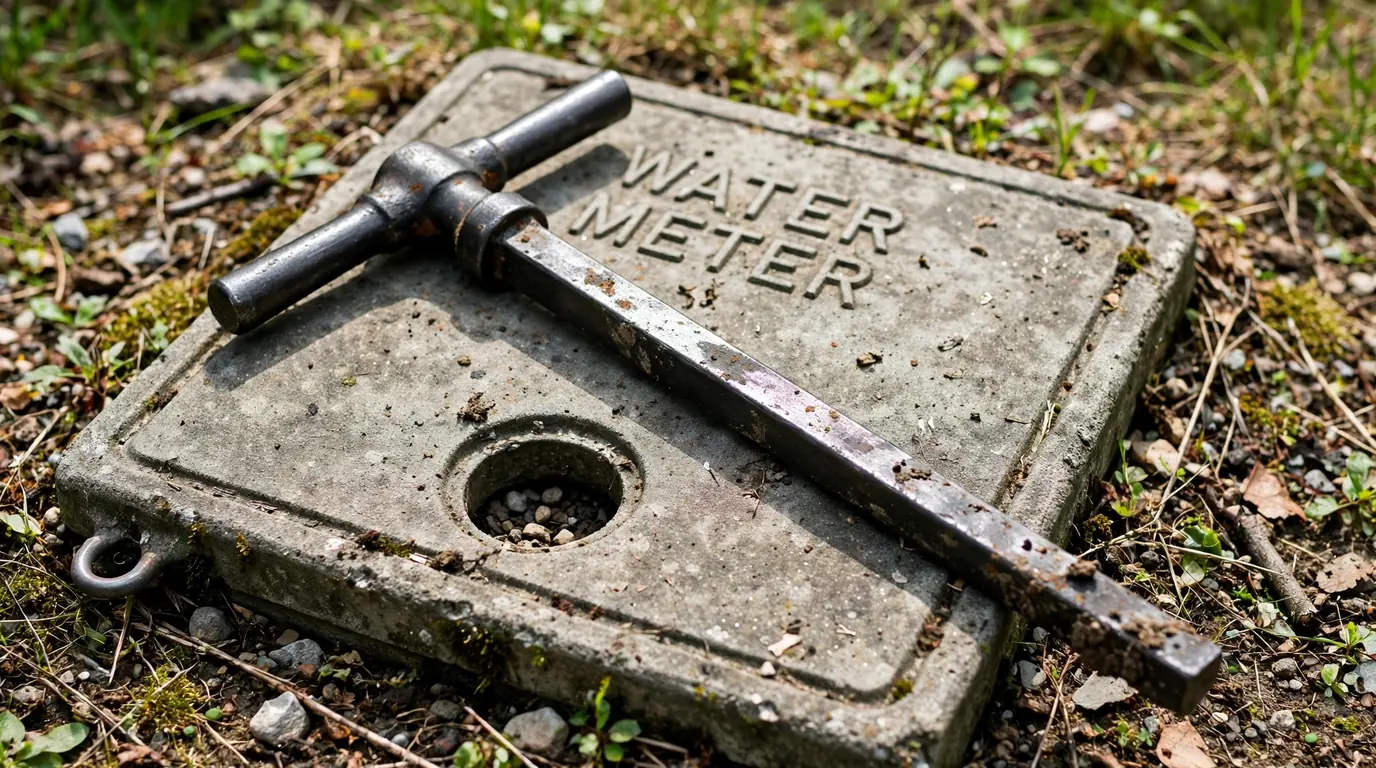
The short answer: a water key is a long steel tool that lets you reach down into a buried meter box and turn the shutoff valve for your water supply. The Bully Tools steel water key with T-style handle is one specific version of this tool — a solid steel shaft with a T-shaped handle at the top for grip and leverage, made to fit over the operating nut or fin of an underground valve. If you own a home, it is one of those tools you hope to never use and are very glad to have when you need it.
Most homeowners discover water keys the hard way: a pipe bursts at 11 p.m., water is pouring into the basement, and nobody can find the main shutoff. The interior shutoff valve — if the house even has an accessible one — is corroded shut. The backup option is the valve in the ground outside, usually in a meter box near the street or property line. That valve sits a foot or more below grade, in a dark concrete or plastic box, and you cannot reach it with a normal wrench. That is the exact job the water key was built for.
In This Guide
What a Water Key Actually Is
Strip away the brand names and a water key is a simple piece of leverage: a long shaft, a working end shaped to grip a valve, and a handle you can turn with both hands. The category goes by several names — water meter key, curb key, curb stop key, shutoff key — and they all describe the same basic job: operating a valve you cannot reach with your hands.
The valves these tools operate are the ones buried between your house and the street. Water reaches your home through a service line, and somewhere along that line there is a shutoff point — often called a curb stop — housed in a meter box or valve box below ground. The valve itself is a metal fitting with a raised fin, pentagon nut, or toggle that you turn to open or close the flow. The box lid sits flush with the lawn or sidewalk, and the valve stem can be anywhere from a few inches to several feet below the lid depending on how deep the line was buried and how much soil has built up over the years.
The T-style handle is the part that makes this particular tool comfortable to use. Instead of a plain bar or a loop, the handle forms a T — a crossbar at the top of the shaft that you grip with both hands. That shape does two things: it keeps your knuckles clear of the shaft while you turn, and it gives you a long lever arm, so a stiff valve that would defeat a short wrench turns with manageable effort. When you are standing over a meter box in the rain trying to stop a leak, that leverage is the whole game.
What the Bully Tools Steel Water Key Is Designed For
Bully Tools is a US-based hand tool brand known for heavy-duty steel construction — the kind of tools sold at farm supply and hardware retailers for people who expect equipment to survive hard use. Their steel water key with T-style handle follows that same philosophy: a solid steel shaft and a welded T-handle, built to take the torque of a stiff underground valve without bending.
The tool comes in multiple lengths — commonly listed as 12-inch, 36-inch, and 48-inch versions — so you can match the key to how deep your meter box or valve box sits. The working end is shaped to fit over the operating nut or fin of standard curb stop and meter valves. Steel matters here for a practical reason: underground valves corrode, seize, and fill with grit, and turning one can take real force. A lighter or thinner tool flexes under that load, which makes it harder to keep the working end seated on the valve — and a tool that slips off a valve under load is how knuckles get hurt and valve stems get rounded.
It is worth being clear about what this tool is not. It is not a universal plumbing wrench, it will not help with the small supply valves under your sinks, and it is not meant for gas meters — gas shutoff valves use different fittings and, around any suspected gas leak, the correct move is always to leave the area and call the gas company, not to start operating valves yourself. The water key has one job: reaching and turning buried water shutoff valves.
Practical tip: if you are buying one, measure your meter box depth first. Drop a tape measure or a straight stick into the open box and note the distance from ground level to the valve. Buy the length that reaches the valve with several inches of shaft still above grade — you need room to grip the T-handle and turn it comfortably.
When You Actually Need One
Nobody browses for a water key on a calm Saturday. People search for this tool in moments that share one feature: water is flowing somewhere it should not be, and the normal shutoff is not cooperating. Here are the situations where homeowners actually reach for one.
A burst pipe or major leak. This is the classic emergency. A supply line splits, a fitting lets go behind a wall, a washing machine hose bursts — and every minute of full-pressure flow is gallons of water damage. The interior main shutoff should stop the water, but in many homes that valve has not been touched in a decade and is frozen solid, or it is buried behind stored boxes in a crawlspace nobody can reach quickly. The curb stop outside becomes the backup plan, and the water key is how you operate it.
Plumbing repairs and fixture replacement. Any job that opens a pressurized line — replacing a water heater, installing a new fixture, reworking supply piping — starts with the water off. If the interior valve is unreliable, shutting off at the curb stop gives you a definite, verifiable stop. Many plumbers will ask whether you know where your meter box is before they start a big job, for exactly this reason.
Seasonal and vacant-home shutoffs. People who close up a vacation home for the winter, or leave a house vacant during a sale, often shut the water off at the curb stop as a precaution against freeze damage and undetected leaks. A water key makes that a five-minute job instead of a call to the utility.
New home orientation. If you just bought a house, finding the meter box and confirming you can operate the shutoff is one of the smartest first-week tasks there is. Do it on a dry afternoon, not during an emergency. Open the box, look at the valve, confirm the key fits. That ten minutes of preparation is what turns a future 2 a.m. crisis into a manageable inconvenience.
Choosing the Right Length
The Bully Tools steel water key with T-style handle is offered in several shaft lengths, and the right one depends entirely on your meter box depth. Too short and you cannot reach the valve at all; excessively long is workable but awkward, and the extra shaft makes it harder to feel whether the tool is seated properly on the valve.
| Length | Best For | Notes |
|---|---|---|
| 12-inch | Shallow valve boxes and meter pits where the valve sits close to the lid | Compact and easy to store; check your depth first — many curb stops sit deeper than this reaches |
| 36-inch | The most common residential situation — valves roughly two to three feet below grade | The safe middle choice if you have not measured; covers the majority of home meter boxes |
| 48-inch | Deep meter boxes, properties where grade has built up over the years | Reaches valves that shorter keys cannot; slightly harder to keep centered on the valve while turning |
If you are unsure, the 36-inch length is the reasonable default for a typical residential property — it reaches the valve depth found in most home meter boxes while staying short enough to control easily. But the genuinely correct answer is to measure your own box, because depth varies by municipality, soil conditions, and how long ago the line was installed. A tape measure and two minutes of your time beats a guess every time.
Practical tip: while you are measuring, take a photo of the inside of the meter box with your phone’s flashlight on. You will want to know what the valve looks like — fin, pentagon nut, or lever — before you are crouching over it in an emergency. Store the photo somewhere you can find it fast.
How to Use a T-Handle Water Key, Step by Step
Operating a curb stop is not complicated, but doing it in the right order prevents the two most common problems: a tool that will not seat on the valve, and a valve that will not budge. Work through these steps calmly.
1. Find and open the meter box. The box is usually near the street, sidewalk, or property line — a round or rectangular lid flush with the ground, often concrete, plastic, or cast iron. Lift the lid with a screwdriver, pry bar, or the lid hook if it has one. Some lids are heavy and some are stuck with soil; work them loose rather than yanking.
2. Clear the box. Meter boxes fill with dirt, leaves, roots, and insects. Scoop out enough debris to see the valve clearly. Gloves are worth wearing here — you will be reaching into a dark box that has been sitting undisturbed for years. A headlamp or a phone flashlight makes this much easier.
3. Identify the valve type. Look at what you are dealing with before you touch it. A curb stop with a raised fin or pentagon nut is what the water key’s working end is designed to grip. If you see a lever-style handle instead, that is a ball valve — it turns a quarter-turn and may need a different approach. Knowing which one you have determines how far you will be turning.
4. Seat the key. Lower the water key into the box and fit its working end squarely over the valve’s operating nut or fin. This is the step people rush, and it is the step that matters most. The tool must sit fully and squarely on the fitting — if it is cocked at an angle, it will slip the moment you apply torque. Wiggle it gently until you feel it settle into place.
5. Turn steadily. Grip the T-handle with both hands and turn with smooth, steady pressure. Do not jerk it. For a ball-valve style stop, the shutoff is a quarter-turn — the handle on the valve ends up perpendicular to the pipe. For older gate-style stops, it may take several full turns. If the valve has not moved in years, expect resistance at first; steady pressure usually wins where sudden force just breaks things.
6. Verify the water is off. Go inside and open a faucet. The flow should slow and stop. Do not assume the valve worked — verify it. If water is still flowing at full pressure, the valve may not be fully closed, or you may have turned the wrong fitting.
7. Turn it back on the same way. When the emergency is over, reopen the valve slowly. Opening a main valve too fast can send a pressure surge through the house plumbing — open it gradually, then check inside for leaks at fixtures and connections before calling the job done.
Mistakes to Avoid
Forcing a stuck valve. If steady, reasonable pressure does not move the valve, stop. Hanging your full body weight on a T-handle can snap an old valve stem, and a broken stem on a curb stop is a far bigger problem than the one you started with — it usually means a call to the water utility and possibly an excavation. A valve that will not budge under firm, steady pressure is a valve you should leave for the utility crew, who have the equipment to deal with it.
Using the key on the wrong fitting. Meter boxes sometimes contain more than one fitting — the meter itself, the utility-side valve, and your side’s valve. The water key should go on the customer-side shutoff. If you are not sure which is which, that is a sign to call the utility rather than guess.
Skipping the verification step. Turning a valve and assuming the water is off has caused its share of indoor flooding. It takes thirty seconds to open a faucet and confirm. Always confirm.
Storing it somewhere you will not find it. A water key buried in the back of a cluttered garage is barely better than not owning one. Keep it somewhere obvious and memorable — hanging on a garage wall near the door, or with your other emergency supplies. Tell everyone in the household where it is.
For more home maintenance and DIY reading, The Modern Post publishes practical home and lifestyle guides worth a look.
What Not to Touch
An honest guide has to include the boundaries. In many municipalities, the curb stop itself — and everything on the street side of the meter — technically belongs to the water utility, and local rules about who may operate it vary. Some utilities do not mind homeowners using the customer-side valve in an emergency; others prefer you call them. It is worth a two-minute check of your utility’s policy before you ever need the answer at midnight. When in doubt, call the utility’s emergency line — they would rather hear from you than dig up a broken valve.
Also keep the water key strictly to water. It is not a gas valve tool, it is not a fire hydrant wrench, and it is not for opening utility vaults or electrical boxes. Those fittings are restricted for reasons that involve public safety and, in some cases, the law. The water key earns its place in your garage by doing its one job well.
FAQs
What is a Bully Tools steel water key with T-style handle used for?
It is used to reach down into a buried meter box or valve box and turn the water shutoff valve (curb stop) for a property. The long steel shaft reaches the valve below grade, the working end grips the valve’s operating nut or fin, and the T-style handle provides the leverage to turn it.
Which length of water key should I buy?
Match the length to your meter box depth. The tool is commonly available in 12-inch, 36-inch, and 48-inch lengths. Measure from ground level to the valve inside your open meter box and choose a length that reaches it with several inches of shaft above grade for a comfortable grip. For most residential boxes, the 36-inch length is a solid middle choice, but measuring first is always better than guessing.
How do I know if the valve is fully closed?
Go inside and open a faucet after turning the valve. If the flow slows and stops, the valve is closed. Never assume — a valve that feels like it turned may not have seated fully, especially an old one. Verification takes seconds and prevents surprises.
Can I use a water key on a gas meter?
No. Gas meter valves use different fittings, and operating gas equipment without training is dangerous. If you smell gas or suspect a gas leak, leave the area and call your gas company’s emergency line or emergency services. Do not operate any valves yourself.
What if the curb stop valve will not turn?
Apply firm, steady pressure — never sudden force. If it does not move, stop and call your water utility. Forcing a seized valve can break the stem, turning a manageable situation into an excavation job. The utility has the tools and the authority to deal with stuck valves.
Conclusion
The Bully Tools steel water key with T-style handle is a simple tool with a specific job: giving a homeowner the reach and leverage to operate a buried water shutoff valve. You buy the length that matches your meter box, you learn where the box is on a calm day, and you keep the key somewhere you can find it in the dark. That is the whole strategy. The tool itself will probably spend years hanging quietly in your garage — and on the one night you need it, that quiet reliability is exactly what you will be grateful for.
Read Also: U.S. Cellular Login (2026 Guide): Sign In, Pay Bills & the T-Mobile Move