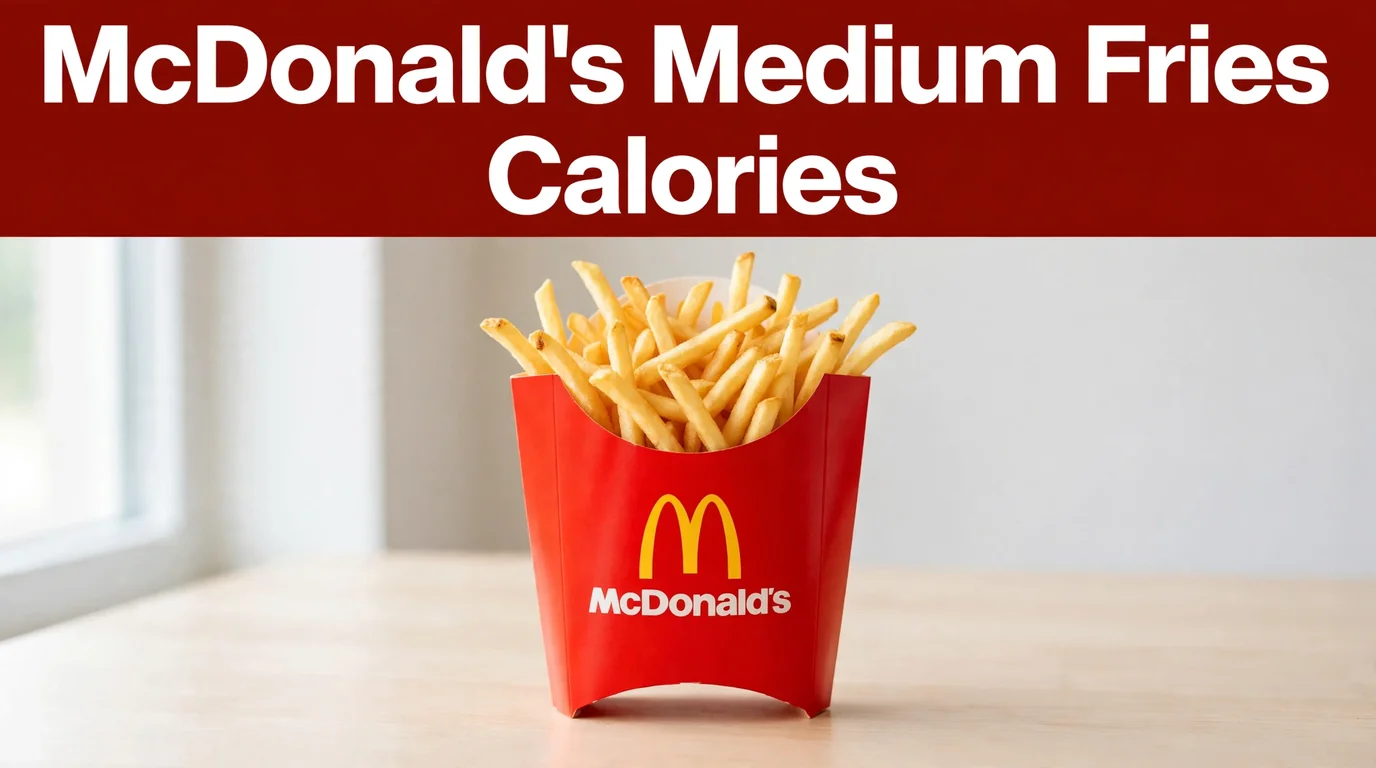
McDonald’s World Famous Fries are one of the most ordered sides in the world, and the medium is the default size that comes with most meals. So it is no surprise that so many people search for the same simple question about McDonald’s medium fries calories: how many calories are in a medium fries?
The short answer: a McDonald’s medium fries contains 320 calories. A standard medium serving weighs about 111 grams and also contains 15 grams of total fat, 43 grams of carbohydrates, 4 grams of dietary fiber, 5 grams of protein, and 260 milligrams of sodium. That is roughly 16 percent of a standard 2,000-calorie daily diet, from the fries alone.
More Information: How Often Does a Lunar Eclipse Happen? Explained Simply
That single number only tells part of the story, though. The calories change a lot between sizes, the fat and sodium add up faster than most people expect, and the fries are rarely eaten on their own — they usually arrive next to a burger and a drink, which is where the meal’s total really climbs. This guide gives you the full nutrition facts for a medium fries, compares every size side by side, explains what those numbers actually mean for your day, and shares practical ways to enjoy the fries without letting them take over your meal.
IN THIS GUIDE
This guide starts with the headline calorie count and the full nutrition table, then compares the small, medium, large and kids sizes, looks at what the calories are made of, explains where the numbers come from and why they can vary, and finishes with realistic ways to fit fries into a balanced day and answers to the questions people ask most often.
The Short Answer: McDonald’s Medium Fries Calories
A McDonald’s medium fries has 320 calories, according to McDonald’s published nutrition information for its United States menu. The figures below are the standard values for a medium serving, and they are the numbers McDonald’s lists in its own nutrition materials and nutrition calculator.
| Nutrient | Medium fries |
|---|---|
| Serving size | About 111 g |
| Calories | 320 |
| Total fat | 15 g |
| Saturated fat | 2 g |
| Trans fat | 0 g |
| Cholesterol | 0 mg |
| Sodium | 260 mg |
| Total carbohydrates | 43 g |
| Dietary fiber | 4 g |
| Total sugars | 0 g |
| Protein | 5 g |
| Potassium | 650 mg |
Practical tip: nutrition figures are updated from time to time, and values can vary slightly between restaurants depending on preparation and portioning. If you need the current figure for a medical or strictly managed diet, check McDonald’s official nutrition calculator before you order rather than relying on any single article, including this one.
McDonald’s Medium Fries Calories by Size
The medium sits in the middle of the range, and the jump between sizes is bigger than it looks. Going from a small to a large adds roughly 250 calories — almost as much as the medium itself. Here is how the sizes compare, using McDonald’s standard published values for the United States menu.
| Size | Serving weight | Calories | Total fat | Carbs | Sodium |
|---|---|---|---|---|---|
| Kids | About 38 g | 110 | 5 g | 15 g | 80 mg |
| Small | About 71 g | 230 | 11 g | 31 g | 180 mg |
| Medium | About 111 g | 320 | 15 g | 43 g | 260 mg |
| Large | About 154 g | 480 | 22 g | 66 g | 400 mg |
A few things stand out in that table. First, the medium has about 90 calories more than the small, which is the price of roughly half again as many fries. Second, the large has about 160 calories more than the medium — a jump of fifty percent for one size step. Third, sodium climbs steeply too: the large carries about 400 milligrams, which is a meaningful share of the sodium most people aim for in a whole day, from a side dish alone.
Practical tip: if you love the fries but want to keep the meal lighter, dropping from a medium to a small saves around 90 calories, 4 grams of fat and 80 milligrams of sodium, and most people find a small is still enough fries to enjoy. Dropping from a large to a medium saves around 160 calories, which is the single easiest cut in the whole meal.
What Are McDonald’s Medium Fries Calories Made Of?
Calories are not all the same, and it helps to know where these 320 come from. Roughly speaking, a little under half of the calories in a medium fries come from fat and a little over half from carbohydrates, with a small amount from protein.
Fat: 15 Grams
The fat comes mostly from the oil the fries are cooked in. Of the 15 grams of total fat, about 2 grams are saturated fat, and trans fat is listed at zero. That is a moderate amount of fat for a side dish, but it is worth remembering that fat is the most calorie-dense nutrient — it carries about nine calories per gram, compared with about four per gram for carbohydrates and protein. That is why a modest-looking portion of fries can hold more calories than people expect.
Carbohydrates: 43 Grams
Most of the carbohydrate comes from the potato itself, in the form of starch. The fries contain about 4 grams of dietary fiber and no added sugar, which means the carbohydrates are mostly fast-digesting starch. In plain terms, fries give you quick energy rather than the slow, steady energy you get from foods that are high in fiber and protein.
Protein: 5 Grams
Five grams of protein is a small amount, and it is not enough to make fries a meaningful source of protein. A meal that is built around fries alone will not keep you full for long, which is one reason people often feel hungry again fairly soon after a fries-heavy meal.
Sodium: 260 Milligrams
The salt is added after frying, and the amount can vary a little from restaurant to restaurant and even from batch to batch. At 260 milligrams, a medium fries delivers around a tenth of the daily sodium limit that many health authorities use as a general reference. That is not extreme on its own, but it adds up quickly when the rest of the meal is salty too.
What Is in McDonald’s Fries?
McDonald’s fries are made from potatoes, vegetable oil, salt, and a flavoring that gives them their familiar taste. The oil is a blend of vegetable oils, and the fries are cooked in it until they are crisp outside and soft inside. The seasoning is simple: salt, added after the fries come out of the fryer.
One ingredient detail matters for some diners. The natural beef flavor used in the fries contains hydrolyzed wheat and milk, which means the fries contain wheat and milk allergens. They are not suitable for people with a wheat or milk allergy, and because of the beef flavoring they are not considered vegetarian or vegan by many diners, even though they are made from potatoes. If allergens or a vegetarian diet matter to you, check the current allergen information on McDonald’s official channels before ordering, because recipes and suppliers can change.
Practical tip: if you are sensitive to salt, you can ask for fries without salt. Restaurants can often make a fresh batch to order without the added salt, though it may take a couple of extra minutes. You lose the salty finish, but you also lose a chunk of the sodium.
How Medium Fries Fit Into a Whole Meal
Fries are almost never the whole meal, and that is where the numbers really matter. A medium fries on its own is 320 calories, but a typical meal adds a main item and a drink, and the total can easily reach two or three times the fries alone.
Think about the structure of the meal rather than any single item. The burger or sandwich is usually the biggest source of calories and the main source of protein. The fries add carbohydrates, fat and salt. A sugary soft drink adds calories without adding fullness. Swap the drink for water or an unsweetened option and the meal gets lighter without feeling any smaller, because a drink does not change how full the food makes you feel.
It is also worth thinking about how often fries appear in your week. One medium fries as an occasional treat is a very different thing from fries with lunch every day. The calories from a daily medium fries add up to more than 2,000 extra calories over a week — roughly the energy in a full day’s food for many adults — even before the rest of the meal is counted. That weekly view is often more useful than the single-meal view, because it shows how a small daily habit turns into a big number.
Practical tip: if you are sharing a meal with someone, consider ordering one medium fries to share instead of one each. You both still get the taste you came for, and each person eats roughly half the calories, fat and sodium. Sharing is the easiest portion control there is, because it does not feel like a sacrifice.
Medium Fries vs Other Fast Food Fries
People often wonder how McDonald’s fries compare with the competition. Direct comparisons are tricky because serving sizes differ between chains, but a few general patterns hold. McDonald’s medium fries, at 320 calories, sit in the middle of the fast-food range for a medium serving. Some chains’ medium fries run higher — a few list medium servings in the high 300s — while others are close to McDonald’s. The differences usually come down to portion weight and how much oil the fries absorb during cooking, not to any secret recipe.
What matters more than the brand is the size you order. A large fries at almost any chain will outrank a medium at any other chain, because portion size is the biggest single driver of the calorie count. If you are comparing menus, compare the same size, and compare the serving weight as well as the calories — a “medium” is not a standard unit, and one chain’s medium can be noticeably bigger than another’s.
How McDonald’s Works Out the Calorie Count
The numbers on a nutrition panel are not guessed. They are based on standard recipes, standard portion weights, and laboratory analysis of the finished product as it is normally prepared. McDonald’s publishes the figures through its nutrition calculator and nutrition documents, which is where the 320-calorie figure for a medium fries comes from.
That also explains why the number can vary a little in real life. A serving that is scooped generously will weigh more and carry more calories. A batch that spends longer in the oil can absorb a little more fat. Extra salt adds sodium without adding calories, but it changes the nutrition picture all the same. None of this means the published figure is wrong — it means it describes a standard serving, and your actual serving may be a little above or below it.
It is also why the published figures change occasionally. McDonald’s has updated its fries nutrition numbers over the years as recipes, oils, and portion weights have changed. Older documents list different figures — for example, some older nutrition sheets show a medium fries at a higher calorie count with a different serving weight — which is why you will see different numbers quoted in older articles. The 320-calorie figure reflects the current standard United States serving of about 111 grams. When in doubt, the current official nutrition calculator is the best source.
More Information: Jimmy John’s Catering: Menu, Prices and How to Order
Easy Ways to Enjoy Fries With Fewer Calories
You do not have to give up fries to keep the calories sensible. Small changes work better than strict rules, because they are changes you will actually keep.
Order a Smaller Size
This is the simplest move. A small fries saves around 90 calories compared with a medium, and a kids size saves around 210. If you are ordering fries as a side to a filling main, the smaller portion is often plenty.
Share the Fries
Splitting a medium between two people halves the calories each person eats, and it works especially well when everyone at the table has their own main item. Ask for an extra empty carton or a tray if you want to split them neatly.
Skip the Extra Sauces
Dipping sauces add calories, sugar, fat or salt depending on the sauce, and it is easy to use more than one packet without noticing. If you like a dip, use one packet and enjoy it slowly rather than opening two or three by habit.
Pair Fries With a Lighter Main
If fries are the part of the meal you care about most, balance them with a lighter main — for example a grilled option or a smaller sandwich — instead of pairing them with the heaviest item on the menu plus a large sugary drink. The meal still feels complete, and the total stays much lower.
Drink Water
Water adds no calories and helps with the thirst that salty food creates. A sugary drink can add as many calories as the fries themselves, so swapping it out is often the biggest single saving in the meal, and it is one most people barely notice.
Make It an Occasional Treat
Frequency matters as much as portion size. Fries once a week as a treat are a different pattern from fries every day. If you eat them often, cutting back to a few times a week makes a bigger difference to your weekly calories than any single swap.
Frequently Asked Questions
How many calories are in a McDonald’s medium fries?
A McDonald’s medium fries contains 320 calories, with 15 grams of total fat, 43 grams of carbohydrates, 5 grams of protein and 260 milligrams of sodium, based on McDonald’s standard published nutrition information for the United States.
How many calories are in a McDonald’s small fries?
A small fries contains 230 calories, with 11 grams of total fat, 31 grams of carbohydrates and 180 milligrams of sodium. That is about 90 calories less than a medium.
How many calories are in a McDonald’s large fries?
A large fries contains 480 calories, with about 22 grams of total fat, 66 grams of carbohydrates and 400 milligrams of sodium. That is about 160 calories more than a medium.
Are McDonald’s fries vegan?
McDonald’s fries in the United States are not considered vegan or vegetarian by many diners, because the natural beef flavor used in them contains hydrolyzed wheat and milk. They also contain wheat and milk allergens, so people with those allergies should check current allergen information before ordering.
Do McDonald’s fries contain gluten?
The fries contain wheat through the natural beef flavoring, so they are not a gluten-free choice. Anyone avoiding gluten should check McDonald’s current allergen guide or ask in the restaurant.
Why do different websites list different calorie counts for medium fries?
McDonald’s has updated its recipes, oils and portion weights over the years, so older nutrition documents show different figures. The 320-calorie figure reflects the current standard United States medium serving of about 111 grams. Values can also vary slightly by restaurant and preparation, and the official nutrition calculator carries the current numbers.
How much sodium is in a medium fries?
A medium fries contains 260 milligrams of sodium. Asking for fries without salt can reduce that, though the restaurant may need a couple of minutes to prepare a fresh batch.
Are McDonald’s fries healthy?
Fries are best thought of as an occasional food rather than an everyday staple. They provide quick energy from starch and fat, with modest fiber and protein and a fair amount of sodium. Enjoyed in a reasonable portion, alongside a balanced meal and not every day, they fit into most diets without a problem.
Conclusion
A McDonald’s medium fries contains 320 calories, along with 15 grams of fat, 43 grams of carbohydrates, 5 grams of protein and 260 milligrams of sodium in a serving of about 111 grams. It sits between the small at 230 calories and the large at 480, and the step up to a large costs about 160 extra calories — a bigger jump than many people expect.
The number itself is not the whole story. What matters is the size you choose, how often fries show up in your week, and what you pair them with. A smaller portion, a shared serving, water instead of a sugary drink, and a lighter main can keep the meal enjoyable while keeping the calories in check. And if you ever need the very latest figure, McDonald’s own nutrition calculator is the place to check, because the numbers are updated as recipes and portions change.
Read Also: Lee Women’s Flex Motion Straight Leg Jeans (2026 Guide)