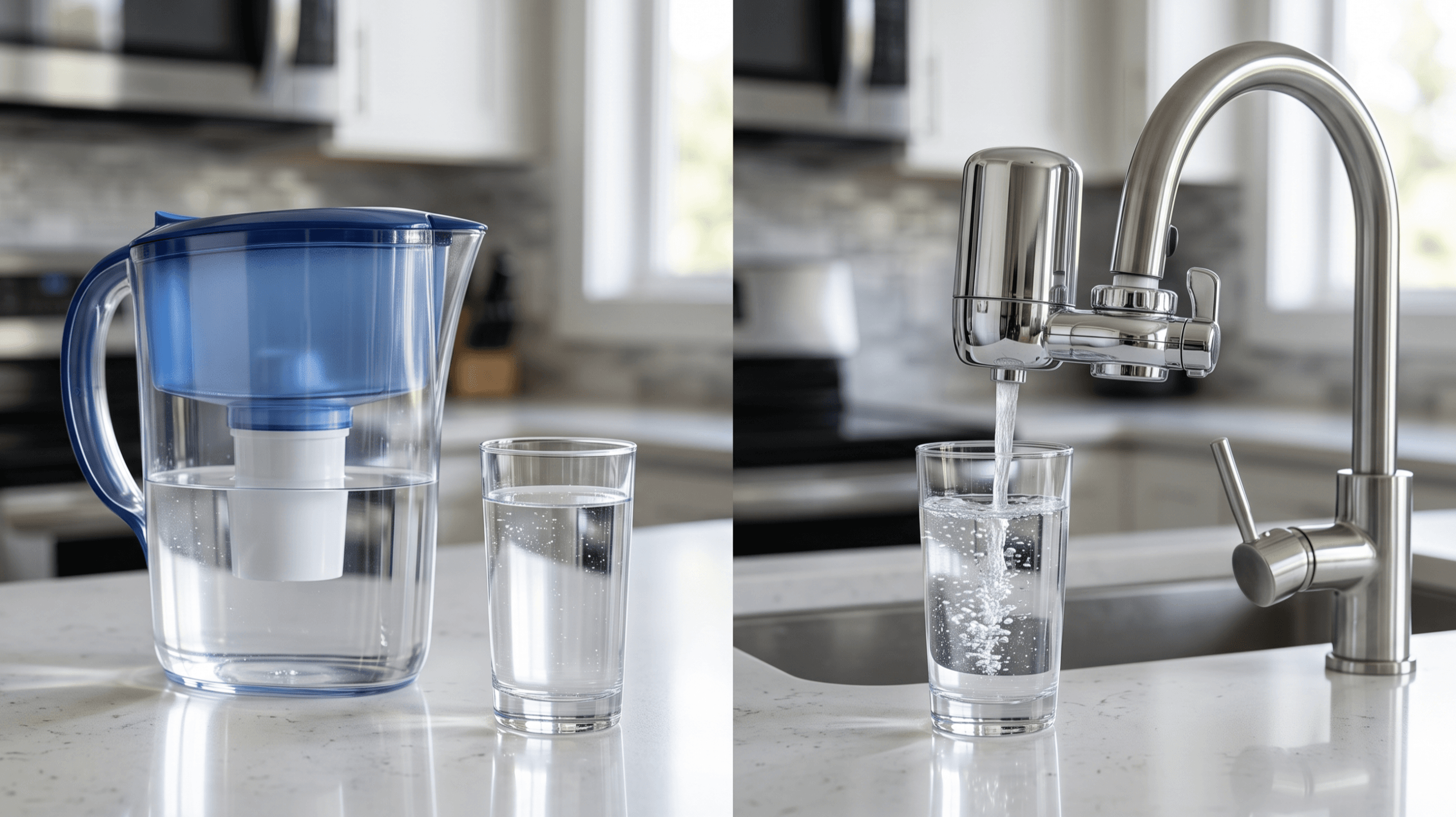
Both water filter pitchers and faucet filters use activated carbon to remove the chlorine, sediment, and organic compounds that make tap water taste off. The difference in taste comes down to how each system is designed — and how well it matches your specific water conditions.
A pitcher filter works slowly, using gravity to pass water through a carbon cartridge. A faucet filter works under water pressure, pushing water through a solid carbon block at the tap. Each approach has real trade-offs in taste, filtration depth, and daily convenience. Understanding those trade-offs is the fastest way to pick the right one for your kitchen.
Why Tap Water Tastes the Way It Does
Most municipal water is treated with chlorine or chloramines to kill bacteria and pathogens. Those disinfectants do their job, but they leave behind a chemical taste and smell — the flat, slightly bleach-like quality that makes tap water less appealing than bottled water.
Other compounds also affect taste: chloramines (a blend of chlorine and ammonia used by many water utilities as a longer-lasting disinfectant), volatile organic compounds (VOCs), sediment, and dissolved minerals. Some of these affect odor more than flavor, but the result is the same — water that doesn’t taste clean. If your tap water has a metallic edge, that could be coming from your pipes rather than the water supply itself.
Activated carbon filtration targets most of these compounds. Both pitchers and faucet filters use some form of it. The key variable is contact time — how long the water stays in contact with the carbon media. Longer contact time removes more contaminants and produces cleaner-tasting water.
How Pitcher Filters Work
A pitcher filter uses gravity to pull water through a carbon cartridge, typically granular activated carbon (GAC) combined with ion exchange resin. Water is poured into an upper reservoir, drips slowly through the filter, and collects in a lower chamber ready to drink.
The slow, gravity-driven flow is actually an advantage for taste. Water spends more time in contact with the carbon media, which gives it more opportunity to adsorb chlorine and organic compounds. Most pitcher filters carry NSF/ANSI Standard 42 certification, which covers taste and odor reduction.
Where pitchers perform well for taste:
- Reducing chlorine taste and odor from chlorinated municipal water
- Removing earthy or musty compounds (geosmin, 2-methylisoborneol) that cause “pond water” flavors
- Improving the flat, metallic taste caused by sediment or low-level pipe corrosion
Where pitchers fall short:
- Standard pitcher filters using GAC cannot effectively reduce chloramines — the alternative disinfectant used by a growing number of water utilities. If your utility uses chloramines and your Brita doesn’t seem to be helping anymore, that’s likely why.
- Pitcher filters typically handle 40–50 gallons per cartridge, meaning the filter media saturates relatively quickly in households with higher water use.
- Some entry-level pitcher filters add carbon particles or microplastics to the water during the first several uses. Discarding the first two or three pitchers when starting with a new cartridge reduces this risk.
For a deeper look at how pitcher filters specifically target chlorine, this breakdown of how water filter pitchers remove chlorine explains the adsorption process in detail.
How Faucet Filters Work
A faucet filter attaches directly to the tap and uses water pressure to push water through a carbon block cartridge. Most models include a bypass valve so you can switch between filtered and unfiltered flow for tasks like washing dishes.
Solid carbon block filters — the type used in most quality faucet filters — are denser than the granular carbon in pitchers. That density creates more surface area and can trap a broader range of contaminants, including sediment, some heavy metals, and select pesticides depending on the model.
Where faucet filters perform well for taste:
- Instant filtered water on demand — no waiting for gravity to do the work
- Carbon block construction filters sediment and fine particles that affect both taste and texture
- Higher-end models with catalytic carbon can reduce chloramines, which standard pitcher filters cannot
Where faucet filters fall short:
- Water pressure is required for the filter to function. If your household has persistently low water pressure, a pressure-dependent faucet filter may not perform optimally. Low pressure reduces the effectiveness of the carbon block and can slow flow to a trickle. Issues like a partially closed shutoff valve or a clogged aerator are worth ruling out first.
- Faucet filters are not compatible with all faucet types. Pull-out, pull-down, and spray faucets typically cannot accommodate a standard mount filter.
- Cartridge capacity varies — most budget models filter 100–200 gallons before replacement, while higher-end units can reach 300+ gallons.
Head-to-Head: Taste Comparison
| Factor | Pitcher Filter | Faucet Filter |
|---|---|---|
| Chlorine removal | Strong | Strong |
| Chloramine removal | Weak (standard GAC) | Better (with catalytic carbon) |
| Contact time | Longer (gravity-fed) | Shorter (pressure-driven) |
| Sediment removal | Moderate | Better (carbon block) |
| Water temperature | Cold (stored in fridge) | Room temperature |
| Filter media quality | Varies by brand | Varies by model |
| Taste consistency | Degrades as filter saturates | Degrades as cartridge ages |
On paper, a quality faucet filter using a solid carbon block with catalytic carbon edges out a standard pitcher for contaminant range. In practice, however, taste perception is also influenced by water temperature — chilled water from a pitcher stored in the refrigerator often tastes cleaner to most people than room-temperature filtered water from a faucet, even if the faucet filter has technically removed more contaminants.
Blind taste tests with filtered water at matched temperatures tend to produce similar results between the two system types when both are certified to NSF/ANSI 42. The bigger taste differentiator is often filter freshness — a saturated or overdue cartridge in either system degrades output quality noticeably.
The Chloramine Problem: Why Your City’s Water Treatment Method Matters
Many water utilities across the U.S. have shifted from chlorine to chloramines as their primary disinfectant. Chloramines are more stable, travel further through pipe systems, and don’t evaporate as quickly — but they’re also harder to remove with standard activated carbon.
If your tap water tastes flat or chemical even after filtering with a pitcher, check whether your utility uses chloramines. Contact your local water supplier or check their annual water quality report for disinfectant type.
- Standard GAC pitcher filters: largely ineffective against chloramines
- Catalytic carbon (faucet filters, under-sink units): significantly more effective against chloramines
- Whole-house carbon systems: the most thorough solution for chloramine-heavy water
Knowing your water’s disinfectant type changes the filter selection entirely.
For households on well water or in areas with known mineral or contaminant issues, the comparison between pitchers and faucet filters may be secondary to addressing the specific water quality challenges that well and off-grid systems present.
Filter Lifespan and Taste Degradation
Both systems decline in taste performance as the filter media approaches capacity. The difference is how quickly that happens and how easy it is to track.
Pitcher filters typically need cartridge replacement every 40–50 gallons, which translates to roughly every 4–6 weeks for a household of two. Some higher-end pitchers extend this to 150 gallons. Most include a timer indicator, though these track time elapsed rather than actual gallons filtered.
Faucet filters typically last 100–300 gallons depending on the model, often 2–3 months. Households with higher water use cycle through cartridges faster.
In both cases, using an overdue filter is counterproductive. Old filter media can release previously trapped contaminants back into the water, and depleted carbon simply stops adsorbing new ones. Setting a calendar reminder tied to actual usage rather than just time elapsed is more reliable. For fridge filters — which operate on a similar principle — replacement timing follows the same logic.
Cost and Practicality
Neither system requires permanent installation or any plumbing changes. That makes both accessible options for renters, apartment dwellers, or anyone who wants improved drinking water without the cost of an under-sink or whole-house system.
Pitcher filters:
- Upfront cost: $20–$60 for the pitcher
- Ongoing cost: $6–$15 per replacement cartridge (every 4–8 weeks)
- No installation, no tools, portable, fridge-compatible
Faucet filters:
- Upfront cost: $25–$80 for the unit
- Ongoing cost: $15–$30 per replacement cartridge (every 2–3 months)
- Quick installation (typically 5 minutes, no tools), but requires a compatible faucet
Over a 12-month period, faucet filter cartridges often cost less on a per-gallon basis than pitcher cartridges, given their longer service life. The gap narrows or reverses for low-use households where a pitcher cartridge lasts longer than average.
Both approaches are significantly cheaper than purchasing bottled water long-term, and both reduce plastic waste — a meaningful consideration for households focused on sustainable water habits. For broader strategies around water conservation and reducing household water-related waste, the choice of filtration system is one piece of a larger picture.
When to Choose a Pitcher
- You want chilled filtered water stored in the refrigerator
- Your household uses 1–2 gallons of drinking water per day or less
- You rent and can’t modify the faucet, or have a pull-out/pull-down tap
- You want a portable option for travel, a dorm room, or a second location
- Your city uses chlorine (not chloramines) as its primary disinfectant
When to Choose a Faucet Filter
- You want filtered water immediately at the tap without waiting for gravity filtration
- Your household uses 3+ gallons of drinking water per day (cooking, coffee, filling bottles)
- You use chloramine-treated water and need catalytic carbon for effective removal
- You want filtered water for cooking directly from the tap, not just for drinking
- Your home has adequate water pressure and a compatible standard faucet
FAQ
Does a pitcher filter or faucet filter remove more contaminants?
Faucet filters that use solid carbon block or catalytic carbon cartridges generally remove a broader range of contaminants than standard pitcher filters. This includes better performance against chloramines, select pesticides, and fine sediment. However, the actual performance of any filter depends on its specific certifications — NSF/ANSI 42 covers taste and odor, while NSF/ANSI 53 covers health-related contaminants. A well-certified pitcher can outperform a basic faucet filter on specific contaminants, so certification labels matter more than filter type alone.
Why does my pitcher-filtered water still taste like chlorine?
The most likely explanation is that your municipal water system uses chloramines rather than chlorine. Standard granular activated carbon (GAC) pitchers — including most Brita and basic PUR models — are not effective at breaking down chloramine bonds. Switching to a filter specifically rated for chloramine reduction, or upgrading to a faucet filter with catalytic carbon, typically resolves this issue.
Can I use both a pitcher filter and a faucet filter at the same time?
Yes, and many households do. A faucet filter handles on-demand filtered water for cooking and filling glasses, while a pitcher in the refrigerator provides consistently chilled water for drinking. Running water through both filters in sequence doesn’t meaningfully improve taste once both filters are functioning properly — the benefit of using both comes from convenience and redundancy, not double filtration.
Does water temperature affect how filtered water tastes?
Yes. Chilled water suppresses the perception of residual mineral tastes and some chemical compounds, which is part of why refrigerator-stored pitcher water often seems to taste cleaner than room-temperature filtered water from a faucet — even when contaminant removal levels are similar. If taste is a priority, storing faucet-filtered water in a sealed pitcher or glass bottle in the refrigerator before drinking can close much of the perceived taste gap.
How do I know when my filter needs replacing?
The most reliable indicator is a return of the taste or odor the filter was originally eliminating — chlorine smell, flat taste, or chemical notes coming back into the water signal that the media is saturated. Manufacturer timelines (weeks or gallons) are useful guides, but actual replacement timing should track usage volume, not just calendar time. Households that filter large amounts of water daily will exhaust cartridges faster than the average timeline suggests.