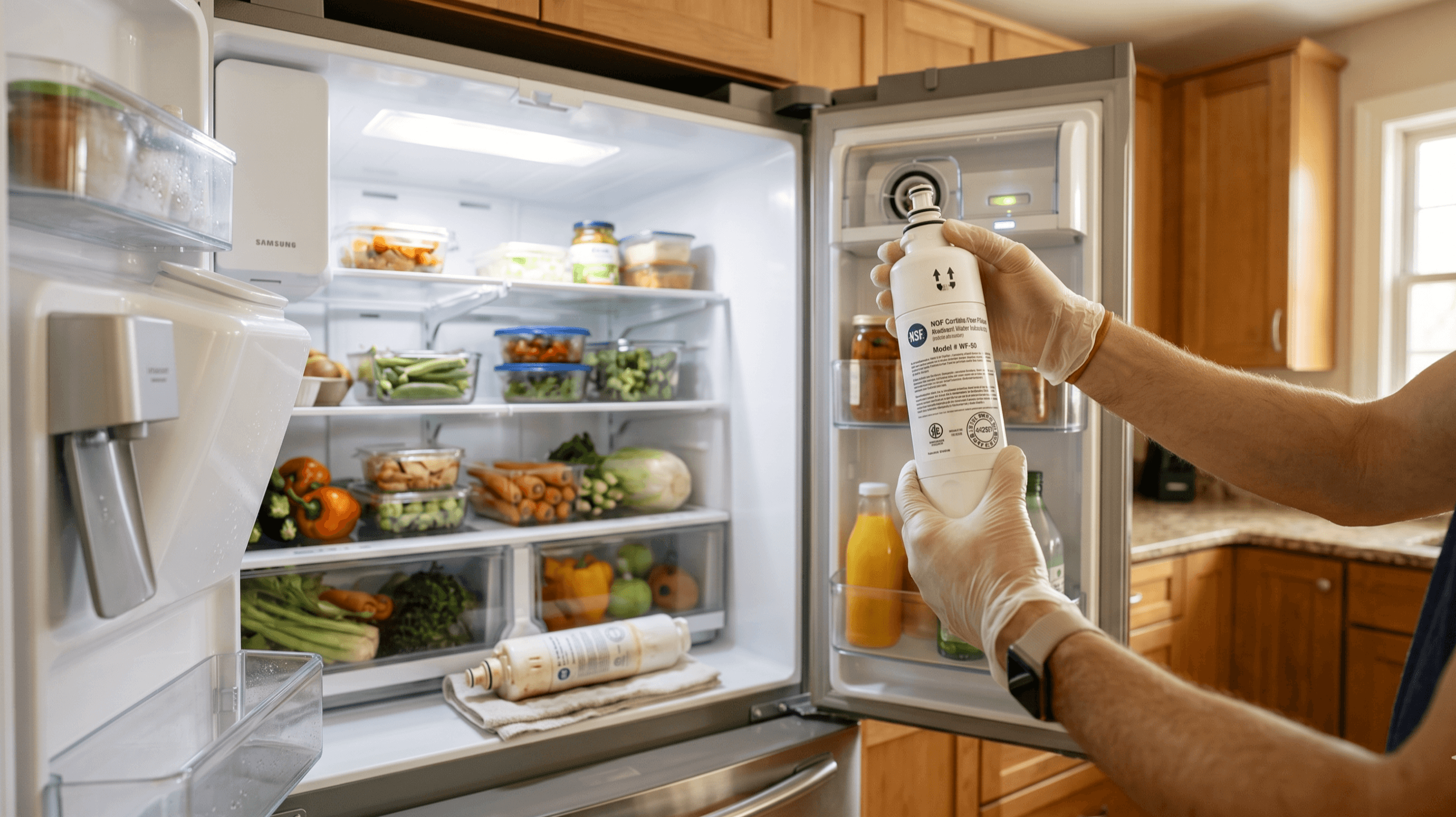
A simple rule of thumb is to replace your refrigerator water filter every six months, or after filtering about 200–400 gallons of water—whichever happens first. That’s the recommendation you’ll find from most major refrigerator brands, including Whirlpool, Samsung, LG, GE, and Frigidaire, to help keep your water tasting fresh and your filtration system working effectively.
But that number assumes average usage, average water quality, and average household size. None of those may apply to your home. Understanding what actually drives filter replacement frequency — and what happens when you wait too long — helps you protect your drinking water without replacing filters needlessly.
Here’s what actually determines how often your fridge water filter needs to come out.
Why the Six-Month Rule Exists
Refrigerator water filters use activated carbon as their primary filtration medium. Carbon works by adsorption — contaminants like chlorine, certain pesticides, and volatile organic compounds bind to the surface of the carbon as water passes through. Over time, that surface fills up.
Once the carbon media reaches saturation, two things happen. First, it stops removing contaminants effectively — they pass straight through into your glass. Second, a moist, used carbon cartridge can become a site for bacterial growth inside the filter housing. Neither outcome is visible until you notice it in the taste of your water or the clarity of your ice.
Most fridge filters are rated for 200–400 gallons of filtration before their carbon media is considered exhausted. For a typical household of two to four people using the water dispenser regularly, that capacity gets used up in roughly six months. That’s why manufacturers settled on this interval — it balances media capacity against the hygiene risk of leaving a wet carbon cartridge sitting unused for too long.
When Six Months Isn’t Long Enough
The six-month standard is a starting point, not a ceiling. Several variables can push your replacement schedule shorter.
Household size and usage are the most direct factors. A family of five that relies on the refrigerator dispenser as their primary drinking water source can burn through filter capacity in three to four months rather than six. At high usage rates, you’re better off tracking gallons — many refrigerators display this — rather than relying purely on the calendar.
Municipal water quality plays a significant role. Tap water carrying higher levels of chlorine, sediment, or heavy metals causes your filter to saturate faster. If your municipality issues boil-water advisories seasonally, or if your water report shows elevated levels of chloramines or VOCs, plan on replacing your filter more frequently — potentially every three to four months during peak-use periods.
Well water requires particular attention. Well water can contain elevated sediment, iron, manganese, and biological contaminants that carbon filters aren’t always designed to handle in high concentrations. If your refrigerator is connected to a well, check the filter more frequently and consider whether your fridge filter alone is adequate for your water quality — or whether a dedicated whole-home filtration system is worth adding upstream.
Older plumbing can also shorten filter life. Homes built before 1986 may have copper or lead-soldered pipes that contribute particulates and metals to the water supply at the point of use. The filter is working harder even before the water reaches your dispenser.
Signs Your Filter Needs Replacing Before the Six Months Are Up
Your refrigerator’s indicator light uses a timer, not a water quality sensor. It resets to a fixed countdown — usually six months — regardless of how much water you’ve actually used or how contaminated your supply is. That makes it a useful reminder, not a reliable quality gauge.
These are the signs that indicate early replacement is needed:
- Taste changes — A metallic, musty, or stale flavor is often the first signal. A functioning carbon filter absorbs chlorine and many taste compounds; once it’s saturated, those flavors return to the water.
- Reduced flow from the dispenser — Sediment and particulates physically clog the filter media over time, restricting water pressure. If filling a glass takes noticeably longer than it used to, the filter is likely the cause.
- Slower ice production — The ice maker draws from the same filtered water line. Reduced flow shows up as smaller or fewer ice cubes, or longer cycle times.
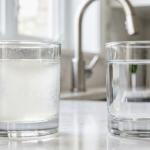
- Cloudiness or visible particles — When a filter degrades, it can release trapped sediment and carbon fines back into the water. Cloudiness or black specks in a glass or ice cubes after initial install flushing is a clear sign to replace the cartridge.
- Unusual odors — A rotten or musty smell coming from the ice or water often indicates microbial growth in a long-overused filter.
Any of these symptoms warrants immediate replacement, regardless of where you are in the six-month cycle.
Can You Go Longer Than Six Months?
Some single-person households or infrequent users might not reach the filter’s gallon threshold in six months. Extending slightly beyond six months based purely on low usage is tempting, but carries a specific risk that’s separate from filtration capacity: microbial growth.
A carbon filter that sits wet inside the housing, even lightly used, can develop bacterial colonies inside the cartridge over time. This is why manufacturers maintain the six-month maximum regardless of actual gallons filtered. The combination of moisture, organic matter from filtered water, and a dark housing creates favorable conditions for microorganisms.
The six-month limit isn’t just about how much the filter has filtered — it’s about how long it has been sitting wet. Extending to seven or eight months on the grounds of low usage isn’t recommended.
OEM vs. Aftermarket Filters: Does It Affect Replacement Frequency?
Both original equipment manufacturer (OEM) filters and quality aftermarket filters follow the same six-month replacement schedule, provided the aftermarket filter carries proper NSF certification.
NSF International independently certifies water filters against specific performance standards. The main certifications relevant to fridge filters are:
- NSF/ANSI 42 — Covers aesthetic contaminants: chlorine, taste, and odor
- NSF/ANSI 53 — Covers health-related contaminants including lead, cysts, and certain VOCs
- NSF/ANSI 401 — Covers emerging contaminants such as pharmaceuticals and certain pesticides
OEM filters from major brands consistently carry all three certifications. Certified aftermarket filters can deliver equivalent filtration performance at 60–80% cost savings — typically $20–40 per year versus $80–120 for OEM filters. The key qualifier is that the certification must be verified. Searching the NSF database directly using the filter’s model number confirms whether the claimed certifications are genuine, which matters given the documented presence of counterfeit filters on major retail platforms.
For households concerned specifically about lead reduction or PFAS, verifying that the specific aftermarket filter carries NSF 53 or NSF 401 — not just NSF 42 — is important before purchasing.
If using an aftermarket filter, confirm it fits your refrigerator model precisely. A poorly fitting seal can result in unfiltered water bypassing the media entirely, or cause leaks at the filter housing. One useful resource for understanding how your filter actually removes contaminants like chlorine applies directly to fridge filters as well, since most use the same activated carbon mechanism.
How to Build a Replacement Schedule That Actually Works
The six-month interval is easiest to track when tied to a fixed calendar date. Replacing filters on January 1 and July 1 each year, for example, removes any guesswork. For households with higher usage or lower-quality source water, shifting to a quarterly check with replacement every three to four months is more appropriate.
Several practical systems work:
- Set a recurring phone reminder every six months at the time of installation
- Note the replacement date on the filter housing with a marker before closing the cover
- Use a filter subscription service that ships a replacement automatically on your chosen interval
- Track gallon usage if your refrigerator displays this data, and replace at 200 gallons if that comes before six months
If your tap water has an unusual taste, odor, or appearance — even without a failing filter — reading your municipality’s annual Consumer Confidence Report can clarify what’s present in your water supply. Issues like metallic-tasting tap water or rotten egg odors often indicate specific contaminants that your filter certification should address.
Keeping your home’s water pressure stable also matters for filter performance. Low inlet pressure reduces flow through the filter, and if you’ve noticed a drop in dispenser pressure, it’s worth ruling out plumbing-side issues before assuming the filter is the cause.
FAQ
Does the fridge water filter light mean the filter has actually failed?
No. The indicator light on most refrigerators operates on a fixed timer or gallon counter — it doesn’t measure actual water quality. It resets to a preset interval, usually six months, after each filter change. The light is a reminder to check the filter, not a sensor that detects contamination or carbon exhaustion. If your water starts tasting or smelling off before the light activates, replace the filter regardless.
What happens if you never replace the fridge water filter?
An overdue filter stops removing contaminants and begins allowing them to pass directly into dispensed water. Over a longer period, the saturated carbon media can release previously trapped contaminants back into the water supply in a process sometimes called backflushing. Additionally, the moist interior of an exhausted cartridge can harbor bacteria and mold, which may then enter the water stream. Flow rate will also decrease noticeably as the media becomes physically clogged.
Do you need to flush a new fridge filter after installing it?
Yes. Running approximately two to four liters of water through a new filter cartridge before regular use clears loose carbon fines — fine black particles from the activated carbon block — that are present in new filters. These particles are not harmful, but they produce dark discoloration and off-flavors in the first few draws. Most refrigerator manuals specify a flush volume; following it ensures the filter is delivering clean, clear water from the first glass you fill.
Will using a generic aftermarket filter void my refrigerator warranty?
In the United States, the Magnuson-Moss Warranty Act generally prevents manufacturers from voiding an entire appliance warranty solely because a third-party replacement part was used, unless the manufacturer provides the OEM filter at no cost. That said, if a non-OEM filter causes specific damage — such as a leak from an improperly fitting seal — that damage may not be covered under warranty. Using a certified aftermarket filter that precisely fits your refrigerator model significantly reduces this risk.
How do you find out which filter model fits your specific refrigerator?
The filter part number is typically printed on the label of the existing cartridge inside the housing. It can also be found in your refrigerator’s owner’s manual or by searching your refrigerator’s model number on the manufacturer’s website or filter retailer sites. Matching the part number exactly — rather than relying on general brand compatibility — ensures the correct seal, fit, and filtration performance for your unit.