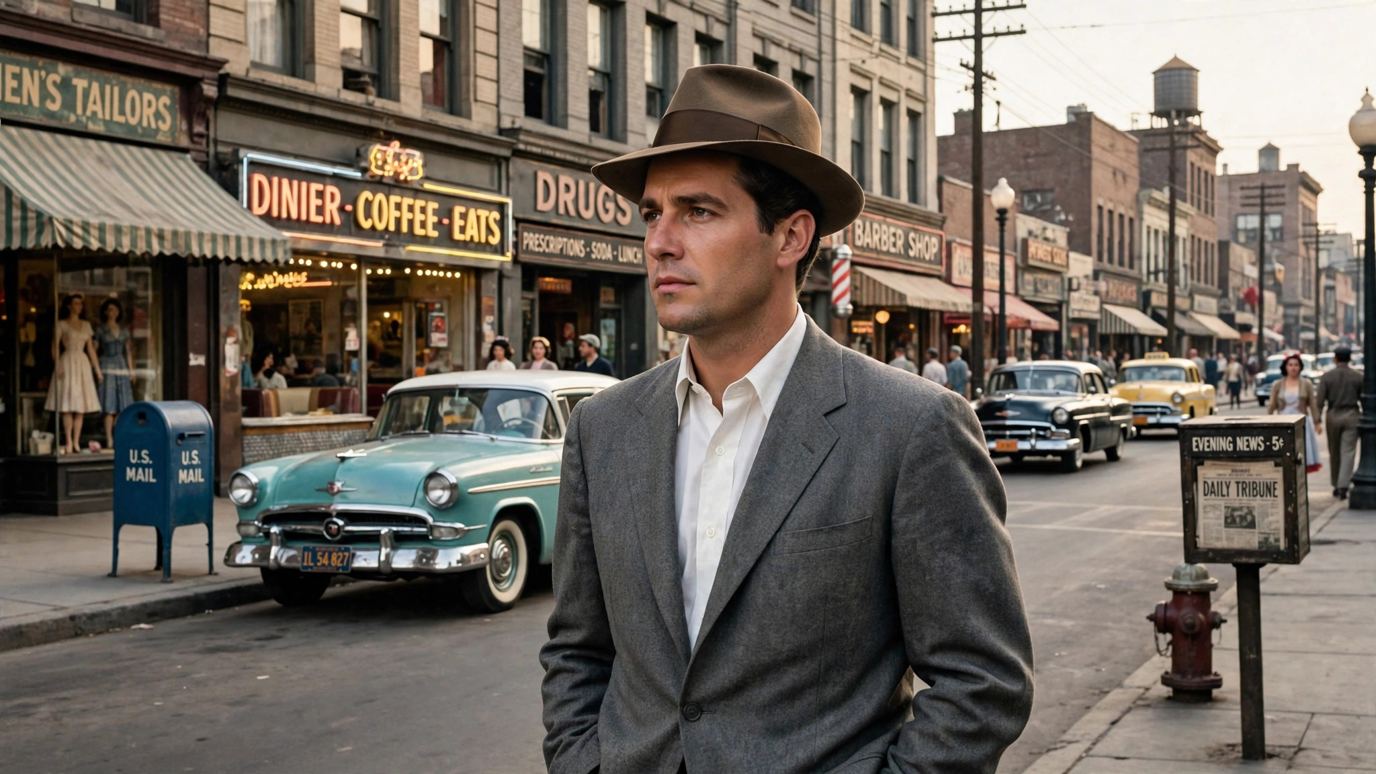
When people picture 50’s mens fashion trends, a few images come to mind instantly: a sharp suit with a slim tie, a leather jacket over a white tee, a teenager in jeans and a bowling shirt. What is remarkable is how many of those looks never really left.
The 50’s mens fashion trends did not just define a decade; they laid down the basic vocabulary of modern menswear, and a surprising amount of it still works today without looking like a costume.
The short answer: the 50’s mens fashion trends were defined by two parallel movements. On one side, grown-up tailoring got sharper and cleaner, with the grey flannel suit as its emblem. On the other, youth culture exploded into denim, leather, and casual sportswear, giving teenagers a style of their own for the first time.
Together, those two movements produced the wardrobe most men still draw from: a good suit, a good jacket, good jeans, and a plain tee. This guide walks through the decade’s defining looks, explains why they caught on, and shows how to borrow from them today without looking like you stepped off a film set.
IN THIS GUIDE
- Why 50’s Mens Fashion Trends Changed Menswear
- The Grey Flannel Suit and Everyday Tailoring
- The Rebel Look: Leather Jackets and White Tees
- Denim Comes of Age
- Ivy League Style: The Preppy Counterpoint
- Casual Shirts, Knits, and Sportswear
- Hats, Shoes, and the Finishing Details
- How the Looks Compare
- Wearing 1950s Style Today
- Frequently Asked Questions
- Conclusion
Why 50’s Mens Fashion Trends Changed Menswear
To understand the 50’s mens fashion trends, it helps to know what came just before it. The 1940s were shaped by wartime rationing, when fabric was scarce and suits were stripped down by necessity.
When the war ended, men had money again, factories were humming, and there was a real appetite for clothes that felt new, generous, and optimistic. At the same time, something new was happening: teenagers became a distinct consumer group.
Before the 1950s, young people largely dressed like smaller versions of their parents. After it, they had their own music, their own movies, and their own clothes, and the fashion industry noticed.
The decade’s style story is really the story of those two forces meeting: adults dressing up in a prosperous new era, and young people dressing down in a rebellious new one. That meeting is at the heart of the 50’s mens fashion trends.
Practical tip: when you borrow from the 50’s mens fashion trends, pick one lane. A full period outfit head to toe reads as a costume. One strong 1950s element, such as a well-cut sport coat or a great pair of straight jeans, paired with modern basics, reads as style.
The Grey Flannel Suit and Everyday Tailoring
The defining image of the respectable 1950s man is the grey flannel suit. It was the uniform of the office, the commuter train, and the new suburban professional class, and it earned its place because it was versatile in a way earlier suits were not.
Grey goes with almost everything, flannel drapes well and holds its shape, and a single suit could carry a man through the working week with a change of shirt and tie. The 1950s suit silhouette was notably different from what came before and after.
Shoulders were natural rather than heavily padded, the jacket was often single-breasted with a two- or three-button front, and trousers were flat-fronted or single-pleated with a tapered leg. The overall effect was clean and understated: a man looked put-together without looking stiff.
Color mattered too. Alongside grey, navy and charcoal dominated, with brown and subtle patterns such as herringbone and sharkskin for variety. The shirt underneath was usually white or pale blue, and the tie was the one place a man could show a little personality.
Slim ties, knit ties, and ties with small geometric patterns all had their moment, and the tie bar, a small clip holding the tie to the shirt, became a common finishing touch. The 50’s mens fashion trends in tailoring were, above all, about restraint.
The short answer: if you want one 1950s tailoring lesson, it is this: fit beats flash. A well-fitting suit in a sober color, with a clean shirt and a simple tie, will look good in almost any decade.
That lesson is why the grey flannel suit never really disappeared. It evolved into the modern business suit, and the same principles, natural shoulders, a clean line, restrained color, still anchor professional menswear today.
The Rebel Look: Leather Jackets and White Tees
If the grey flannel suit was the decade’s establishment look, the leather jacket was its rebellion. The black leather motorcycle jacket, already worn by real motorcyclists, became a cultural symbol through film, most famously through Marlon Brando’s performance in The Wild One in 1953.
Paired with a plain white T-shirt, jeans, and boots, it created an image of effortless toughness that young men copied immediately. The white tee deserves attention of its own.
Before the 1950s, the T-shirt was underwear. It was something you wore beneath a shirt, not on its own. When film stars wore it as outerwear, that rule broke overnight.
Suddenly the plain white tee was acceptable on its own, and it has stayed that way ever since. It is worth remembering how radical that was: a garment moving from underwear to everyday outerwear in the space of a few years. That shift is a key part of the 50’s mens fashion trends.
James Dean added another layer to the rebel image in Rebel Without a Cause in 1955, with a red windbreaker, white tee, and jeans becoming one of the most copied outfits of the decade. The appeal was not really about the clothes themselves; it was about what they signaled.
The rebel look said a young man was not simply waiting to inherit his father’s suit. He had his own attitude, and his clothes announced it. The 50’s mens fashion trends gave that attitude a wardrobe.
Practical tip: the rebel look works today precisely because it is so simple. A well-fitting leather or suede jacket, a plain white tee that actually fits, dark straight jeans, and clean boots: that combination still looks good because nothing in it is trying too hard.
Denim Comes of Age
Jeans had existed for decades as workwear, but the 1950s turned them into fashion. Teenagers adopted denim as their everyday uniform, and the look was specific: dark indigo jeans, often with the cuffs rolled up, worn with a tee, a checked shirt, or a leather jacket.
The jeans of the decade were high-waisted by modern standards, with a straight leg and a rigid, unwashed denim fabric that softened with wear. That rigid denim is part of why vintage jeans are so prized today; they molded to the wearer over time and developed fades that were unique to each pair.
Denim’s rise also marked a class shift in fashion. For the first time, a working-class fabric became a youth-culture status symbol, worn precisely because it was not formal. Parents and schools often disapproved, which of course only made jeans more appealing to teenagers.
That cycle, adults disapprove, young people adopt, the style goes mainstream, would repeat with almost every youth trend that followed. The 50’s mens fashion trends made denim a central part of that cycle.
The short answer: denim’s 1950s breakthrough matters because it made casual clothing legitimate. Before the decade, casual meant sloppy. After it, a man could be casual and still look intentional, and jeans were the garment that proved it.
Ivy League Style: The Preppy Counterpoint
Not every young man in the 1950s was a rebel. On the East Coast, and on college campuses in particular, a very different look took hold: Ivy League style. This was the wardrobe of the buttoned-down student, and it has proven just as durable as the rebel look, arguably more so.
The Ivy look centered on natural-shoulder sport coats, often in tweed or herringbone, worn with Oxford cloth button-down shirts, slim ties or none at all, chino trousers, and penny loafers. The colors were muted: navy, grey, olive, tan, and brown, with the occasional repp-stripe tie or madras accent in warmer months.
What made Ivy style distinctive was its studied casualness. The clothes were traditional, but they were worn loosely. A sport coat might be paired with chinos instead of matching trousers. A shirt might be worn without a tie. Loafers replaced lace-up shoes.
The message was that the wearer knew the rules of dressing well and was relaxed enough not to follow all of them. Among the 50’s mens fashion trends, Ivy style is one of the most wearable today.
Practical tip: Ivy style is the easiest 1950s look to wear to a modern office. A navy sport coat, a white Oxford button-down, grey or khaki chinos, and loafers will look polished in almost any workplace that is not strictly formal, and every piece is easy to find today.
Casual Shirts, Knits, and Sportswear
Beyond suits, leather, and denim, the 1950s produced a rich casual wardrobe that is easy to overlook but worth knowing. The bowling shirt is a good example.
Originally worn, as the name suggests, for bowling, it featured a camp collar that could be worn open, short sleeves, a boxy cut, and often a two-tone or patterned panel design. It became general leisure wear, and its relaxed, slightly retro shape is still popular in warm weather today.
Hawaiian shirts, sometimes called Aloha shirts, also surged in popularity as air travel made tropical holidays more accessible and as returning servicemen brought island styles home. Loud floral prints were a deliberate contrast to the sober colors of office wear, and they gave men a way to dress playfully on vacation without looking sloppy.
Knitwear played a quieter but important role. Shawl-collar cardigans, crew-neck pullovers, and knitted polo shirts gave men comfortable layers for cooler weather and for evenings at home. Worn over a shirt or on their own, they offered a middle ground between a suit and a tee, and that middle ground is still where much of men’s casual dressing lives.
Then there were the checked and plaid shirts, often in flannel, worn for outdoor work and weekend leisure. Paired with jeans, they completed the casual uniform of the decade, and the combination of a plaid shirt and jeans has never really gone away. These pieces round out the 50’s mens fashion trends beyond tailoring and rebellion.
Hats, Shoes, and the Finishing Details
No account of 50’s mens fashion trends is complete without the details, because the decade took accessories seriously. Hats were still everyday wear for adult men at the start of the decade.
The fedora was the most common choice, in grey, brown, or black felt, worn with suits and overcoats. Flat caps and newsboy caps were popular for casual wear.
By the end of the decade, hats were already fading as everyday items, as car travel, changing hairstyles, and a more casual culture made them less practical, but for most of the decade a hat was simply part of getting dressed. Shoes tell a similar story.
Oxford shoes in black or brown were the standard for formal and office wear. Loafers, especially penny loafers, became the casual and campus favorite. Suede desert boots, known as chukka boots, gained ground as a smart-casual option. And for the rebel look, engineer boots or plain black boots completed the outfit.
Grooming was part of the look too. Short back and sides was the standard haircut, often with a side part, while teenagers experimented with longer, slicked-back styles using pomade, including the pompadour and the ducktail. A clean shave or a neat mustache was the norm for adults.
The grooming was not an afterthought; it was part of the same discipline that made the clothes work. The 50’s mens fashion trends were as much about grooming as about garments.
Practical tip: you do not need a fedora to borrow from the 1950s. The transferable detail is simpler: clean shoes, a neat haircut, and one considered accessory, such as a good watch or a leather belt that matches your shoes, will do more for an outfit than any period piece.
How the Looks Compare
The decade’s main looks served different people and different moods, and comparing them side by side makes the choices clearer:
| Look | Signature pieces | Best for today |
|---|---|---|
| Grey flannel suit | Grey suit, white shirt, slim tie | Work, weddings, formal events |
| Rebel look | Leather jacket, white tee, jeans | Casual weekends, evenings out |
| Ivy League style | Sport coat, Oxford shirt, loafers | Smart-casual offices, dinners |
| Casual sportswear | Bowling shirt, chinos, knit polo | Warm weather, holidays, relaxed days |
The table makes one thing obvious: these were not competing fashions so much as a complete wardrobe system. A man in the 1950s might own pieces from several of these looks and wear them in different parts of his life, and that is exactly how they are best used today.
Wearing 1950s Style Today
The reason 50’s mens fashion trends endure is that its best ideas were about proportion and simplicity, not about decoration. Those ideas translate easily. Start with fit.
The 1950s silhouette favored natural shoulders, a defined but not tight waist, and trousers that tapered without squeezing. That shape flatters most body types, and it is a useful corrective if your wardrobe has drifted toward either extreme of very slim or very boxy.
Next, build around neutrals. Grey, navy, white, black, brown, and olive made up most of the decade’s palette, and they still mix effortlessly. Add one accent at a time, a patterned tie, a colored knit, a checked shirt, rather than several at once.
Then choose your hero piece. A leather jacket, a tweed sport coat, a great pair of dark straight jeans, or a well-cut suit can each anchor an outfit. Let that piece carry the vintage character, and keep the rest of the outfit modern and simple.
Modern shoes, a modern haircut, and a simple watch keep the look current. Finally, respect the fabric. The 1950s valued natural fabrics: wool flannel, cotton Oxford cloth, denim, and leather.
Those materials age well and look better with wear, which is part of why vintage clothing from the era is still wearable. When you buy a 1950s-inspired piece today, the fabric is often the difference between something that looks like a costume and something that looks like good clothing. The 50’s mens fashion trends reward that attention to fabric.
The short answer: wear one 1950s idea at a time, in good fabric, with a clean modern fit, and the decade will flatter you instead of dressing you up.
Frequently Asked Questions
What were the most popular 50’s mens fashion trends?
The most lasting trends were the grey flannel suit for professional wear, the leather jacket and white tee rebel look, dark straight-leg jeans, Ivy League style with sport coats and loafers, and casual pieces like bowling shirts and knit polos. Together they covered work, campus, and weekend life.
Why was the 1950s so important for men’s fashion?
The decade combined post-war prosperity with the rise of teenagers as a distinct consumer group. Adults refined tailoring into the modern business suit, while young people created a casual wardrobe of denim, leather, and tees that had never existed before. Both movements still shape what men wear today, which is why the 50’s mens fashion trends still matter.
Did men really wear hats every day in the 1950s?
For much of the decade, yes, especially adult men. Fedoras were standard with suits, and flat caps were common for casual wear. Hat-wearing declined toward the end of the decade as cars, new hairstyles, and a more casual culture made hats less practical, and it never fully recovered as an everyday habit.
What is Ivy League style from the 1950s?
Ivy League style was the campus look of natural-shoulder sport coats, Oxford button-down shirts, chino trousers, and penny loafers. It was traditional but relaxed, and it remains one of the easiest vintage styles to wear in a modern smart-casual workplace.
How can I wear 1950s style without looking like a costume?
Pick one element, such as a leather jacket, a sport coat, or dark straight jeans, and pair it with modern basics. Keep the fit clean, the colors mostly neutral, and the grooming modern. One strong vintage piece reads as style; a head-to-toe period outfit reads as a costume.
Were jeans acceptable everywhere in the 1950s?
No. Jeans were youth and casual wear, and many schools, restaurants, and workplaces did not allow them. Their respectability grew slowly, and it took decades before jeans became acceptable in most settings. In the 1950s, wearing jeans was itself a small statement.
Conclusion
The 50’s mens fashion trends matter not because they were quaint, but because they were foundational. The decade gave men the modern suit, the modern casual wardrobe, and the idea that a young man could have a style of his own.
Grey flannel, leather, denim, tweed, and the plain white tee all came out of those ten years, and all of them are still in your wardrobe, or could be, today. Borrow the decade’s discipline about fit, its respect for good fabric, and its confidence about simplicity, and you will be wearing the best of the 1950s without ever looking like you are dressed for a theme party.
Read Also: Under Armour Men’s Challenger Track Jacket Complete 2026 Guide