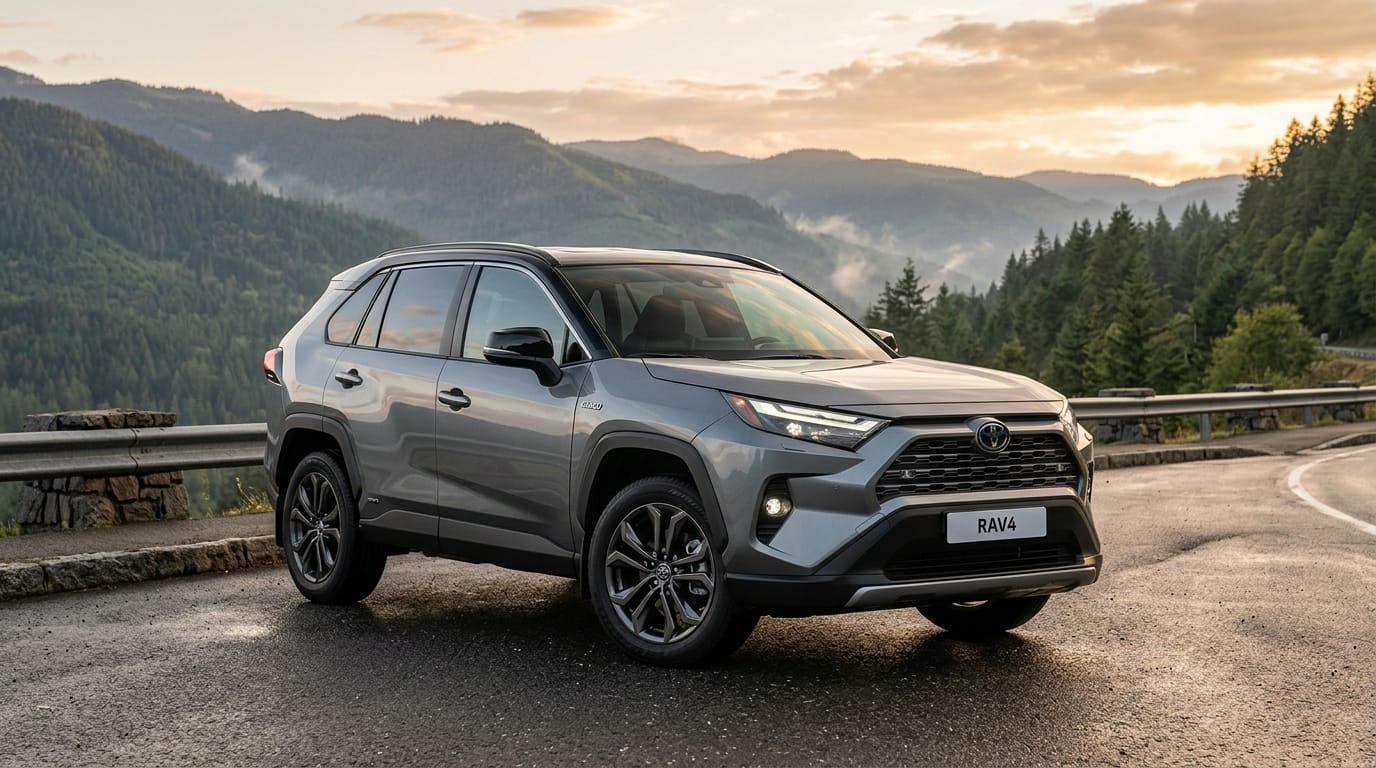
The 2025 Toyota RAV4: The Last of Its Kind (and Why That Might Be a Good Thing)
If you’re shopping for a 2025 Toyota RAV4, here’s the one sentence that matters most: this is the last RAV4 you can buy with a plain gasoline engine — and it may be your best shot at a deal on America’s best-selling SUV before the lineup goes all-hybrid.
Let’s be honest up front. The RAV4 2025 is not a redesign. Toyota barely touched it. If you were hoping for a fresh look or a new engine, you’ll have to wait for the 2026 model. But that doesn’t make the 2025 irrelevant — in some ways, it makes it more interesting. This is a mature, proven SUV at the end of its generation, with every quirk worked out, strong resale value, and dealers who know the next model is coming and may be willing to negotiate.
This guide covers everything: what’s actually new, real pricing, every trim, gas vs. hybrid vs. plug-in hybrid, honest fuel economy numbers, reliability (including the problems owners actually report), how it stacks up against the Honda CR-V and Hyundai Tucson, and whether you should buy now or wait.

What’s Actually New for 2025? (The Honest Answer: Almost Nothing)
Some corners of the internet will tell you the 2025 RAV4 got a redesigned grille or a new infotainment system. It didn’t. The 2025 model is essentially a carryover from 2024, with one genuinely notable change and a couple of footnotes:
- Adventure and TRD Off-Road trims are gone. Toyota quietly dropped both rugged-themed gas trims from the lineup, trimming the range down to LE, XLE, XLE Premium, and Limited on the gas side. If you wanted the most off-road-flavored RAV4, the Hybrid Woodland Edition is now your only option.
- The hybrid lost its blue badge accents. For years, Toyota hybrids wore blue-tinted badges front and rear. On the 2025 RAV4 Hybrid, those are gone — a small cosmetic detail, but it’s literally the only visual change.
- Prices crept up slightly — roughly a couple hundred dollars over the 2024 model, depending on trim.
Everything else — the 2.5-liter engines, the transmissions, the interior, the safety equipment — carries over unchanged. And there’s a reason Toyota left it alone: the fifth-generation RAV4, introduced for 2019, has been a sales juggernaut. In 2022 it outsold the Camry, the Tacoma, and the Highlander. When something works that well, you don’t mess with it in its final year.
The bigger story is what comes next. Toyota has confirmed that the all-new sixth-generation RAV4 arriving for 2026 drops the gas-only engine entirely — every 2026 RAV4 will be a hybrid or plug-in hybrid. That makes the 2025 the end of an era: the last chance to buy a brand-new, conventional gasoline RAV4.
2025 Toyota RAV4 Price and Trims
Pricing spans a wide range because there are effectively three RAV4s: gas, hybrid, and plug-in hybrid. Here’s how the money breaks down at a glance (MSRP, before destination charge, taxes, and dealer fees — always confirm with a dealer, as prices vary by region):
| Powertrain | Starting Price (approx.) | Top Trim (approx.) |
|---|---|---|
| Gas (FWD/AWD) | ~$28,850 (LE) | ~$38,000+ (Limited) |
| Hybrid (AWD standard) | ~$33,295 (LE) | ~$41,600 (Limited) |
| Plug-in Hybrid / Prime (AWD) | ~$43,000 (SE) | Near $50,000 loaded (XSE) |
The hybrid costs roughly $3,000 more than the equivalent gas trim. That premium is the single most important number in this whole guide, because it decides the gas-vs.-hybrid question for most buyers (more on that below).
Gas trims: LE, XLE, XLE Premium, Limited
- LE — the value play. You still get the full Toyota Safety Sense suite, wireless Apple CarPlay and Android Auto, and LED headlights. Cloth seats, 17-inch wheels, no frills — but nothing you actually need is missing.
- XLE — the sweet spot for gas buyers. Adds blind-spot monitoring, power liftgate, dual-zone climate control, and nicer wheels. This is the trim most gas shoppers should start with.
- XLE Premium — SofTex synthetic leather seats, larger touchscreen, and more convenience features. It feels meaningfully nicer inside without jumping to the top price.
- Limited — everything: leather-trimmed seats, 19-inch wheels, 12.3-inch digital gauge cluster, JBL audio, and the works. Well-equipped test cars push past $42,000.
Hybrid trims: LE, XLE, SE, Woodland Edition, XLE Premium, XSE, Limited
The hybrid lineup mirrors the gas range but adds three flavor options: the SE (sport-tuned suspension, blacked-out trim), the Woodland Edition (the adventure pick — all-terrain tires, raised roof rails, TRD-tuned suspension bits, and a 120V outlet in the cargo area), and the XSE (sporty looks with near-luxury equipment). The Woodland Edition is slightly less efficient than other hybrids, but it’s the closest thing to the discontinued Adventure/TRD Off-Road models.
Plug-in Hybrid (RAV4 Prime): SE and XSE
The Prime is the halo of the lineup: 302 combined horsepower, 42 miles of electric-only range, and 94 MPGe. It’s genuinely quick — the fastest RAV4 you can buy. The catch is price and availability; Primes have historically been hard to find on dealer lots, and they cost a lot more than the standard hybrid.
Powertrains: Gas vs. Hybrid vs. Plug-in Hybrid
Three very different driving experiences hide under nearly identical sheet metal:
| Gas | Hybrid | Plug-in Hybrid | |
|---|---|---|---|
| Engine | 2.5L 4-cylinder | 2.5L 4-cyl + electric motors | 2.5L 4-cyl + larger motors & battery |
| Power | 203 hp | 219 hp combined | 302 hp combined |
| Transmission | 8-speed automatic | Electronically controlled CVT | Electronically controlled CVT |
| Drivetrain | FWD or AWD | AWD standard | AWD standard |
| 0–60 mph | ~8.0 seconds | ~7.3 seconds | ~5.7 seconds |
| Max towing | 1,500 lbs | 1,750 lbs | 2,500 lbs |
The gas engine is fine — adequate, reliable, unexciting. It gets the job done but feels strained when you ask for quick passing power, and testers consistently note an irritating engine drone under hard acceleration. The hybrid, paradoxically, is the better driver’s car: it’s quicker off the line (electric torque fills in instantly), quieter in normal driving, and doesn’t suffer from the same drone. If you test-drive both back to back, most people pick the hybrid on feel alone — the fuel savings are a bonus.
The plug-in hybrid is in another league for performance, but let’s be realistic about who it’s for: someone with home charging who drives mostly short trips. Its 42-mile electric range covers the average American daily commute without burning a drop of gas. If you can’t charge at home regularly, you’re paying a big premium for a battery you rarely use — the standard hybrid is the smarter buy.

Fuel Economy: The Real Numbers
EPA estimates for the 2025 RAV4 (city/highway/combined):
| Configuration | City | Highway | Combined |
|---|---|---|---|
| Gas FWD | 27 | 35 | 30 |
| Gas AWD (LE) | 27 | 34 | 30 |
| Gas AWD (XLE / XLE Premium) | 27 | 33 | 29 |
| Gas AWD (Limited) | 25 | 33 | 28 |
| Hybrid AWD | 41 | 38 | 39 |
| Hybrid Woodland Edition | 38 | 35 | 37 |
| Plug-in Hybrid | 94 MPGe / 38 mpg (gas-only) / 42-mile EV range | ||
The hybrid’s advantage is biggest in the city — 41 mpg vs. 27 mpg is a 50% improvement, thanks to regenerative braking and electric-only creeping in traffic. On the highway the gap narrows but the hybrid still wins comfortably. Real-world testing backs this up: independent testers typically see high-30s overall from the hybrid and high-20s from the gas AWD model.
Quick math on that ~$3,000 hybrid premium: if you drive 12,000 miles a year and gas costs $3.50/gallon, the hybrid saves roughly $700–$800 a year in fuel. That means the premium pays for itself in about four years — sooner if gas prices rise or you drive more. Add in the hybrid’s standard AWD (a ~$1,400 option on gas models) and stronger resale, and the financial case is solid for anyone who keeps cars more than a few years.
Interior, Technology, and Cargo Space
The 2025 RAV4’s cabin won’t wow you, but it works. Materials are a mix: soft-touch surfaces where your elbows land, hard plastics where they don’t. Consumer Reports has called the interior “bland, bordering on cheap” compared to rivals like the Mazda CX-5 — fair criticism, though the higher trims with SofTex and contrast stitching look considerably better than the base LE.
What the cabin does well is ergonomics. Unlike some competitors that bury everything in touchscreens, the RAV4 keeps physical knobs and buttons for climate control — a genuine usability win you’ll appreciate every single day. The driving position is good, visibility is decent (thick rear pillars aside), and the rear seat fits two adults comfortably with 37.8 inches of legroom.
Tech highlights:
- Up to 10.5-inch touchscreen with Toyota’s latest Audio Multimedia system (faster and more responsive than the old Entune setup)
- Wireless Apple CarPlay and Android Auto standard
- Available 12.3-inch digital gauge cluster on upper trims
- Available JBL premium audio, wireless phone charging, and panoramic moonroof
- Toyota’s connected services with available Wi-Fi hotspot
Cargo space is a strong point: 37.6 cubic feet behind the rear seats and 69.8 cubic feet with them folded — competitive for the class, and impressively, the hybrid gives up none of it to the battery pack. The load floor is flat, the opening is wide, and the available hands-free power liftgate makes grocery runs easy.
Safety: Standard Equipment Done Right
Every 2025 RAV4 — even the base LE — comes standard with Toyota Safety Sense, a full suite of driver-assistance tech: pre-collision braking with pedestrian detection, lane departure alert with steering assist, full-speed adaptive cruise control, lane tracing assist, road sign recognition, and automatic high beams. Blind-spot monitoring with rear cross-traffic alert is standard on XLE and up.
That standard-everything approach is one of the RAV4’s quiet advantages. Some competitors still charge extra or reserve this equipment for higher trims. Here, the cheapest RAV4 on the lot has the same core safety tech as the most expensive one.
Reliability and Common Problems: An Honest Look
Let’s start with the big picture: the RAV4’s reliability reputation is one of the main reasons people buy it, and it’s largely earned. Toyota’s powertrains are proven, the hybrid system has been refined over decades, and owners routinely report 200,000+ miles with basic maintenance. Resale value reflects this — the RAV4 retains value better than almost any competitor, with estimates around 64% after five years.
That said, no vehicle is perfect, and the 2025 has a few documented weak spots worth knowing before you buy:
- Hybrid fuel tank fill issue. The most widely reported RAV4 Hybrid quirk: many owners find the tank won’t take a full fill — the pump clicks off early, leaving usable range well below what the spec sheet suggests. Toyota has acknowledged the pattern on earlier model years; check owner forums for your specific build if this matters to you.
- Infotainment glitches. Frozen touchscreens, dropped CarPlay connections, and laggy responses are among the most common owner complaints on recent model years. Software updates help but don’t always eliminate the issue permanently.
- Cabin and engine noise. The gas engine drones under acceleration, and road noise at highway speed is higher than in rivals like the CR-V. The hybrid is noticeably quieter.
- Minor quality nits. Thin paint that chips easily, occasional rattles, and wind noise from door seals show up in owner reports — annoyances rather than deal-breakers.
Federal data is reassuring in scale: complaint trackers show a small number of recalls and under a hundred NHTSA complaints for the 2025 model — modest for a vehicle selling at this volume. As always, run the VIN for open recalls and get a pre-purchase inspection on any used example.
2025 RAV4 vs. The Competition
The compact SUV segment is brutally competitive. Here’s how the RAV4’s key rivals compare on character, if not spec sheets:
| Rival | Where It Beats the RAV4 | Where the RAV4 Wins |
|---|---|---|
| Honda CR-V | More refined ride, quieter cabin, roomier interior | Lower starting price, stronger resale, available plug-in hybrid |
| Hyundai Tucson / Kia Sportage | Longer warranty, flashier tech, bold styling | Proven long-term reliability, better resale value |
| Subaru Forester | Standard AWD, excellent visibility, lower price | Hybrid efficiency, more power options, towing |
| Mazda CX-5 | Nicer interior materials, sharper handling | More cargo space, hybrid option, resale |
| Chevrolet Equinox | Lower purchase price | Efficiency, reliability reputation, resale |
The honest summary: the CR-V is the RAV4’s toughest rival and arguably the better vehicle to drive day-to-day, but it costs more and doesn’t hold value quite as well. The Korean twins offer more features per dollar but can’t match Toyota’s long-term ownership story. If your priority is lowest total cost of ownership over 8–10 years, the RAV4 Hybrid is very hard to beat.
Should You Buy the 2025 — or Wait for the 2026?
This is the question every RAV4 shopper faces right now, so let’s answer it directly.
Buy the 2025 if: you want a conventional gasoline engine (the 2026 won’t offer one), you prefer a proven design over a first-year redesign, or you can negotiate a discount as dealers clear inventory. Late-cycle models are often the best value in a generation — every flaw is known, parts are plentiful, and reliability data is mature.
Wait for the 2026 if: you were going to buy the hybrid anyway (the new one gets more power and better economy), you want the latest tech and safety systems, or you plan to keep the car a decade and want the freshest platform. Just know that first-year redesigns carry some risk, and early 2026 models faced real supply constraints.
Consider used if: a 1-year-old 2025 lists around $33,000 on average — not much less than new after incentives. The RAV4 holds value so well that buying new often makes more financial sense than buying nearly-new. The real used bargains start at 3–5 years old.

Frequently Asked Questions
Is the 2025 Toyota RAV4 a good year to buy?
Yes, with one caveat. It’s the final year of a proven generation, which means mature reliability and potential end-of-cycle discounts. The caveat: the redesigned 2026 brings meaningful improvements, so buy the 2025 for the deal or the gas engine — not because it’s the newest thing.
Should I get the gas or hybrid RAV4?
For most buyers, the hybrid. It costs about $3,000 more but returns roughly 50% better city fuel economy, comes with standard AWD, is quicker, and holds value better. The gas model only makes sense if you drive very few miles, need the absolute lowest purchase price, or specifically want a conventional automatic transmission.
What is the 2025 Toyota RAV4 price?
The gas model starts around $28,850, the hybrid around $33,295, and the plug-in hybrid near $43,000 — all before destination charges, taxes, and fees. Well-equipped models run into the low-to-mid $40,000s.
What’s the difference between the 2025 and 2026 RAV4?
The 2026 is an all-new sixth generation that’s hybrid-only (no gas engine), with more power (226–236 hp), better fuel economy, new tech, and Toyota Safety Sense 4.0. The 2025 is the last of the fifth generation — same proven design since 2019, with gas, hybrid, and plug-in options.
How reliable is the 2025 RAV4?
Very, by class standards. Toyota’s reliability reputation is backed by strong owner satisfaction and resale value. Known issues are mostly minor: infotainment glitches, a widely reported hybrid fuel-tank fill quirk, and above-average cabin noise on gas models. The hybrid battery carries a 10-year/150,000-mile warranty.
Does the 2025 RAV4 have wireless Apple CarPlay?
Yes — wireless Apple CarPlay and Android Auto are standard across all trims.
Which 2025 RAV4 trim is the best value?
The Hybrid XLE hits the sweet spot: the efficient powertrain, standard AWD, blind-spot monitoring, power liftgate, and dual-zone climate at a reasonable price. For gas-only buyers, the gas XLE plays the same role.
Can the 2025 RAV4 tow a trailer?
Light duty, yes. The gas model is rated up to 1,500 lbs, the hybrid up to 1,750 lbs, and the plug-in hybrid up to 2,500 lbs — enough for a small utility trailer, jet skis, or a teardrop camper, but not a full-size travel trailer.
Read Also: Understanding TheSindi com: A Complete Guide for New Users