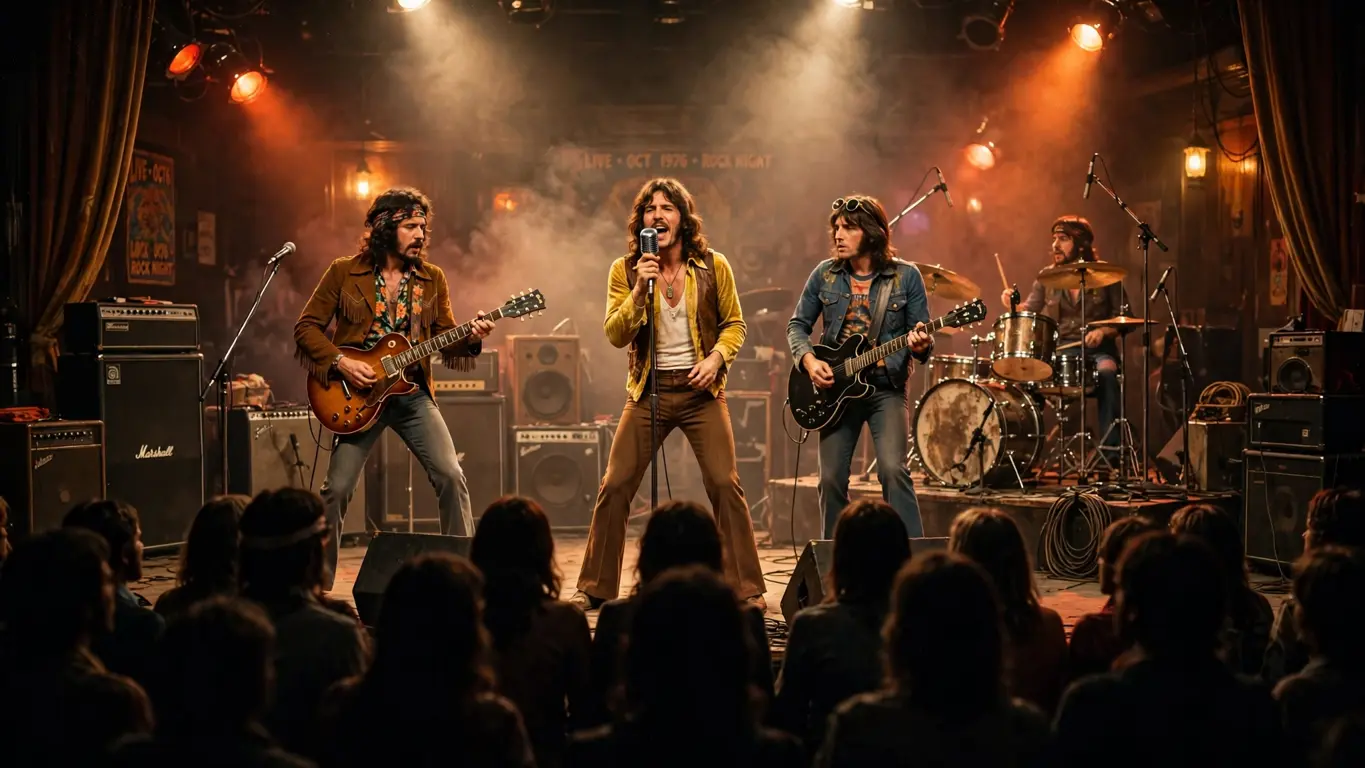
The short answer: the rock bands from 70’s that most define classic rock are Led Zeppelin, Pink Floyd, Queen, Fleetwood Mac, the Eagles, AC/DC, Black Sabbath, and Deep Purple, with the Rolling Stones and The Who carrying their 60s greatness deep into the decade. If you only have time for a handful of records, start with Led Zeppelin’s fourth album, Pink Floyd’s “The Dark Side of the Moon,” Fleetwood Mac’s “Rumours,” and the Eagles’ “Hotel California.” Between them, they cover almost everything the decade did best: thunderous riffs, studio ambition, flawless songwriting, and choruses that still fill arenas fifty years later.
Ask a room full of music fans which decade produced the best rock, and the 1970s will win more votes than any other. That is not just nostalgia. The 70s were the decade when rock grew up without growing boring: albums became statements, concerts became spectacles, studios became instruments in their own right, and bands learned to be both massive and personal at the same time. This guide looks at the bands that made that happen, what each one actually sounded like, and where a new listener should begin.
IN THIS GUIDE
- The short answer: why the 1970s still rule classic rock
- What made 70s rock different
- Led Zeppelin: the blueprint for hard rock
- Pink Floyd: rock as a journey
- Queen: theatre, harmony, and audacity
- Fleetwood Mac: heartbreak turned into perfect pop-rock
- The Eagles: the sound of the American West
- AC/DC: three chords and total conviction
- Black Sabbath and Deep Purple: the heavy end
- The Rolling Stones and The Who: the 60s giants who owned the 70s too
- The wider field: Aerosmith, KISS, Lynyrd Skynyrd, and more
- How to start listening: a beginner’s path through the decade
- Frequently asked questions
- Conclusion
What Made 70s Rock Different
The 1960s had invented modern rock. The 1970s gave it scale. Three changes drove the decade. First, the album overtook the single as the main artistic unit. Bands were no longer judged only on their latest hit; they were judged on forty minutes of music that hung together. Concept albums, running orders that told a story, and cover art you could stare at for an hour all came from this shift.
Second, technology caught up with ambition. Multi-track recording, synthesisers, and better live sound systems let bands build sounds that would have been impossible a decade earlier, from Pink Floyd’s layered soundscapes to Queen’s stacked vocal harmonies. Third, rock fragmented into tribes that all still shared the same radio stations: hard rock, progressive rock, southern rock, glam, punk, and soft rock all lived side by side. A listener in 1977 could hear Fleetwood Mac, the Sex Pistols, and Led Zeppelin in the same evening and not find that strange.
Practical tip: when you explore these bands, listen to whole albums rather than shuffled playlists, at least the first time. Many of these records were sequenced deliberately, with songs flowing into each other or answering each other, and shuffling them is like reading the chapters of a novel out of order.
Led Zeppelin: The Blueprint for Hard Rock
Formed in England in 1968, Led Zeppelin dominated the 1970s more completely than any other rock band. Guitarist Jimmy Page built the band around a simple idea: blues heaviness, folk delicacy, and sheer volume, all in the same band, sometimes in the same song. Robert Plant’s voice could move from a whisper to a wail, John Paul Jones anchored everything on bass and keyboards, and John Bonham played drums with a power that drummers still study today.
Their untitled fourth album, released in 1971 and usually called “Led Zeppelin IV,” is the natural starting point. It contains “Stairway to Heaven,” a song that begins as an acoustic folk ballad and ends as a full-throated rock anthem, and that journey, quiet to loud, gentle to crushing, is Zeppelin in miniature. “Black Dog” shows their riff-writing at its sharpest, and “When the Levee Breaks” shows Bonham’s drumming at its most elemental. Later albums pushed further: “Houses of the Holy” from 1973 added reggae and funk colours, and “Physical Graffiti” from 1975 sprawled across two records without losing focus.
What Zeppelin gave rock was a template: the idea that a hard rock band could be musically ambitious, dynamically extreme, and commercially enormous all at once. Almost every hard rock and metal band since has borrowed something from them, whether they admit it or not. Start with “Led Zeppelin IV,” then try “Led Zeppelin II” for raw power and “Physical Graffiti” for range.
Pink Floyd: Rock as a Journey
If Zeppelin were about power, Pink Floyd were about space. The band’s 1970s run is one of the great creative streaks in popular music: “Meddle” in 1971, “The Dark Side of the Moon” in 1973, “Wish You Were Here” in 1975, “Animals” in 1977, and “The Wall” in 1979. Each album is a world you enter, not just a collection of songs.
“The Dark Side of the Moon” is the essential record. It flows as a single piece, with songs connected by heartbeat sounds, clocks, cash registers, and spoken voices, and it deals with time, money, conflict, and madness in a way that feels personal rather than preachy. David Gilmour’s guitar playing is the emotional centre: he famously said more with a few well-chosen notes than many guitarists manage with a hundred. “Wish You Were Here” is a quieter, sadder record, a tribute to the band’s lost founding member Syd Barrett, and its title track remains one of the most beautiful songs the decade produced.
Floyd’s influence is everywhere in modern music, from the way albums are sequenced to the way concerts use light and visuals. They proved that rock could be patient, atmospheric, and intellectually serious without losing a mass audience. “The Dark Side of the Moon” stayed on the charts for an extraordinary length of time, which tells you something: millions of people did not just buy this record, they lived with it.
Practical tip: listen to “The Dark Side of the Moon” from start to finish, in order, with no interruptions. It is only about forty minutes long, and it is designed to be heard as one continuous piece.
Queen: Theatre, Harmony, and Audacity
No band in the 1970s had more nerve than Queen. Fronted by Freddie Mercury, one of the great performers in rock history, and powered by Brian May’s unmistakable guitar sound, Queen treated every genre as fair game: hard rock, opera, music hall, funk, and disco all appear in their catalogue, and somehow it all sounds like Queen.
The turning point was “A Night at the Opera” in 1975, home to “Bohemian Rhapsody.” That song should not work: a six-minute single with no chorus, an operatic middle section, and a hard rock ending. It became one of the most famous recordings ever made, because Queen committed to it completely. “We Will Rock You” and “We Are the Champions,” both from 1977’s “News of the World,” took the opposite approach: stomping, chanting simplicity, designed to be sung by tens of thousands of people at once, and they still are.
Queen’s gift was making the theatrical feel sincere. Mercury could sing an absurd line and make you believe it, because he believed it first. For a new listener, the “Greatest Hits” collections are genuinely useful, since Queen’s singles were so strong, but the albums “A Night at the Opera” and “Sheer Heart Attack” show the band at its most inventive.
Fleetwood Mac: Heartbreak Turned Into Perfect Pop-Rock
Fleetwood Mac’s story is one of the strangest in rock. The band began in the late 1960s as a British blues group, then, through a series of line-up changes, became a California pop-rock band built around two couples whose relationships were falling apart in real time. The result was “Rumours,” released in 1977, an album about breakups written and recorded by people breaking up with each other, and it became one of the best-selling albums of all time.
That tension is exactly why “Rumours” works. “Go Your Own Way” is angry and driving, “Dreams” is cool and forgiving, “Don’t Stop” is optimistic, and “The Chain” is the whole mess held together by a bass line. Lindsey Buckingham’s guitar playing, Stevie Nicks’ songwriting and voice, and Christine McVie’s calm, melodic songs gave the band three distinct songwriters, which is why the album never gets boring. Their follow-up, “Tusk” from 1979, was weirder and more experimental, and it deserves a listen once you know “Rumours” well.
If Zeppelin showed what rock could do at full volume, Fleetwood Mac showed what it could do with restraint, harmony, and emotional honesty. Start with “Rumours,” then try “Fleetwood Mac,” the 1975 album that introduced the classic line-up.
The Eagles: The Sound of the American West
The Eagles took country, folk, and rock, polished them until they gleamed, and sold them to the world. Formed in Los Angeles in 1971, the band wrote songs about the American dream with a scepticism that kept them from sounding naive. “Take It Easy” and “Desperado” established their early sound: harmonies like sunlight, lyrics like short stories. “Hotel California,” from the 1976 album of the same name, is their masterpiece, a song that starts as a travel story and turns into something stranger and darker, with one of the most famous guitar duets in rock at the end.
The Eagles are sometimes dismissed as too smooth, but that smoothness was a choice, and a hard one to pull off. Their harmonies are precise, their arrangements are clean, and their songs are built to last. The “Hotel California” album and the compilation “Their Greatest Hits (1971–1975)” are the two essential starting points, and between them they contain most of the songs you already know without realising it.
AC/DC: Three Chords and Total Conviction
AC/DC, formed in Australia in 1973, are the great proof that simplicity is not the same as easiness. Their formula barely changed across the decade: a pounding rhythm section, Malcolm Young’s relentless rhythm guitar, and a singer, first Bon Scott and later Brian Johnson, who sounded like he meant every word. “Highway to Hell” from 1979 is the peak of the Bon Scott era: a title track that is both a joke and a mission statement, delivered with total seriousness.
What makes AC/DC special is consistency of attitude. They never chased trends, never softened their sound for radio, and never pretended to be something they were not. That honesty is why their crowds span generations. Start with “Highway to Hell” and “Back in Black,” the 1980 album that carried their 70s sound into a new decade, and then work backwards to “High Voltage” and “Let There Be Rock.”
Practical tip: AC/DC are best appreciated loud. Their music is built on the physical feeling of rhythm guitar and drums hitting together, and it loses half its point at low volume.
Black Sabbath and Deep Purple: The Heavy End
Heavy metal was born in the 1970s, and its parents were Black Sabbath and Deep Purple. Sabbath, from Birmingham in England, slowed rock down, tuned it down, and made it sound ominous. Guitarist Tony Iommi’s riffs, dark and massive, defined the sound of metal, and singer Ozzy Osbourne’s voice gave it a haunted quality. Albums like “Paranoid” from 1970 and “Master of Reality” from 1971 are the foundation documents: “Iron Man” and “War Pigs” still sound heavy today, not because of studio tricks, but because the riffs themselves are that strong.
Deep Purple took a different route to heaviness: speed and virtuosity. “Smoke on the Water,” from 1972’s “Machine Head,” has the most famous guitar riff in rock, a four-note figure that almost every beginner guitarist learns first. But Deep Purple were also a band of extraordinary musicians: Ritchie Blackmore’s guitar, Jon Lord’s organ, and Ian Gillan’s voice traded solos like a jazz band, only louder. “Machine Head” is the essential album, and “Made in Japan,” their live album from the same era, captures what made them a great live band.
Together, Sabbath and Purple drew the map that metal would follow for decades: Sabbath showed metal could be dark and slow, Purple showed it could be fast and technically dazzling.
The Rolling Stones and The Who: The 60s Giants Who Owned the 70s Too
Two bands from the 1960s refused to hand the decade over. The Rolling Stones, already veterans by 1970, made some of their best work in the early 70s: “Sticky Fingers” in 1971, with “Brown Sugar” and “Wild Horses,” and “Exile on Main St.” in 1972, a sprawling double album recorded in difficult circumstances that fans now rank among their greatest. Mick Jagger and Keith Richards’ songwriting partnership stayed sharp, and the band’s swagger, blues-based and unbothered, set the tone for countless rock bands after them.
The Who, meanwhile, spent the decade proving that rock could be both loud and ambitious. “Who’s Next” from 1971 contains “Baba O’Riley” and “Won’t Get Fooled Again,” songs built around synthesiser patterns and guitar power that still sound modern. Their earlier rock opera “Tommy” had already shown their ambition, and their live shows, famously destructive and famously loud, made them one of the great concert bands. Both bands are reminders that the 70s did not belong only to new names: the old guard adapted, and in some cases improved.
The Wider Field: Aerosmith, KISS, Lynyrd Skynyrd, and More
Beyond the giants, the decade was crowded with bands that defined whole subgenres. Aerosmith, from Boston, brought swing and swagger to American hard rock, with Steven Tyler’s voice and Joe Perry’s guitar driving songs like “Dream On” and “Walk This Way.” KISS turned rock into theatre, with face paint, costumes, and stage shows that made them a phenomenon, especially with younger fans, and their live album “Alive!” from 1975 captured the excitement of their concerts.
Lynyrd Skynyrd defined southern rock: three guitars, a country soul, and “Free Bird” and “Sweet Home Alabama,” two songs that became part of American culture far beyond rock fandom. The Ramones, from New York, did the opposite: they stripped rock back to two-minute bursts of speed and attitude, and in doing so invented punk’s template. The Clash took that punk energy and mixed it with reggae, rockabilly, and politics, pointing the way to the 1980s. And bands like Genesis, Yes, and Kansas kept progressive rock’s flag flying, with long, intricate compositions for listeners who wanted rock to be as complex as classical music.
The table below gives a quick way to compare the decade’s major sounds and where to begin with each.
| Sound | Defining bands | Start here |
|---|---|---|
| Hard rock | Led Zeppelin, AC/DC, Aerosmith | Led Zeppelin IV, Highway to Hell |
| Progressive and atmospheric | Pink Floyd, Genesis, Yes | The Dark Side of the Moon |
| Theatrical rock | Queen, KISS | A Night at the Opera |
| Soft rock and harmonies | Fleetwood Mac, Eagles | Rumours, Hotel California |
| Heavy metal origins | Black Sabbath, Deep Purple | Paranoid, Machine Head |
| Southern rock | Lynyrd Skynyrd, Allman Brothers | Second Helping |
| Punk beginnings | Ramones, The Clash | Ramones, London Calling |
How to Start Listening to the Rock Bands From 70’s: A Beginner’s Path Through the Decade
With so much great music, the hardest part is knowing where to begin. Here is a simple path that covers the decade’s range without overwhelming you.
First, spend a week with the big four albums: “Led Zeppelin IV,” “The Dark Side of the Moon,” “Rumours,” and “Hotel California.” These are the records that everyone references, and knowing them makes everything else easier to place. Second, branch out by mood: if you want energy, try AC/DC and Aerosmith; if you want atmosphere, try “Wish You Were Here” and “Animals”; if you want songwriting, try Fleetwood Mac’s “Tusk” and the Eagles’ “Desperado.”
Third, try a live album. The 1970s were a great decade for live rock, and records like Deep Purple’s “Made in Japan” and KISS’s “Alive!” show these bands at their most exciting. Fourth, follow your curiosity: if one band’s guitarist impresses you, find out who influenced them, and work backwards. Rock history is a chain, and the 70s bands are the middle links that connect the 60s pioneers to everything that came after.
Practical tip: many of these albums are available on streaming services in remastered versions. The remasters are usually worth choosing, because they clean up the sound without changing the performances, and on a good pair of headphones the difference is real.
Frequently Asked Questions
Who is the most influential rock band from the 70s?
There is no single answer, because influence takes different forms. Led Zeppelin shaped hard rock and metal, Pink Floyd shaped how albums are made and how concerts look, and Queen shaped how rock can mix genres and theatre. If forced to pick one starting point, most fans and musicians would begin with Led Zeppelin, because their influence touches the most later bands.
What is the best-selling rock album of the 1970s?
Fleetwood Mac’s “Rumours” and the Eagles’ “Hotel California” are among the best-selling albums of the decade, and both remain in print and widely streamed today. The Eagles’ greatest hits collection from the same period is also one of the best-selling records ever released. Exact sales figures vary by source, so treat any single number with caution, but there is no doubt about which records sit at the top.
Which 70s rock bands are still touring?
Several of the decade’s bands have continued performing in various forms, though line-ups have changed over the years. The Rolling Stones, The Who, and members of Fleetwood Mac, Queen, and AC/DC have all toured in recent years. Before buying tickets, check the current line-up, because a band’s name does not always mean its original members are on stage.
What is the difference between classic rock and 70s rock?
Classic rock is a radio format and a loose label that covers rock from roughly the late 1960s through the 1980s, while 70s rock refers specifically to music made in that decade. Most of what classic rock radio plays is 70s rock, which is why the two terms feel interchangeable, but classic rock also includes 60s bands like the Beatles and 80s bands like Guns N’ Roses.
Where should a complete beginner start with 70s rock?
Start with “Rumours” by Fleetwood Mac and “Led Zeppelin IV.” They are accessible, they reward repeated listening, and they represent two opposite poles of the decade: harmony and songwriting on one side, power and riffs on the other. From there, follow whichever pole you liked more.
Are there good rock bands from 70’s beyond the famous names?
Yes, many. Bands like Thin Lizzy, Bad Company, Blue Öyster Cult, and the Allman Brothers Band all made excellent records in the 70s and are well worth exploring once you know the biggest names. Part of the fun of this decade is how deep the bench goes.
Conclusion
The rock bands from 70’s earned their reputation the hard way: by making albums that still sound vital, by playing concerts that became legends, and by writing songs that new generations keep discovering. Led Zeppelin gave rock its power, Pink Floyd gave it depth, Queen gave it theatre, Fleetwood Mac gave it heart, the Eagles gave it polish, and AC/DC, Sabbath, and Purple gave it weight. Together they made a decade that no other has matched for range and staying power.
The best way to honour that legacy is simple: listen. Put on “Rumours” or “Led Zeppelin IV” from the beginning, give it your full attention, and see where it takes you. The 1970s have been waiting fifty years, and they have not aged a day.
Read Also: Pay Kohl’s Credit Card Bill Online Easily (2026 Guide)
For more entertainment and music reading, visit The Modern Post and explore science and culture at Astronomy 101.