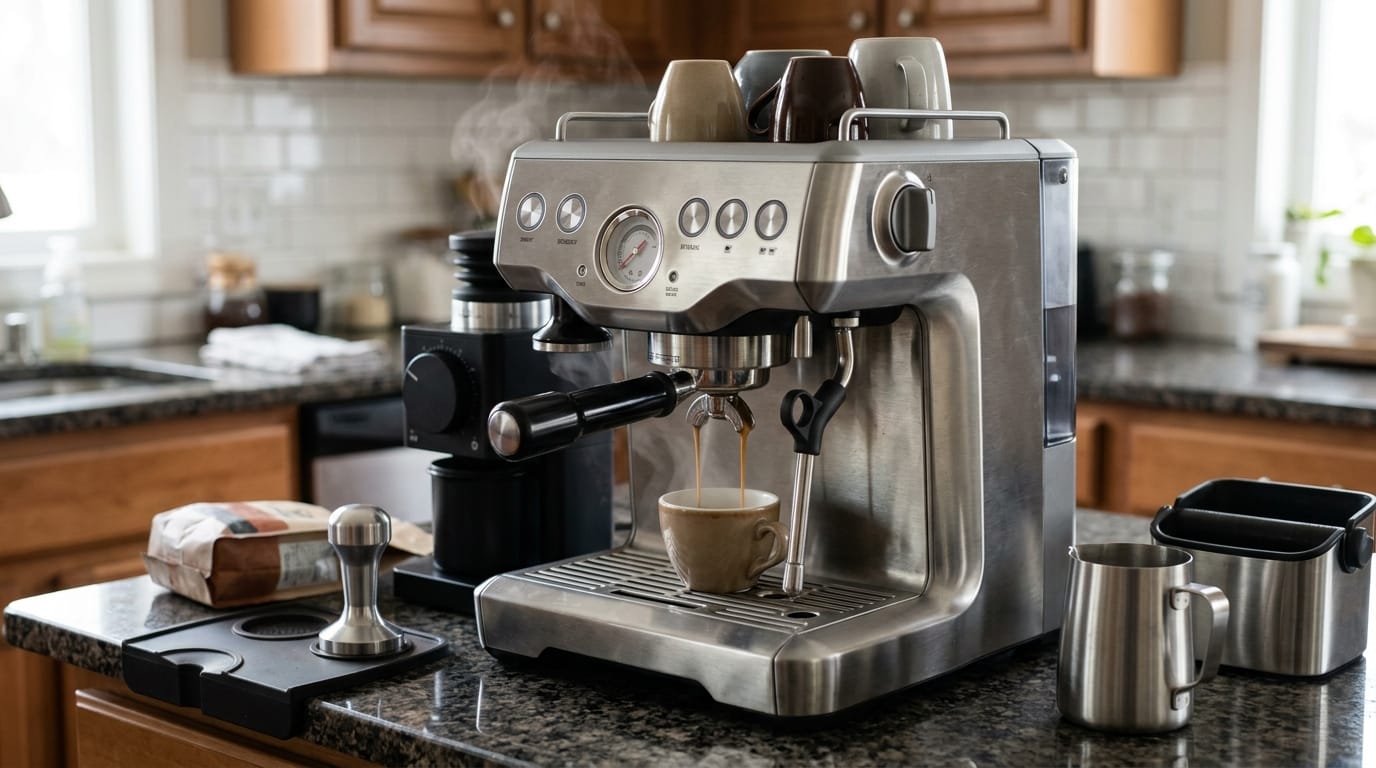
I remember standing in a coffee shop three years ago, watching the barista pull a perfect shot of espresso. The steam rose from the portafilter, the crema sat on top like a golden crown, and I thought to myself: I need this at home. But then I looked at the prices online. Machines were going for two thousand dollars, three thousand dollars, even more. I felt deflated. Then I started researching, and I discovered something that changed everything. You don’t need to spend a fortune to get genuinely good espresso at home. You can make café quality drinks for under five hundred dollars. Let me share what I have learned through trial, error, and a lot of coffee.
Why Budget Doesn’t Mean Bad Quality
Here is the thing about espresso machines that nobody tells you when you are starting out. The expensive machines are mostly expensive because of the brand name, the build quality that lasts decades, and features you might never use. When you are beginning, you do not need a machine that pulls the perfect shot eight thousand times before needing maintenance. You need something that works well enough to make you fall in love with espresso again.
I have made terrible espresso on a two thousand dollar machine because I did not know what I was doing. I have also made surprisingly good espresso on a three hundred dollar machine because I understood the fundamentals. The machine is just one part of the equation. What matters most is understanding pressure, knowing how to tamp correctly, using fresh beans, and owning a decent grinder. These things matter infinitely more than whether your machine costs four hundred or four thousand dollars.
When people ask me if they can really get good espresso for under five hundred dollars, I tell them honestly: yes, absolutely. But you have to be realistic about what you are getting. You are not getting a machine that looks like it belongs in a high-end café. You might be getting a machine that is a little bit loud. You might need to wait a bit longer between shots while the boiler heats up. But the espresso coming out? That can be genuinely excellent.
Understanding Espresso Machine Basics
Before I get into specific machines, I want to make sure you understand what actually makes espresso. This matters more than you think. Espresso is not just strong coffee. Espresso is coffee brewed by forcing hot water under high pressure through finely ground coffee beans. That pressure is the magic ingredient. Without proper pressure, you are just making hot coffee.
The pressure needs to be around nine bars. Do not get too caught up in the exact number, but understand that this pressure is what creates that beautiful crema on top and that rich, concentrated flavor. Machines under five hundred dollars can definitely provide this pressure. In fact, most of them will.
The basic process works like this. You grind your coffee very finely. Finer than you would for pour over or French press. You put that ground coffee into a filter basket. You tamp it down with a specific amount of force, creating an even puck of compressed coffee. You attach this basket to the group head of your machine. Then you pull the shot by pressing a button or pulling a lever. Hot water, pushed by pressure, forces through that coffee puck for about twenty to thirty seconds. Out comes espresso. That small amount of concentrated coffee is your starting point for lattes, cappuccinos, americanos, or drinking it straight as a shot.
Understanding this process helps you understand why certain features matter on a machine. It helps you understand why you cannot just use any grinder. It helps you make the right choice when you are looking at different options.
Types of Espresso Machines Under 500
There are several different types of machines you can find for under five hundred dollars, and each type has different advantages and disadvantages.
Semi automatic machines are the most common type in this price range. These machines have a button you press to start and stop the water flow. You have some control, but not total control. The machine handles the pressure and temperature. You handle the grind size, the tamping, the timing. This gives you enough control to make really good espresso without needing to be a scientist. Most home baristas prefer semi automatic machines because they offer that perfect balance of control and simplicity.
Automatic machines are similar to semi automatic, except they automatically stop the water flow after a preset time. So you press the button, it runs for whatever time is programmed, then it stops. This takes a bit of control away from you, but it can be nice if you want consistency and simplicity. It is one less variable to think about.
Manual machines are not as common in the under five hundred dollar range, but they do exist. These machines require you to manually pull a lever to create pressure. It is basically a spring lever that you pull down, building pressure, and then you release it. Manual machines are a bit of an acquired taste. They require more skill and more attention. But for people who enjoy the ritual and the hands-on experience, they can be incredibly satisfying.
Super automatic machines are sometimes available near the five hundred dollar price point if you look at sales. These machines grind the beans, tamp them, brew the shot, and dispense it all at the touch of a button. The convenience is amazing. The espresso quality is usually mediocre. These machines are often not worth the money for true espresso lovers because you lose so much control. I would personally skip these and go with a semi automatic option.
For most people beginning their espresso journey, a semi automatic machine is the sweet spot. You get enough control to learn and improve. You are not overwhelmed by too many variables. And you can make genuinely good shots.
Key Features to Look For
When you are shopping for an espresso machine under five hundred dollars, certain features matter more than others. Let me walk you through what actually makes a difference versus what is just marketing.
Pressure is critical, and I want to be clear about this. Your machine needs to deliver at least nine bars of pressure. Most machines under five hundred dollars do this through either a vibration pump or a rotary pump. Do not get too worried about the difference. Both work fine. Just make sure the spec sheet says nine bars or more.
The boiler or heating system determines how hot your water gets and how stable that temperature is. Some cheaper machines have a single boiler that heats water for both brewing and steaming. This means you have to wait between making a shot and steaming milk because you need to change the temperature. Machines with separate boilers for brewing and steaming are nicer, but they usually push you over the five hundred dollar budget. If you are okay with waiting thirty seconds between shots and steaming, a single boiler machine is absolutely fine. Many excellent machines use single boilers.
Heating time matters too. Some machines take five minutes to heat up. Some take thirty seconds. If you are trying to make coffee before work, a fast heating machine is nice. If you are someone who enjoys the process and does not mind the wait, it is less important. This one is really about your lifestyle and patience level.
The size of the water tank affects how often you have to refill. Larger tanks are convenient. Smaller tanks sometimes mean you can fit the machine in a tight space. The difference usually does not matter that much for home use since you are only making a few shots at a time.
Build quality is worth thinking about. Some machines feel cheap and flimsy. Some feel solid. A machine that feels solid usually lasts longer and performs more consistently. When you hold a machine, does it feel like it will fall apart, or does it feel like it will still be working in five years? That instinct is usually right.
The steam wand is important if you want to make lattes or cappuccinos. Some steam wands are better than others. A wand that is not too thick is easier to control. A wand that produces good steam pressure makes frothing milk much easier. This is worth paying attention to because a bad steam wand can make milk drinks frustrating.
Honestly though, do not get too caught up in every tiny feature. Most machines under five hundred dollars that are from reputable brands will have the essential things you need. The differences are usually small.
Top 5 Best Espresso Machines Under 500
Based on my research and on feedback from people I know who actually use these machines, here are five solid options.
The Breville Barista Express is probably the single most popular machine for beginners under five hundred dollars. It is around four hundred to four hundred fifty dollars depending on sales. What makes it special is that it includes a built-in grinder. This is huge because a good separate grinder often costs as much as a budget espresso machine. Having both in one unit is attractive. The machine heats up quickly, usually in under a minute. The pressure is good. The steam wand is decent. The group head is not the biggest, but it works. People consistently make good shots on this machine. The main complaint I hear is that the grinder that comes with it is not quite as good as a standalone grinder would be, but for the price point, the combination is very hard to beat. I have made excellent coffee on a Barista Express, and I know several people who still use one regularly.
The Gaggia Classic Pro is a machine I respect a lot. It costs around three hundred to three hundred fifty dollars. It is simple, straightforward, and reliable. It is not fancy. It does not have a fancy display or tons of bells and whistles. But it does what it does well. It pulls good shots. The steam wand is surprisingly good. The build quality is solid. The main limitation is the heating system. You do need to wait a bit between pulling a shot and steaming milk. But honestly, this is not a deal breaker. Many professionals learned on machines with similar limitations. If you want to save money and do not mind waiting thirty seconds, this is a legitimate choice.
The Roka Clickk is a newer machine that has gotten attention for a good reason. It is around three hundred fifty dollars. The Clickk is a manual lever machine, which makes it different from the others on this list. It does not have a pump or boiler. You manually pull the lever, which has a spring that builds pressure. This takes more technique and more awareness, but many people find it incredibly satisfying. The shots can be genuinely excellent because you have so much control. It is also very easy to maintain and clean. It does not have electronics that can fail. It is simple and elegant. If you enjoy hands-on work and are willing to spend time learning proper technique, the Clickk is phenomenal.
The DeLonghi Dedica is a super compact machine that costs around three hundred to three hundred fifty dollars. If your kitchen space is extremely limited, this machine might be perfect for you. It is tiny. It pulls decent shots. The steam wand works okay. The main issue is that it is not quite as durable as the other machines on this list. It is also easier to move around, which some people like and some people do not care about. If you live in a small apartment and think you might move around, this could work well. For everyone else, I would probably choose one of the other options.
The Lelit Victoria is around five hundred to five hundred fifty dollars, so it is just barely over budget, but if you can stretch a bit, it is worth considering. It has two boilers, so you do not have to wait between pulling shots and steaming milk. The steam power is excellent. The build quality is solid. The pressure is good. If you prioritize making milk-based drinks and you can find it on sale or stretch your budget just a bit, this is a step up from the other options.
Grinder: Your Hidden Game Changer
I want to spend time on grinders because this is where I see most new people make a huge mistake. They buy a great machine and then use the cheap blade grinder that came with their coffee or they buy the cheapest electric grinder they can find. Then they wonder why their espresso tastes bitter or sour or just does not taste as good as the coffee shop.
Here is the truth: a good grinder matters more than which espresso machine you buy. This is not hyperbole. It is genuinely that important. The grinder determines how uniform your coffee grounds are. Uniformity matters for espresso. A lot. If some grounds are fine and some are coarse, the water flows unevenly through your coffee puck. You get overextraction in some parts and underextraction in others. The result is a shot that tastes inconsistent and muddy.
If your espresso machine comes with a grinder, like the Breville does, that is helpful and convenient. But if you have the budget, a separate burr grinder is better. A burr grinder, whether it is conical burrs or flat burrs, produces much more uniform grounds than blade grinders.
For espresso, you want a burr grinder that goes fine enough to handle espresso grinds. The grind has to be very fine, finer than pour over. The Breville Smart Grinder Pro is around one hundred twenty to one hundred fifty dollars and works well if you do not already have a grinder. The Baratza Encore Plus can work in a pinch, though it was originally designed for pour over and drip coffee, not espresso.
My recommendation is this. If you are willing to spend around five hundred dollars total, here is how I would allocate money: three hundred to three hundred fifty for the machine itself and one hundred fifty to two hundred for the grinder. This gives you a mid-range machine and a good grinder, which is better than getting a four hundred dollar machine and using a terrible grinder.
If you have to choose between a very good machine with a mediocre grinder or a decent machine with a good grinder, choose the good grinder option. Every single time.
Essential Accessories You Will Actually Use
Once you have your machine and grinder, there are a few things that will genuinely make your life easier and improve your results.
A good tamper makes a huge difference. A lot of machines come with a cheap plastic tamper. A solid metal tamper, preferably weighted, will cost you twenty to forty dollars and will make tamping more consistent. Consistency is what makes espresso consistent. Your tamper does not need to be fancy or expensive. It just needs to feel solid and be the right diameter for your filter basket.
A scale is incredibly helpful. I know this sounds excessive, but measuring the amount of coffee going in and the amount of espresso coming out helps you dial in shots. If you pull a shot and get sixteen grams of coffee out when you aimed for thirty grams, you know the grind is too coarse. If you get forty-five grams when you aimed for thirty, you know it is too fine. You can adjust and improve. Without a scale, you are basically guessing. A basic digital scale costs fifteen to twenty dollars.
A milk pitcher for steaming is necessary if you want to make lattes or cappuccinos. Get one that is stainless steel with a spout designed for pouring. They cost ten to fifteen dollars. The cheap ones are fine. It is not a place to spend a lot of money.
Cleaning supplies matter. A group head brush with the right diameter for your machine helps you clean the group head properly. A backflush attachment, if your machine allows it, helps clean the shower screen. A water cleaner and a descaling solution are necessary for maintaining your machine. None of these are expensive individually, but they add up to maybe thirty to forty dollars total. They are worth every penny because they keep your machine working well.
A WDT tool, which stands for Weiss Distribution Technique, helps break up clumps in your coffee grounds before tamping. This costs five to ten dollars and can noticeably improve your shots. It is a small tool, but it makes a real difference.
Do not buy gadgets just for the sake of it. There are a million espresso accessories out there. Most of them are not necessary. These ones I mentioned actually improve either the quality of your shots or the longevity of your machine.
Tips for Getting Great Espresso as a Beginner
When you first get your machine, you might be frustrated. Your first shots might taste sour or bitter. They might flow too fast or too slow. This is completely normal. Espresso has a learning curve. But the curve is not as steep as people think.
First, start with fresh beans. I mean really fresh. Beans that were roasted within the last two to three weeks. Older beans will fight you. They oxidize and lose the nuances that make espresso interesting. Find a local roaster if you can. They usually have a roast date on the bag. Use that.
Second, dial in your grind before you do anything else. This is the foundation. Grind a small amount of coffee and pull a test shot without worrying about whether it is perfect. Time how long it takes to pull. If your shot pulls too fast and tastes sour, your grind is too coarse. Make it finer. If your shot pulls too slowly and tastes bitter, your grind is too fine. Make it coarser. Keep adjusting until you get a shot that takes about twenty five to thirty seconds to pull and tastes decent. Once you have that baseline, everything else is small adjustments.
Third, focus on your technique. Consistency in technique leads to consistency in shots. Use the same amount of coffee every time. Tamp with the same pressure every time. Be deliberate about it. This is the boring part that nobody wants to hear about, but it genuinely matters.
Fourth, taste your shots and think about what you are experiencing. Sour shots usually mean underextraction. Too little contact time between water and coffee. Bitter shots usually mean overextraction. Too much contact time. Really muddy, unpleasant shots often mean channeling, which is when water finds a path of least resistance through your coffee puck and flows through unevenly. A WDT tool helps with this.
Fifth, embrace the process. The beautiful thing about espresso is that there is always something to learn and improve. Your fifth shot will be better than your first. Your fiftieth will be better than your fifth. You are building a skill, and skills take practice. That practice is enjoyable if you approach it with patience.
Maintenance and Long-term Care
A machine you take care of will last. A machine you neglect will fail. It is that simple. The good news is that maintenance is not complicated or time-consuming.
After every shot, run water through the group head while the portafilter is attached. This clears out old coffee grounds and oils. Takes ten seconds. Do this.
Once a week, do a proper backflush if your machine allows it. This involves inserting a blind basket, which has no holes, into the group head and running water through it for a second, then stopping for a second, then running water again, over and over. This forces water and old oils back out through the shower screen. It keeps the group head clean. Many machines allow backflushing. Check your manual.
Once a month, do a deep clean of the group head. Use a group head brush and some water to really scrub inside the group head. Wipe down the shower screen thoroughly. This prevents buildup that causes problems.
Every few months, run a cleaning cycle with a commercial espresso machine cleaner. This dissolves oils that have built up inside the machine. Follow the instructions on the cleaner. Usually you run a cycle with the cleaning solution, then run several cycles with just water to rinse everything out. This keeps the internal components working properly.
Every six months to a year, depending on water quality in your area, run a descaling cycle. Hard water deposits build up inside the boiler. Descaling removes these deposits. Again, follow the instructions on the descaling product. This keeps your heating system efficient.
None of this is difficult. None of this requires specialized knowledge. You are just being a responsible machine owner. The people whose machines fail are usually the people who never descale and never do deep cleans. Do not be that person.
Common Mistakes and How to Avoid Them
I have made most of these mistakes myself, so I am not judging. But you do not have to make them.
Mistake one: Buying a good machine and then using mediocre or old beans. I see this all the time. People spend money on the machine but then buy the cheapest coffee they can find. Cheap, old coffee will ruin even good equipment. Your beans are not where you save money. Spend properly on beans.
Mistake two: Expecting consistency immediately. Your second day of making espresso will not look like your hundredth day. Do not get discouraged by early shots that are not quite right. Expect a learning curve. Give yourself permission to practice.
Mistake three: Not investing in a good grinder. I have already talked about this, but it is so common that it deserves another mention. Do not skip on the grinder.
Mistake four: Tamping inconsistently or with the wrong pressure. This is harder to notice because you cannot see it easily, but it happens. Focus on developing a consistent tamping technique. Many people benefit from a weighing scale for this or a calibrated tamper.
Mistake five: Not cleaning the machine regularly. People who neglect cleaning end up with machines that do not work well. It is preventable with basic maintenance.
Mistake six: Buying super automatic machines if you care about espresso quality. You lose all control. You cannot improve because there is nothing for you to actually do. If convenience is your only priority, okay, but do not expect amazing espresso.
Mistake seven: Overthinking it. Espresso is just hot water and ground coffee. You do not need to be a scientist. Get the basics right, make shots, taste them, adjust. That is how learning happens.
Frequently Asked Questions
Q: Can I make good espresso on a machine under five hundred dollars?
A: Absolutely yes. I have had genuinely excellent espresso made on machines under three hundred dollars. The machine is just one part of the equation. Beans, grind, and technique matter just as much or more.
Q: Do I need to buy a separate grinder?
A: Not necessarily, but it helps a lot. If your machine comes with a grinder, that solves the problem. If not, a separate burr grinder is better than trying to use a blade grinder or coffee shop grinders, though the machine budget will eat into the grinder budget.
Q: How long does it take to learn to make good espresso?
A: You can make a drinkable shot after a few tries. You can make a really good shot after a week or two of practice. You can make a consistently excellent shot after maybe a month of regular practice. True mastery takes longer, but you do not need true mastery to enjoy good espresso at home.
Q: Are manual lever machines better than pump machines?
A: No, just different. Pump machines are more convenient. Manual machines offer more control and a more hands-on experience. Neither is objectively better. It depends on what you prefer.
Q: What is the cheapest I should spend if I want the machine to last?
A: I would not go below two hundred dollars honestly. Below that, you start getting machines that are not very well built. Between two hundred and five hundred dollars, there are many solid options that will last years if you maintain them.
Q: Can I use pre-ground coffee in an espresso machine?
A: Technically yes, but it is not ideal. Pre-ground coffee oxidizes quickly and loses flavor. You will get better results grinding just before brewing. If you have to use pre-ground, use it as quickly as possible after grinding and store it airtight.
Q: How much does it cost to operate an espresso machine at home?
A: Just the cost of beans and occasional cleaning supplies. Espresso does not cost much to make once you have the equipment. Maybe twenty cents of beans per shot. Water usage is minimal. Electricity is not much. The equipment is the big expense upfront, but ongoing costs are low.
Q: Should I get a machine with two boilers?
A: Two boilers are nice if you make a lot of milk drinks because you do not have to wait between shots and steaming. But two boiler machines usually push you over five hundred dollars. Single boiler machines work fine and actually force you to slow down and enjoy the process between drinks.
CONCLUSION
After spending time researching, using machines, talking to people who use machines, and making a lot of espresso, I truly believe that you can find an excellent machine under five hundred dollars. The Breville Barista Express with its built-in grinder is hard to beat for convenience. The Gaggia Classic Pro offers simplicity and reliability. The Roka Clickk gives you a hands-on experience. There are legitimate choices at this price point.
The real takeaway is this: do not let budget be an excuse not to start. I have tasted espresso made on budget machines that was indistinguishable from espresso made on machines ten times more expensive. The difference came down to the person making it, not the machine itself.
Invest in good beans. Take time to learn. Understand that the first week will be a learning curve and that is okay. Get yourself a decent grinder. Maintain your machine. These things matter infinitely more than whether you spent two hundred dollars or five hundred dollars.
Espresso at home is achievable. It is affordable. It is within reach. Start now.